Wireless: Platoon network
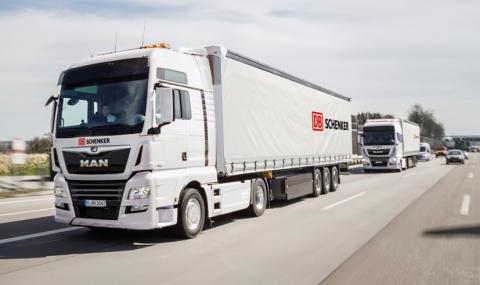
Mark Patrick from Mouser Electronics looks at what platooning means for autonomous lorries
The latest radar and wireless technology is driving a revolution in trucking. Technologies that have been developed for automotive adaptive cruise control are now being used to link lorries together, so that one driver can control four or five vehicles simply and safely. These platoons of lorries are being tested around the world to make the transport of goods more cost- and energy-efficient.
Platooning relies on several technologies coming together. A radar sensor detects the distance to the lorry in front, feeding back to the steering and throttle to maintain a safe gap. To do this safely requires an additional wireless link back from the lead lorry to all the others. This reduces the time needed to make a decision about braking or accelerating, because data from the lead vehicle are available quickly to all the others in the platoon.
How quickly these data can be transmitted, and which technology to use, has been the focus of research projects over the past few years. One option is digital short range communications (DSRC), which runs at 5.9GHz in the USA for vehicle-to-vehicle (V2V) links. Another possibility is a variant of wifi called 802.11p, which can also run in the 5.9GHz band. Lastly, there are the next-generation 5G cellular phone systems.
All these technologies need to be integrated with sensors, antennas and controllers in secure networks between the vehicles and back to a control centre, which monitors the operation and health of the lorries.
Scania, part of the Volkswagen group, is developing its own technology for the world’s first full-scale autonomous lorry platooning systems. The platoon of four lorries will travel on public roads, transporting containers between port terminals in Singapore. The lead lorry will be driven by a human, while the other three will follow entirely autonomously.
The technology comes from the Companion European research project, where Scania is working with Ericsson on using low-latency 5G cellular links to the lead vehicle and 802.11p wireless links in the platoon. Scania has three early-stage 5G wireless base stations at its research centre in Sweden.
“The test network, with its 5G components, allows for a high-quality mobile network service, with low latency and high bandwidth, where a lot of complex data can be transferred very quickly and very reliably,” said Anders Ställberg, project manager for city automation at Scania. “This provides us with a priority communications lane when it comes to projects such as platooning.”
The low latency, of under 3ms, will enable 5G to be used for vehicles transmitting braking or directional information to each other, where speed and reliability are vital. It could also be used to help improve the reliability and speed of the exchange of information between the two or more vehicles in a lorry platoon. Commercial 5G services that could be used by platoons of lorries will roll out in 2018.
The platooning trials will take place in two phases. The first will focus on designing, testing and refining the platooning technology to adapt to local conditions. These trials will be conducted by Scania and Toyota at their respective research centres in Sweden and Japan. The second phase will consist of local trials and development of the technology in Singapore.
“Trucking as we know it today is a highly labour-intensive industry,” said Pang Kin Keong, of the government Committee on Autonomous Road Transport in Singapore (Carts). “We face a shortage of truck drivers. In this regard, truck platooning technology presents us with an opportunity to boost productivity in both the port sector and the trucking industry. It will also open up opportunities for truck drivers to take on higher-skilled roles as fleet operators and managers.”
Another technology being used to link platoons of lorries is V2X wireless. This is a mature wireless technology for linking vehicles to one another (V2V) and to infrastructure (V2I), with enhanced security in the links. Cohda Wireless, for example, has teamed up with Autotalks, a supplier of automotive-grade V2X communications processors and RF transceivers, for such applications.
“Connected autonomous vehicles, such as platoons of trucks on highways, require the most mature V2X communications technology and very low signal delay,” said Cohda Wireless CEO Paul Gray. So it is working with Autotalks’ V2X communications chipset, which is designed with a low-latency V2X hardware security module.
In the USA, start-up Peloton is beginning to deliver its flagship platooning product for lorries. The technology synchronises braking and acceleration between pairs of lorries within 0.1s, using the V2V link. This gives a 4.5 per cent fuel saving for the lead lorry and a ten per cent saving for the following lorry in a two-lorry platoon, according to independent testing by the North American Council for Freight Efficiency.
The technology is not just in the lorry. The Peloton platoons are managed continuously by a cloud-based network operations centre that connects to lorries through secure cellular and wifi communications. This restricts the operation of platoons to specified roads in safe driving conditions.
“Peloton has developed technology that is on the cutting edge of advanced driver assistance systems and the automated vehicle movement,” said John Graham, CEO of Omnitracs, which is using the Peloton technology in its lorries. “The emphasis on spatial awareness is a crucial and foundational component of improving truck safety and fuel efficiency.”
Another lorry-making subsidiary of Volkswagen, Man, has also teamed up with German logistics company DB Schenker for platooning. The two companies will test platooning under real conditions over an extended period of time on the A9 motorway between Munich and Nuremberg next year, but there are significant regulatory restrictions.
"The pilot projects are key components of more efficient transportation of goods on the road,” said Andreas Renschler, chief executive officer of Volkswagen Truck & Bus. “Platooning is beneficial for the environment, improves the flow of traffic and increases road safety. What we now need is the legislative framework allowing us to introduce platooning on public roads."
Joachim Drees, chairman of Man Truck & Bus, added: "Platooning offers clear advantages in terms of fuel consumption and a reduced risk of accidents. The tests performed to date have shown this. Now we want to work with DB Schenker to demonstrate what platooning is capable of in real-life conditions.”
The use of platooning in Europe will be technically possible from around 2020, but this relies on the legislative framework being modified in EU countries.
One way around this is to use private estates, and Volvo is extending its adaptive cruise control technology to self-driving lorries at the Boliden mine in Kristineberg in northern Sweden this autumn. By next year, there will be three lorries on the site.
“Working together with Boliden brought the development of autonomous vehicles to a new, highly promising stage,” said Claes Nilsson, president of Volvo Trucks. “This is the first time that self-driving trucks have been tested for regular tasks underground.” The FMX lorry is part of an R&D project into self-driving lorries and platooning.
These make more use of the sensor system to determine the geometry of the mine and establish the route the lorry will take. This is used to ensure correct steering, gear changes and speed. The accuracy of the model improves with every trip.
The lorries can drive non-stop, and exact route planning and constant speed prevent tailbacks, while loading and unloading times can be cut. Usually, after controlled explosions in the mine, drivers have to wait until the gallery has been properly ventilated. These limitations don’t apply to the self-driving lorries.
Platooning doesn’t just affect the design and operation of the lorries. Scania in Singapore is also fully automating the processes for precise docking and undocking of cargo. This brings together a wide range of sensors for stopping the lorries in the right place and automatically attaching winches, as well as remote release of latches. All this has to be reliably handled by software in the control centre.
As a result, platooning can have a significant impact across the logistics sector. Radar and cruise control systems, secure wireless links, and reliable control systems, both locally to the lorry and in a control centre, all need to be considered. All this will start to appear on roads around the world from later this year, as platoons of lorries start operating commercially. When automated loading and unloading is added, this is a considerable design effort.
Mark Patrick is Emea supplier marketing manager for Mouser Electronics
