Safety & Security: Closing the door
Francois Ortolan from Anritsu explores automotive cyber security threats
Motor vehicles are gradually introducing connected technologies aiming to provide benefits such as added safety features, improved fuel economy and entertainment. With the explosion of connected cars, we are seeing ever growing security concerns. Hacking demonstrations including the remote controlling of a Jeep car proved that cellular connectivity poses a big vulnerability and could be potentially life threatening.
When it comes to vehicles, cyber security is much more challenging as the electronic components’ life span is expected to be much higher than usual electronic devices.
So how do hackers breach vehicle security over a cellular network and how could this be prevented using proven cyber security testing techniques?
Hacking
One of the most dangerous car hacking methods is to gain access though the telematics system using the wireless communications interfaces such as Bluetooth, wifi and cellular. Telematics systems are the wireless doors, which are critical as they do not require any physical connection to access the car.
The major threats touch on privacy of the driver’s personal information, as this is easily accessible and easily shared. Despite car makers’ efforts to isolate the telematics and infotainment system from the rest of the essential core network (Can bus) there is always a potential risk to find a path to go even deeper and access total control of the vehicle. The Can bus is the vehicle’s internal network, which interconnects all the vehicle’s most important components – engine, transmission, sensors and so on, almost everything on board.
System integrators such as car manufacturers or telematics makers too often rely on the operating system providers to ensure their system is secure. However, once a major vulnerability is discovered in the main public OS, it takes several months for the patch to be issued, and the upgrades need to be rolled out over the air. The vulnerabilities are often highlighted to the community to raise awareness of the risk, but this information can also be used by hackers to exploit these vulnerabilities.
Design consideration
The best way to prevent attacks is by design. In the first stage of designing a system it’s important to look at the known vulnerabilities and the security recommendations to ensure they are taken into account in the requirements. The iconic example is the most used secure communications protocol TLS/SSL, which has been consistently hacked due to its popularity. Hence, TLS/SSL is regularly updated to fix the breaches. The systems including it should be catching up closely with its evolution.
Testing the doors
Telematics systems are often composed of different short-range connectivity paths which are easy to access with conventional off-the-shelf access points which makes them more available to hackers but also easier to test, in general.
As for the long-range connectivity, referred to as cellular for technologies such as 2G, 3G and LTE, this proves to be more complex to access and test as the network is managed by operators.
Once the system has been designed following its security requirements, it’s time for the prototype to go through a phase of practical security testing.
The cellular technology threats are then usually evaluated on live cellular networks. Due to their different unknown configurations – such as ports open, filtering and routing – live testing is not always appropriate for a full assessment and visibility of the vulnerabilities.
The main drawback of cyber security analysis is the time potentially lost by trying to solve problems that are not in fact problems at all. The false positive is the nightmare of every security analysis. Choosing the right tool and identifying cyber security goals is essential.
Network simulator
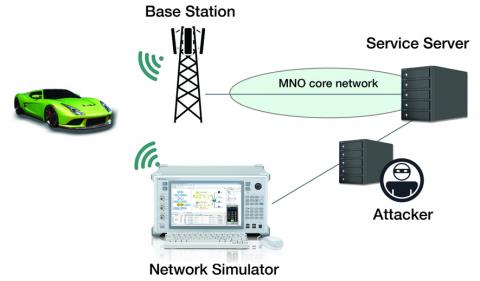
A new approach allows an extension of the testing capabilities for cellular networks, namely the use of cellular network simulators. Due to their open architecture they allow for a connection from the vehicle to a controlled network to tackle various potential threats that cover the diversity of live network operators’ configurations. The testing can be automated and repeated with the same conditions after each new update of the car software to ensure vulnerabilities are discovered and patched.
Using a network simulator can be ideal if it has a simple gui that allows an engineer to configure two cells with network technologies, including those not necessarily available in a particular region.
Practical testing involves a variety of techniques and by connecting the testing servers directly to simulators to access the devices over cellular, various types of testing can be carried out.
Functional security
Functional testing checks all security-related functions inside the test system for correct behaviour and robustness. This step is similar to general functional testing but focuses on security functionality. It validates the design requirements and allows the measurement of the performance of the system.
The recent example of the Jeep hacking showed that a port left wide open (port 6667) led to the ability to control the car’s vital functions: steering, braking, high beams, door locks, as well as reset the speedometer and tachometer, kill the engine, and disengage the transmission so the accelerator pedal failed. This could have been prevented by a simple port scan of the system with a tool such as Nmap Zenmap during the functionality testing.
Some network operators are actually closing this port for security reasons, as many Trojans use it. Testing with a network simulator with all ports open ensures thorough testing of the device.
Vulnerability scanning
Vulnerability scanning involves testing the system for already known common security vulnerabilities, for instance, known security exploits or (security) configurations with known weaknesses.
Recently Telsa released an update to fix several major vulnerabilities on its Model S. The car’s infotainment system was using an out-of-date browser, which contained a four-year-old WebKit vulnerability that could potentially let an attacker conduct a fully remote hack to start the car or cut the motor. Theoretically, an attacker could have made a malicious web page, and if someone in a Tesla car visited the site it could have gained access to the infotainment system.
Several tools are available that are able to scan for vulnerabilities. OpenVAS is a popular one. Its database is updated regularly with the latest known vulnerabilities. It is able to report the risk level for each vulnerability and the potential methods to fix them.
Using OpenVAS on a live network is often complicated as much of the functionality testing can be blocked by firewalls.
Fuzzing
Fuzzing goes even further and tries to find new vulnerabilities by systematically sending the malformed input to the target system to check for unknown, potentially security-critical system behaviour.
By using a network simulator, an engineer can generate a variety of fuzzed protocols. Thanks to its controllable interface it is also possible to replicate abnormal behaviour of the cellular network such as rejection or ignore behaviour.
Once again fuzzing is complicated on a live network as the malformed packets may be discarded.
Penetration tests
Pen testing aims to test the security of the whole system, both software and hardware. A smart human tester tries to exploit all the vulnerabilities which were found in the earlier steps in a sophisticated way based on many years of hacking experience with the aim to change the behaviour of the target system.
Network simulators are appreciated by white hat users for their flexibility and their advanced tracing capabilities with tools such as Wireshark. Packet tracing is usually not possible on a cellular network as the flow goes directly through the closed operator network. A network simulator performs man-in-the-middle attacks by relaying and reforging packets to read their content. This can be used to gather valuable information about the design of the security interface and potentially gain access to the vehicles.
Usually operator networks are considered trusted, however recent events show they can be hacked or even accessed by governments thanks to lawful interception. A recent example is the Iranian government compromising the SMS validation of famous chat Telegram.
Guidelines and standards
For now there is no direct certification for the automotive industry. An overall security certification standard that assures certain levels of security for an automotive system would be extremely useful. This is, however, actually quite difficult to put in place due to the ever changing nature of the security threats.
An effort has been made by some organisations to come up with a set of guidelines to integrate the traditional system design, integration and testing of cars.
The SAE this year released its first guideline (J3061) to include cyber security in the established Asil process. It describes a methodology for threat analysis and risk assessment.
This proves to be a good reference framework for the industry for which cyber security is not a traditional core knowledge. The connected car is challenging the traditional long development cycle to integrate the fast moving ICT technologies. Any security breach may lead to rejection of responsibilities on different suppliers so rethinking the supply chain is required to deal with cyber security.
Conclusion
It is always good remember that the most conventional type of hacking remains to hack humans. The Trojan installed unintentionally by the user remains the main threat. Another type of hacking on the rise is social engineering, where phishing techniques are used to incite the users to give the passwords by themselves. This is by far the most efficient type of hacking and only security education can really cure this behaviour by bringing security awareness.
Francois Ortolan is a wireless specialist at Anritsu
