Software: New age
Marques McCammon from Intel subsidiary Wind River discusses how software and the autonomous car are altering the automotive industry and life as we know it
Autonomous vehicles look to be an inevitable part of our future, and they will have a dramatic impact on the way consumers live, work and play. But what are the most probable outcomes, short term and long term, for consumers, and for the 130-year-old auto industry? And what steps should car makers now take to avoid being left in the lurch?
Connected age
Before any prophecy about the future of the autonomous car can be truly meaningful, it is important to look at the big picture.
A major potential outcome is that deaths, injuries and medical expenses will be radically reduced. Self-driving cars can eliminate most of the accidents that currently result in the deaths of more than 1.24 million people worldwide each year. Studies show that 95 per cent of accidents are caused by human error and, even accounting for software errors that lead to accidents, the total injury rate will be far lower than today, dramatically reducing medical costs and loss of property and productivity.
Individual car ownership will significantly decrease. The autonomous car may usher in a new robo-cab or mobility-as-a-service model, in which car service is simply ordered online and fulfilled by fleets of ubiquitous, self-driving vehicles. In this model, the automotive experience is personalised not by the make and model of the car but from inside the cabin via software, for example, via the music, video and web services it has available.
If a growing mass of consumers choose not to buy cars, they will not need insurance and the real estate dedicated to parking spaces would be impacted as well. While commercial fleets will still need these, they can be located outside of consumer-dense hubs. Clearly, the economic repercussions are staggering.
With the rise of autonomous cars, advancements in traffic management and ride sharing will ease traffic congestion. Vehicles sharing the pavement will get to their destinations faster because they’ll use software to optimise everything from routing to communications with other vehicles and the road infrastructure. Traffic congestion costs Americans more than 4.8 billion hours of time and 1.9 billion gallons of wasted fuel each year, translating to $101bn in economic impact every year.
Most experts agree that the vast majority of autonomous cars will be electric. Even with traditional vehicle engineering, modern electric cars get the equivalent of 50km/litre, and electricity production is much cleaner than petrol production. This translates to about a 50 per cent savings compared with traditional automobiles.
Value chain
These predictions and statistics are just the tip of the iceberg for consumers. The key point is that these changes may also fundamentally alter the automotive industry, and the global economy.
The automotive industry is undergoing a software revolution. The next generation of automobiles, be they autonomous, connected, shared or electric, is being driven and differentiated by its software. Software has changed the game.
Vehicle makers are struggling to come to terms with the car becoming a deployment platform for new software innovations. They see that software has become more and more ingrained into the functionality, the experience and the dynamics of the vehicle – from dashboard instruments to the power train to safety systems to in-vehicle infotainment (IVI) – and an increasingly large percentage of the vehicle’s perceived value will be software driven. Given the increasing impact that software is making to the value of a car, manufacturers are seeing a greater need to control the software better. And that requires a transformation.
Many car makers have responded by investing in software start-ups to accelerate innovation and learn the ropes in the software business. Others are investing in new ecosystem partners to gain a foothold in new business models. For example, GM has made a major investment in Lyft, Toyota has invested in Uber, and Volkswagen has made an investment in Gett.
What else will this transformation and digital maturity look like for the automotive industry? It means replacing the linear transactions between suppliers, car makers and customers with a more dynamic model. The good news is that the innovations of the connected age can benefit everyone in the automotive ecosystem. The increasing capabilities of connected software will enable automotive supply chain partners to communicate and collaborate more effectively in real time. Fully connected smart companies can organise countless supply chains in parallel and dynamically align their offerings to trends as they emerge.
First steps
With so many elements converging within the industry, such as increasing connectivity, automated driving and the resulting exponential growth of data, plus the requirement to manage them intelligently, automotive systems are becoming more complex than ever. It is becoming vital to develop software that enables ever-smarter interconnections and interactions among the myriad systems within and around the vehicle. Simply put, car makers are now in the software business, whether they acknowledge it or not. Software and connectivity drive an increasing share of the vehicle’s value chain, and future innovations in software and the hyper-connected internet of things will be the source of competitive advantages and business value.
How valuable are software-oriented features to consumers? A survey conducted by Tesla shows that consumers in the USA, Germany and China were all willing to pay a high premium – of US$3000 –for an autopilot upgrade.
For car makers, a digital transformation means embracing software-driven capabilities and innovations that are available today as well as actively working towards a longer-term vision, including the integration of big data insights into greater business opportunities, broader use of social, mobile, analytics and cloud technologies, and exploration of opportunities from the internet of things.
A good starting point for forward-looking car makers is to focus on software integration. To date, the evolution of the autonomous car has proceeded in a piecemeal fashion: many software capabilities were developed via one-off academic projects, often by smaller research teams with little production-level experience of related software elements specific to the automotive environment. Other software components – from the software driving the ECUs that power dashboard instruments to IVI systems to embedded safety features, telematics and powertrain functions – are evolving separately and are not well integrated. What’s needed is a software platform with the ability to integrate the diverse software elements, sensors and driving systems of the autonomous vehicle.
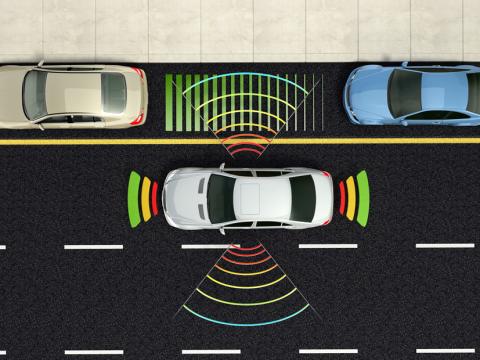
Decentralised systems using multiple sensors and ECUs to deliver limited adas functions such as rear parking cameras, adaptive cruise, blind-spot detection, lane departure alert, emergency braking and emergency assistance must evolve to partially centralised systems for safety features and functionality such as self-parking, lane keeping, smart stop, V2V and V2I communications, advanced navigation, wifi hot spots, and a range of assistance with informational and monitoring applications.
This means the various complex systems within the vehicle must communicate and work together to create the advanced connected capabilities of the car of the future, and do it securely.
Moreover, two separate networks are evolving separately, and these will need to work together as well: the intra-car network (also called the intra-car cloud) and the broader external network of the outside world, commonly referred to as the internet of things. Ultimately, the car’s software platform will need to accommodate the convergence of these two networks.
Equally important, as the car becomes a more intelligent device, car makers can begin leveraging big data analytics into an increasing range of capabilities. As massive amounts of data travel to and from the car, car makers have the opportunity to take these insights and make them actionable. For example, they could use real-time analytics to determine and offer appropriate on-demand services to the consumer, or diagnostics and vehicle usage data could educate car makers on how to improve performance continually and reduce costs.
Impact
The answer to when autonomous cars will appear on our roads in massive numbers isn’t as simple as one might expect. A large number of rudimentary autonomous features are already in use, and these features will become much more sophisticated.
Meanwhile, an avalanche of additional innovation is underway.
However, the vast majority of software innovation today comes from small, research-oriented businesses, and these companies do not have the experience or the scale to design, test and validate production-ready mechanical systems. Similarly, car makers typically do not have the breadth of embedded software development tools or the depth of experience required to deliver production-ready software systems for autonomous vehicles.
The tipping point for autonomous vehicles will arrive when the automotive industry masters the intricacies of radically new software-centric business models. And when that happens, the impact for consumers will be monumental.
Conclusion
In this period of profound and rapid change, it is essential for car makers to maintain control of their brand and customers. In this new digital and connected landscape, consumer loyalty is becoming fluid, and software is increasingly becoming the means for vehicle makers to differentiate themselves from the competition. Those who cannot become software-savvy and quickly adapt to changing trends risk becoming irrelevant.
Marques McCammon is general manager for connected vehicles at Intel subsidiary Wind River
