Simulation & Modelling: Ahead of the pack
How Lucid Motors used multi-physics simulation to design its luxury-class electric vehicle
Lucid Motors’ new luxury-class electric vehicle (EV) is designed to compete with the leaders in the high-end EV market. Lucid engineers extensively leveraged multi-physics simulation software to improve the operation of most of the vehicle's subsystems by accounting for a wide range of performance factors to create a digital prototype.
The use of a consolidated engineering simulation platform was critical to facilitate cooperation across the many different engineering disciplines on the design team, resulting in a wide range of performance improvements, both for the car and the engineering team.
In developing a new high-end EV from scratch in just a couple of years, Lucid Motors faced enormous technical challenges, a complex regulatory environment and competitors with up to a century head start. However, being a new entrant also gave Lucid some advantages as it was able to adopt best-in-class practices without being hindered by legacy methods.
The company pioneered a unique approach, housing the teams working on each discipline involved in electric vehicle design – electromagnetics, thermal, structural, aerodynamic and so on – in a single room to encourage collaboration from the beginning of the design process. Lucid further promoted teamwork and expedited the engineering process by equipping most of the engineering team with a common simulation platform: multi-physics simulation software integrated in the Ansys Workbench environment, which enables simultaneous optimisation of all the different subsystems of the vehicle.
This approach is making it possible for Lucid to address customer needs, solve engineering problems, optimise subsystems and components, meet regulatory requirements, and bring a world-class vehicle to market in a fraction of the time required by a conventional approach in which engineers work with different simulation tools in different and segregated disciplines.
Lucid aerodynamics engineers used Ansys Fluent, the key computational fluid dynamics (CFD) software within the simulation platform, including the Asnys Adjoint Solver to develop a vehicle body, and a new air intake and duct system to reduce the drag coefficient. The engineers leveraged Ansys DesignXplorer, the parametric analysis tool that is part of the integrated platform, to drive the CFD software to simulate a broad range of vehicle shapes to determine aerodynamic performance.
These simulations provided detailed guidance about the specific effects on drag of numerous shape parameters in the form of response surfaces, sensitivity charts, Pareto plots and trade-off plots. Armed with this information, stylists and aerodynamicists identified the vehicle shapes that yield the least possible drag while adhering to styling themes and other constraints.
The Lucid team also used Ansys Maxwell electromagnetic field simulation software for the design and analysis of electric motors, actuators, sensors, transformers, and other electromagnetic and electromechanical devices. Maxwell determined electromagnetic losses in the motor and, through Workbench – the host environment and data exchange backbone of the simulation platform – integrated these losses with a Fluent simulation to determine temperatures throughout the motor.
Two separate systems cool the motor. The first is a water jacket moulded into the motor case. In the second system, transmission oil is injected into the hottest areas – the end windings and rotor. Engineers used two coupled models, an oil model and a water model, to simulate these two cooling systems. Multiphase transient analysis with the volume of fluids model was used to solve the domain cooled by oil in the oil model. This model produced heat transfer coefficients of the surface wetted by the oil and the local oil temperatures. Engineers modelled the water cooling system with a water model in Fluent that used steady-state conjugate heat transfer to predict temperatures of the solid components of the motor.
The temperatures predicted by the water model were then used with the oil model and the simulation was run again. The resulting heat transfer values were mapped to the water model. This iterative process continued until the two models converged on the same temperatures. After the models converged, Workbench enabled the engineers to incorporate the temperatures of the solid objects into a mechanical structural model to calculate thermal stresses and, finally, to perform fatigue analysis to ensure that the motor will deliver its promised life.
Using simulation, Lucid engineers increased the power density and energy efficiency of the motor by 12 per cent. The temperature predictions matched physical measurements within a three per cent margin of error.
Another important aspect of motor design was to create the rotor flux map, which is embedded into the control algorithm and used to reduce motor losses under different operating conditions. Engineers employed Maxwell and the an electric machine design toolkit, which computes torque speed curves, efficiency maps and other performance curves for electrical machines.
They varied parameters such as frequency, slip and input current to calculate the rotor flux map and embedded it into the control algorithm as a lookup table. The fluxes are translated to pulse width modulation (PWM) voltages during operation of the vehicle. Compared with the normal approach of generating the rotor flux map with experiments on a dynamometer, this approach cut calibration dynamometer time by 80 per cent.
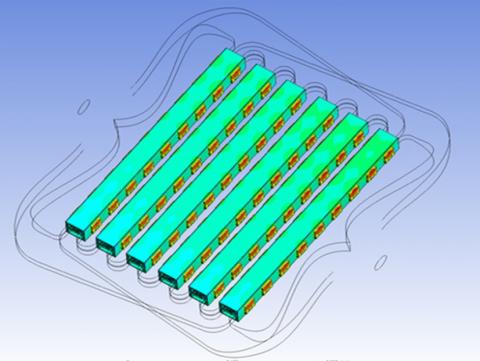
The inverters convert low voltage DC to high voltage AC to power the vehicle; this generates huge amounts of heat that needs to be removed to avoid exceeding the junction temperatures of the inverters and destroying them. Engineers created a fully parameterised model of the inverters and used ModeFrontier, design optimisation software from Italian firm Esteco, which interfaces with the Ansys platform to optimise key design parameters such as the fins' topology and the cross-sections of the channels that move water through the inverter housing.
They then leveraged the Adjoint Solver to optimise by mesh morphing the shape of the manifolds connecting with the upstream and downstream piping. This process reduced peak temperatures by 18˚C while maintaining the temperature of the different power transistors within 4˚C of each other. At the same time, the pressure drop in the cooling system was reduced by one-third, and the volume and weight of the inverter housing was reduced by 15 per cent.
Lucid engineers also created electrical and thermal models of the battery pack using the structural mechanics solver in the simulation platform and Fluent coupled within Workbench to simulate electrode degradation during charging and discharging of the battery. By understanding the potential conditions that could degrade the electrodes during different drive cycles, engineers increased the life of the battery. The simulation results were condensed into reduced-order models that are used to simulate battery performance under drive cycles, such as a lap at the Nürburgring race track.
Simulation also enables engineers to improve key vehicle attributes. For example, the conventional approach is to configure the batteries in a flat panel stacked under the car. This increases torsional stiffness and lowers the centre of gravity, but it has a negative impact on legroom. Lucid engineers used simulation to reduce the size of the front inverter motor and heating ventilation air conditioning units, freeing up space so that battery pack height could be increased in this area. This made it possible to sculpt the battery pack to reduce its profile beneath the passenger cabin, providing more legroom inside the cabin for greater passenger comfort.
Lucid's pervasive use of simulation with the common simulation platform throughout the design cycle, along with dedication to upfront simulation, has positioned the company for success against established EV competitors. Engineers from different disciplines employ the tools within the simulation platform to perform digital exploration that takes the complex, multi-physics nature of the design into account.
As an example of the results, the exterior of the Lucid Air is only a little larger than a Mercedes E class vehicle, yet the new vehicle has the interior space of a larger Mercedes S class. Lucid is taking reservations for the Lucid Air, which is scheduled to go into production in a new $700m factory in Arizona during 2019, positioning the company to deliver a best-in-class automobile in a fraction of the time required by its competitors.
