London Motor Show: Pain relief
Steve Rogerson reports from this year’s London Motor Show
More and more cars have technology that can hand over some of the control from the driver to the vehicle. And car-sharing schemes are becoming increasingly popular around the world. It is the combination of these two trends that will lead to a wave of self-driving taxis operating around the clock.
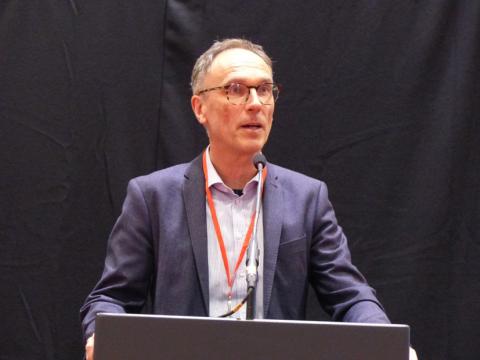
This is the vision of Andreas Herrmann, a professor at the University of St Gallen in Switzerland, speaking at this year’s London Motor Show.
He pointed out that the 1.2bn cars on the road around the world drive about 16 trillion kilometres, and are in use for about 55 minutes every day. On top of that, the urbanisation trend is set to influence the car market. In 1950, only 30 per cent of the world’s population lived in towns and cities. By 2050, that is predicted to rise to 70 per cent.
“By 2025, we expect 600 urban centres to hold a fifth of the world’s population,” he said. “In some cities, 30 per cent of the traffic is searching for parking spots. Drivers usually need 20 minutes to find a spot.”
On top of that, around 94 per cent of traffic accidents can be attributed to human failure.
“Machines can be more reliable,” he said. “By 2025, Los Angeles does not want to see any road deaths, and other cities are looking to follow.”
The picture, he said, would be better if human-driven cars were replaced with autonomous vehicles. For example, they will take up less space as the gap between cars can be reduced if they are being driven autonomously.
“You can improve fuel efficiency with autonomous cars,” he said. “You can have smoother acceleration and deceleration. The cars will communicate with each other so the traffic flow is smoother.”
And a major benefit for autonomous vehicles is a reduction in the space they occupy.
“This means you can manage the infrastructure better and give space back to people,” he said. “Autonomous driving can reduce the social costs of driving in terms of fuel savings and life savings, and that money can be reinvested into the infrastructure.”
While he admitted the technology still had its doubters, he believed that people would grow to trust the technology, especially as it meant they could spend the time in the vehicle doing other things.
“When the car is driving, people can watch videos,” he said. “They can turn the windows into a screen, work on their PowerPoint presentations. There is a potential 400 billion hours that could be used for other activities, which is why the likes of Google and Netflix are interested.”
And for those who like to drive, he said: “Driving can be a pleasure but in most situations it is a pain, and we want to remove that pain.”
