Vehicle Networks: Road noise
Ken Waurin, strategic marketing manager at Analog Devices, shows how an innovative digital bus architecture reduces audio system costs
Car manufacturers strive to make future generations of vehicles safer, smarter and more fuel efficient than their predecessors. To accomplish this, electronic systems continue to increase in number and complexity as more ECUs are deployed in the vehicle, enabling features and capabilities such as smart radio connectivity, active and road noise cancellation (ANC and RNC), personal audio zones, in-car communications (ICC) and autonomous driving.
As the number of ECUs increases, so does the weight and cost of the required cabling harnesses that provide connectivity between the various ECUs. This added weight, in turn, decreases the fuel efficiency of the vehicle, much to the chagrin of car manufacturers.
Car manufacturers must balance their desire to deliver feature-rich infotainment systems with the need to comply with government imposed fuel efficiency standards. Reducing the weight of existing cable harnesses can lead to significant improvements in fuel efficiency.
Landscape
Traditionally, automotive audio ECUs have been connected by either individual analogue cables or existing digital bus architectures, both of which present limitations, inefficiencies and unnecessary expenses. Car audio systems that use analogue wiring require dedicated, expensive, shielded cables for each audio signal or channel.
In today’s premium audio systems, supporting multichannel (5.1 or 7.1) Dolby or DTS decoding, the number of required cables rapidly increases. Additionally, the required analogue-to-digital converters (ADCs) and digital-to-analogue converters (DACs) increase total system cost while introducing potential areas of audio performance degradation.
Digital bus standards such as Most or Ethernet AVB have been widely adopted in current infotainment systems because they greatly simplify the wiring complexities associated with analogue implementations. However, the added performance and flexibility of Most and Ethernet AVB carry the added cost of expensive microcontrollers to manage their associated software protocol stacks.
Additionally, these digital bus architectures are inherently nondeterministic with variable system delays from node to node. This fundamental flaw in existing digital bus architectures is not acceptable for latency-sensitive speech and voice-based applications, such as ANC, RNC and ICC.
Automotive Audio Bus
The Automotive Audio Bus (or A2B) is an innovative and application tuned technology that is proven to reduce the weight of cable harnesses by up to three quarters while delivering high fidelity digital audio. A2B is optimised for audio applications delivering better audio quality than analogue connectivity at significantly lower cost than existing digital bus standards.
In its simplest form, A2B is a high bandwidth (50Mbit/s) digital bus capable of transporting I2S audio and I2C control data together with clock and power using a single, two-wire, unshielded, twisted pair cable over significant distances, up to 15m between nodes and 40m over the entire daisy chain.
Basics
From an implementation standpoint, A2B is a single master, multiple slave line topology. The latest pin-compatible, enhanced A2B transceivers support daisy-chaining of a single master, plus up to ten slave nodes, which represents a 20% increase relative to first generation A2B offerings.
This daisy-chaining capability allows a maximum A2B bus distance of up to 40m with up to 15m supported between individual nodes. Using a line topology instead of a ring topology is an important element of the A2B technology related to overall system integrity and robustness. If one connection of the A2B daisy-chain is compromised, the entire network does not collapse. Only those nodes downstream from the faulty connection are impacted by the failure, while the embedded diagnostics inherent to the A2B technology are able to isolate the source of the failure, signalling an interrupt to initiate corrective action.
The A2B master-slave line topology is inherently efficient when compared with existing digital bus architectures. After a simple bus discovery process, zero additional processor intervention is required to manage normal bus operation.
As an added benefit of the A2B architecture, system latency is completely deterministic (two-cycle delay) irrespective of the audio node’s position on the A2B bus. This is extremely important for speech and audio applications, such as ANC, RNC and ICC, where audio samples from multiple remote sensors must be processed in a time-aligned fashion.
A2B transceivers can deliver audio, control, clock and power over a single, two-wire, UTP cable. This reduces overall system cost for a variety of reasons:
- • The number of physical wires is reduced relative to traditional implementations.
- • The actual wires themselves can be lower cost, lower weight UTP as opposed to more expensive shielded cables.
- • Most importantly, for particular use cases, the A2B technology offers a phantom power capability that delivers up to 300mA to audio nodes on the A2B daisy-chain. This phantom power capability eliminates the need for local power supplies at the audio ECU, further reducing costs.
The total 50Mbit/s bus bandwidth delivered by the A2B technology supports up to 32 upstream and up to 32 downstream audio channels using standard audio sample rates (44.1 and 48kHz) and channel widths 12, 16 and 24bit.
This provides flexibility and connectivity to a wide range of audio IO devices. Maintaining a completely digital audio signal chain between audio ECUs ensures high quality audio is preserved without introducing the potential for audio degradation via ADC and DAC conversion.
System-level diagnostics are an essential component of the A2B technology. All A2B nodes have the capability to identify various fault conditions including opens, wires shorted together, wires reversed, or wires shorted to power or ground. This is important from a system integrity standpoint because in the case of opens, wire shorts or reversed wire faults, A2B nodes are still fully functional upstream of the fault.
The diagnostic capability also provides for the efficient isolation of system-level failures, which is critically important from the dealer and installer standpoint.
Targets
A wide variety of markets, both mature and emerging, will benefit from the efficiencies offered by the A2B technology. Target applications include:
- • Audio ECU (head unit and premium audio amplifiers) connectivity;
- • Microphone arrays for hands-free, speech recognition and in-car communications;
- • Active noise cancellation and road noise cancellation;
- • Personal audio zones and active speakers;
- • Ecall and telematics, autonomous driving and self-parking;
- • Vital signs monitoring; and
- • Smart radio connectivity.
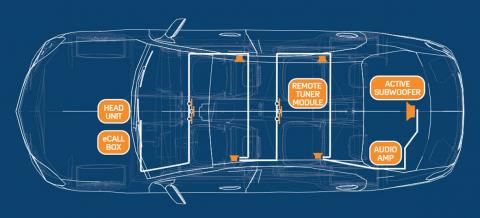
Audio ECU connectivity is an attractive, mature application area where A2B has already been deployed in production vehicles. In a simple example, as seen in the diagram, where a head unit connects to a premium trunk amplifier, A2B removes the need for individual wires for multichannel audio, plus nav, mobile phone and chime. A2B replaces all these wires with a low cost, single two-wire UTP cable that has been tested and confirmed to pass the automotive EMC- and EMI-compatibility requirements.
Efficient and cost-effective microphone connectivity is a design priority driving a variety of use cases and applications. Bluetooth connectivity and hands-free and speech-recognition systems are standard equipment and ecall systems are already mandatory in some regions. The trend from the OEM standpoint is to move towards multi-microphone (two to four) systems configured individually or as modules.
In either case, a system that uses A2B technology has a significantly lower overall cost when compared with analogue connectivity, especially in multi-microphone arrays.
Each A2B transceiver can support up to four PDM-input microphones, eliminating the need for three of the four microphone wires in a four-microphone array.
Road noise cancellation is a derivative of the broader ANC application area and is now under investigation by many car makers. In wideband ANC, tones harmonically related to a reference input, as well as some non-harmonically related or random tones, can be cancelled. These reference inputs are typically supplied via accelerometers physically distributed around the vehicle, most often in the four wheel wells.
Additional inputs to the wideband ANC system would come from error microphones, again physically distributed about the inside of the vehicle with one required for each passenger quiet zone. A traditional implementation uses dedicated analogue connections from each accelerometer or microphone to the wideband ANC processing unit. Clearly, this approach can be prohibitive in terms of both wiring cost and complexity as well as connector area on the processing unit. All these issues are resolved using an A2B implementation.
A2B can also be considered an enabling technology for emerging applications that demand cost-effective sensor connectivity. Applications such as autonomous driving, vital signs monitoring and self-parking systems, targeting production dates in 2020 and beyond, can all benefit from the features, capabilities, simplicity and time to market benefits offered by the A2B technology.
Ken Waurin is a strategic marketing manager at Analog Devices
