TDK motor controller to make bow at Embedded World
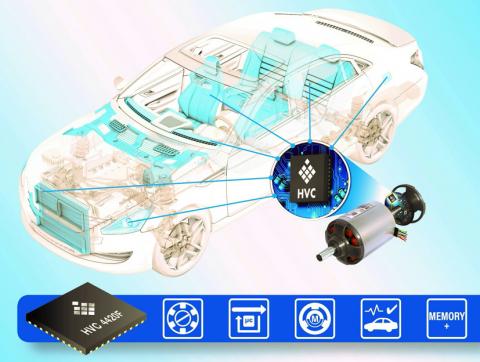
Ready for next week’s Embedded World in Nuremberg, TDK has expanded expands its Micronas embedded motor controller portfolio with the HVC 4420F, featuring extended flash memory for the drive of small brush-type, stepper or brushless motors in the automotive industry.
To provide diagnostics capability introduced in the field of smart actuators, samples will be available next month. Start of production is planned for 2020.
With an extension of the flash memory to 64kbyte and sram to 4kbyte, the controller suits OEMs' increased functional and diagnostic demands. Currently, OEMs use their own ideas and approaches on diagnostics. This includes sensor data fusion strategy, actuator status and resulting activities.
To ensure the required data analysis, software routines have to be implemented, which activate the underlying hardware diagnostic features, while respecting the OEMs' framework to ensure proper integration.
Due to its larger memory and the built-in diagnostic feature set, the controller has the storage capacity and processing capability to execute these actions for smart actuators.
It is part of the Micronas high-voltage controller family (HVC) for smart actuators. The HVC family combines an Arm standard microcontroller core with additional functions to enable particularly compact and cost-efficient system designs for use in automotive applications and beyond.
Powered by a 32bit Arm Cortex-M3 CPU core with 64kbyte flash memory, it contains timers, counters, interrupt controllers, multichannel ADC, SPI and enhanced PWMs with diagnosis functions, important for use in safety relevant applications.
A Lin uart with a Lin 2.x transceiver as well as voltage regulators to connect the device directly to the automotive board net (5.4 to 18V) round up the all-in-one approach.
Several power management modes help reduce the current consumption. Various integrated digital and analogue circuit units, such as comparators with virtual star point reference, current scaling and an embedded programmable gain amplifier allow users to reduce the number of external components.
Due to its high processing power, it allows complex motor control algorithms such as space vector modulation for permanent magnet synchronous motors, six-step commutation with sensor feedback or sensorless control, as well as various stepper configurations.
It optionally comes with production-ready and flexible, parameterisable firmware with communication, monitoring and power management functions (Asil A ready) as well as a configuration tool.
Users can develop application software based on the firmware to design the combination of motor and control and reduce time to market.
The controller will make its debut at Embedded World next week on stand 438 in Hall 3A.
