Rohm improves mounting reliability for mosfets in adas cameras
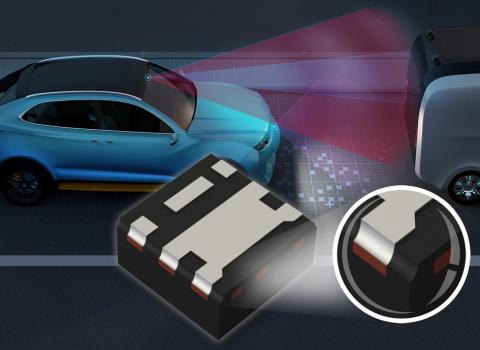
Rohm has developed 1.6 by 1.6mm mosfets with improved mounting reliability. The RV4xxx series is AEC-Q101 qualified, ensuring automotive-grade reliability and performance under extreme conditions.
The firm’s original package processing technology enables the miniaturisation of automotive components, such as adas camera modules, that demand high quality.
In recent years, the growing number of vehicle safety and convenience systems such as adas cameras has emphasised the problem of limited space to accommodate these systems and spurring the demand for smaller components. To meet this need, bottom electrode type mosfets that can be miniaturised while maintaining high current are increasingly attracting attention.
However, for automotive applications, optical inspection is performed during the assembly process to ensure quality, but in the case of bottom electrode components solder height cannot be verified after mounting, making it difficult to confirm mounting conditions.
Rohm ensures the electrode height on the side of the package (130µm) required for vehicle applications by using original wettable flank formation technology. The result is a consistent solder quality – even for bottom electrode type products – letting automatic inspection machines easily verify solder conditions after mounting.
The wettable flank formation technology involves making a cut into the lead frame on the side of the package before plating. However, burrs resulting from cutting into the lead frame can occur more frequently as the height of the cut increases.
In response, the company developed a method that introduces a barrier layer on the entire surface of the lead frame to reduce the occurrence of burrs. This not only prevents component rise and solder defects during mounting, but ensures a 130µm electrode height on the side of DFN1616 1.6 by 1.6mm packages.
Until recently, Schottky barrier diodes (SBDs) were commonly used in the reverse connection protection circuits of adas camera modules. But due to the larger currents required by high-resolution cameras in vehicle systems, SBDs are increasingly being replaced by compact mosfets that provide low on-resistance and less heat generation.
For example, at a current and power consumption of 2.0A and 0.6W, respectively, conventional automotive mosfets can reduce mounting area by 30% over SBDs. However, adopting bottom electrode mosfets capable of providing good heat dissipation while still supporting large currents in an even smaller form factor makes it possible to decrease mounting area by as much as 78% compared with conventional SBDs and by as much as 68% compared with conventional mosfets.
