Big issues
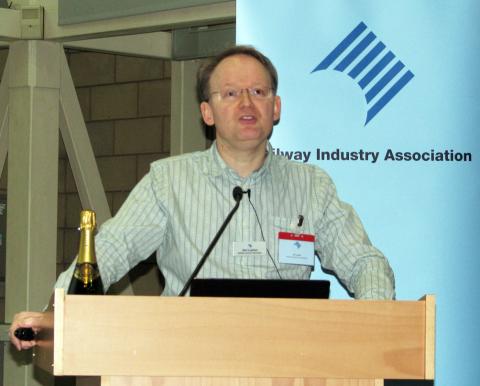
Steve Rogerson reports from The Issue Sustainable Transport Technologies Conference in Loughborough, Leicestershire
Nine out of every ten city dwellers in the European Union experience a level of air pollution that is considered damaging to health. That was the message from Professor Paul Monks from the University of Leicester at The Issue Sustainable Transport Technologies Conference in February.
Held at the Holywell Conference Park on Loughborough University’s campus, the event had the theme of looking at how collaboration between different transport sectors, from automotive to rail, marine and air, could provide the innovation necessary to tackle this growing problem.
Not surprisingly, Nicky Morgan, the local Conservative MP, claimed the government was tackling these issues with a long-term strategy of “stable funding, new investment and leadership for bold projects”. But she did seem to appreciate the scale of the problem pointing out that, for example, more people are using trains now than in 1920 when the network was twice the size and that the past 20 years have seen road traffic increase by a fifth.
“The government is investing in rail and road,” she said. “The next few decades will be exciting for the transport sector.”
This was echoed by Jim Lupton, deputy technical director of the Rail Industry Association. “The rail sector is very buoyant,” he said. “We are seeing tremendous growth not just in the rail network but in London Underground.”
Urbanisation
The question though is how to increase the level of transportation to meet a growing demand yet tackle air pollution. Now, while Monks acknowledges that the problem is higher in city centres, on the overall pollution front there are positives from this.
“There is an increase in urbanisation,” he said, “but this is not necessarily a bad thing. You can minimise journeys and resource use in cities.” But he acknowledged that: “Transport lies at the centre of many of the solutions to the problems of air pollution. However, it is not fair to say that all the problems are from transportation.”
He said that even though there were methods that were being explored to reduce pollution, it might reach a situation where the policy was to adapt to the pollution.
“The whole push on air quality is to reduce the effect on health,” he said. “We make policy to affect emissions. We then observe the effects on human exposure. We may have to move towards adaptation. We have high concentrations of pollution, so how do we adapt to that?”
He pointed out that there have been successes and many pollutants had experienced a two-thirds reduction. But at the same time there had been an increase in other pollutants. This brings with it another, quite serious problem, in that reducing one pollutant can increase others, ozone being a prime example.
“In urban areas, traffic is actually suppressing the amount of ozone,” he said. “So as we clean up traffic in urban areas, we could accelerate global warming. So there are choices when we are trying to improve air quality and reduce climate change. Some ideas that improve air quality are actually bad for climate change.”
A good example of this he said were diesel particulate filters that did improve air quality but were bad for climate change.
“This is a particularly thorny issue,” he said. “You attack one problem and increase another. I think full lifecycle analysis is absolutely essential to see the effects of improving one area on other areas.”
Different approaches
This brings with it the problem of analysing traffic in urban areas and then using the data to improve the situation. Traditionally, Europe and the USA have taken different routes towards this, with the USA concentrating on analysing particularly bad intersections and looking at how traffic flow through them can be improved. Europe tends to take a more macro approach, bringing in factors such as average vehicle speed and distance travelled.
“We propose an approach that takes into account the best of both of these,” said Marco Petrelli from Roma Tre University in Italy. “We estimate pollutant emissions over a large area but with the microscopic accuracy you get from the US system.”
This approach has been put to the test in the southern Italian city of Brindisi, with about 100,000 inhabitants.
“We can see the localisation of emissions at intersections,” he said. “And we can see the impact of different policies, such as one-way systems, as well as optimising flow through intersections.”
Gathering data
At present, there are a number of ways already that data needed to perform the analysis can be gathered, and these were explored by Roland Leigh, a lecturer at Leicester University. Such data sources include automatic number plate recognition systems, vehicle profiles, CCTV, MoT information, satnavs, GPS, tyre pressure measurement devices, road temperature sensors, fleet management systems, radar, wireless sensor networks and so on. Induction loops can measure traffic volumes, wheel base, weight and speed.
“What they don’t measure is queue length,” said Leigh, “but that can be modelled from existing data. Satnav systems are now giving more information on congestion. There are some interesting apps that are now appearing to gather the information from smartphones.”
In the future, drones – unmanned aerial vehicles – could be used to gather traffic data. There are also now trials of vehicle-to-vehicle and vehicle-to-infrastructure networks. Sensor systems can already direct drivers to vacant parking spaces.
“Full vehicle tracking is one of the major data schemes we could see,” said Leigh. “That could be widely available within ten years.”
The question though is how to use these data for improving air quality and traffic management. In certain areas, they could be used for autonomous driving schemes and platooning on motorways. The difficult issue there is the transition to autonomous driving. How easy will it be to have self-driving cars mixing in the same areas as those being driven normally? Maybe areas in cities could be created in which only cars with autonomous driving are allowed into at certain times of day.
“The real issue is the transition from non-autonomous to autonomous vehicles,” said Leigh.
In the short term though data can provide congestion information to drivers. There could also be adaptive speed limits on motorways and adaptive prioritisation where, say, electric vehicles are given priority in high pollution areas.
Leigh said that these data could also be used by large corporations that have many people commuting into one area to encourage car sharing, cycling and so on.
But he warned about there being too many journey planning and congestion systems, which could lead to fragmentation in the market and a dilution of the available data.
“You need to reach a critical mass and avoid fragmentation with different systems,” he said.
Transportation
On the railway front, Marcus Mayers, programme manager for Future Railway, said the number of passengers was set to double over the next 20 years, which will mean more carriages are needed and increase the amount of electricity used.
“Where will the electricity come from?” he asked. “How can we guarantee supplies? What will that do to our power networks?”
He also said remote areas would continue to rely on diesel engines and the railway companies had to look at reducing emissions from them.
The marine industry was also looking at moving from diesel to diesel-electric hybrids, said Adrian Waddams, a marine specialist at the Transport Knowledge Transfer Network (KTN). But he pointed out: “Shipping is the most environmentally friendly method of transportation. Shipping accounts for about six per cent of global CO2 production, but the industry is looking to reduce that.”
He said that while there was no mandate in the same way as there was with automotive, there was a global agreement for future ships to be designed in a way that reduced CO2.
“The goal is to reduce CO2 by 25% by 2050,” he said. “There is a lot of research and development work going on.”
Cost he said was also a driver in this as diesel accounted for 50 to 70% of the total cost of a shipping operation.
“That is why they are looking towards alternatives such as diesel-electric hybrids and fuel cells,” he said.
They are also looking at alternative fuels and at wind power. Sails could return in a big way. And hull coatings are also being considered.
“If a ship has a dirty bottom, it can cancel out all the other savings,” he said. “Weather routing is also important. Anticipating where there is heavy weather and knowing how to avoid it can make big savings.”
The number of planes is set to double in the next 20 years, warned Philippe Lattes, deputy director of Aerospace Valley. “This is a major challenge to reduce the impact of that,” he said.
One of the problems was that they could not make big modifications to existing planes so much of the emphasis was on the design of new planes. One possibility though with existing planes is to reduce the fuel consumption when they are on the ground, which accounts for up to about two per cent of fuel consumption. Moving to electric motors could help here.
“Another is to optimise the trajectories of all the planes,” he said. “In Europe, a lot of planes are not flying in direct lines and we are trying to optimise the flight trajectories. This could reduce fuel consumption by between five and 15%.”
Conclusion
What all at the conference were clear on was that to solve these problems, closer collaboration between the different transport sectors was needed, but achieving that might not be that straightforward.
“The rail industry is dreadful at working with other people,” said Mayers. “We have to change that to take advantage of commonality in technologies. Automotive is doing that very well in the UK.”
“Working in partnership is the right way to go,” added Adrian Vinsome, interim director of the Transport KTN.
Good intentions for sure, but time will tell whether these can be put into practice.
