Guest blog: Top tips for aspiring female electronics engineers
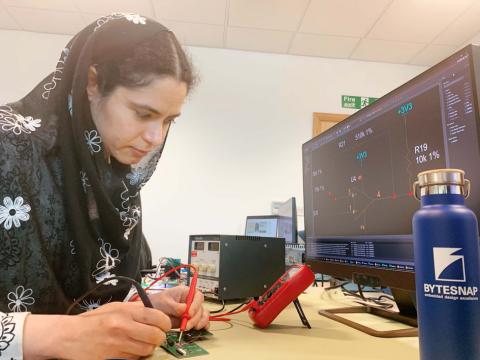
Magda Abdelbasit Abbas from ByteSnap Design shares her tips for women looking to enter the field of engineering.
International Women in Engineering Day falls on 23 June 2022 and raises awareness of career opportunities available to girls in this industry and women already thriving in the sector.
I’ve always been interested in learning about how things work. I decided to go for an engineering degree as it seemed more practical to me than maths or physics. Electronic engineering offered me the opportunity to develop new devices and methods for improving human life.
I completed my BSc in electrical and electronic engineering from the University of Khartoum and worked as an electronics engineer in Sudan for a couple of years. I then undertook a masters in embedded systems in the University of Leeds in the UK. I worked for a few more years before deciding to do a doctorate in biomedical engineering at the University of Oxford, which I completed in 2020.
At ByteSnap, I’m mainly responsible for creating circuit design for embedded products and modifying firmware for product updates.
I was recently surprised to learn that only 12% of the UK’s engineering pool are women and globally only two per cent of all professional engineers are women of colour. I come from Sudan where there is a higher representation of women in computer and electronic engineering than there is in the UK. In the company I worked for in Sudan, the representation of women was 40%. In the UK I have mostly been the only female engineer in the companies for which I have worked.
Knowledge-sharing and collaboration are key to the growth of women in male-dominated fields such as engineering here in the UK. I hope, one day, to create online resources on embedded systems in Arabic; material that could be used as a starting point for students in Sudan and other Arabic-speaking countries to introduce them to the hardware and software platforms used to build embedded devices.
Here are my top five tips any aspiring woman in engineering should know:
1. Conduct due diligence
Research what is necessary to pursue a career in engineering. From my understanding, a big reason for girls in the UK not following an engineering path is their misplaced belief that they are not good at maths, and the image of a hard hat associated with engineering.
I would recommend exploring the broad range of engineering disciplines and careers to gain a better understanding of the type of opportunity that can be pursued, from chemical, civil, electrical to structural, mechanical and more. Engineering is a broad field and offers careers that are rewarding and fulfilling.
2. Broaden your skillset
It’s important to have a wide skill set that allows you to adapt to changes in the industry. Keeping up to date with innovative technologies and learning new skills prepares you for future developments.
For example, being a hardware engineer doesn’t mean you don’t do any coding. Having software skills is important to be a well-rounded engineer.
3. Use resources for women in engineering
It is worth looking at some organisations and groups that are specifically setup to help women in engineering. Women Who Code, for instance, is a community that aims to support women to learn software programming and excel in technology careers.
The Women in Engineering Society is a network that can help with mentoring and promotes the uptake of engineering among female students.
4. Contribute…open source is a good option
In many cases, universities have proprietary software packages available for students. However, to continue using these products after graduating, a licence fee has to be paid.
Therefore, build experience of open-source platforms or alternative packages that are more widely used in industry. Using open-source software is also a good way to contribute to a wide network of computer scientists and engineers.
Involvement with open source early on in one’s career could help women to gain the requisite skills to take part in open-source society, and facilitate networking while establishing one’s profile in the community.
5. Don’t be put off by any misconceptions around engineering
Common ones are that it’s physically tough work or that it’s a rough environment. Engineering encompasses a wide range of disciplines – varying from jobs such as software engineering, that are entirely computer based, to petroleum engineering which might require field work in offshore locations.
Conclusion
In the UK, the percentage of female engineers is low considering how advanced the country is terms of gender equality policies. This situation is not likely to improve without action, particularly after the pandemic where female STEM students are reporting that it is affecting their future career prospects.
Women in Engineering Day presents an opportunity to celebrate females in engineering while creating awareness among those who are considering a career in the industry.
Magda Abdelbasit Abbas is an electronics hardware and embedded systems engineer at ByteSnap Design.
