Taiwan seeks more free trade deals to boost automotive electronics exports
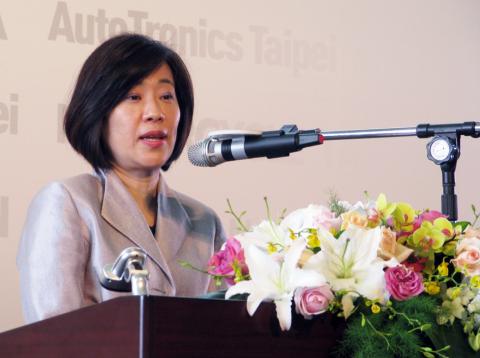
Tariff barriers will continue to hold back Taiwanese automotive electronics exports unless more free trade agreements can be set up, Wen-Jo Kiang, deputy director general for foreign trade at the Ministry of Economic Affairs, told delegates at this week's Autotronics conference in Taipei.
At the event’s opening ceremony she said that South Korea had 43 free trade agreements in place and they accounted for 36% of the country’s exports. In contrast, Taiwan had just five agreements accounting for 9% of exports.
“We need to accelerate our efforts in this,” she said. “We need to consider global economic factors and tackle the tariff barrier problems. We are seeing some progress but we are falling in global rankings because of the high tariffs we face.”
Autotronics forms part of the larger Taipei Ampa auto parts and accessories event being held this week with 1346 exhibitors, up 1.5% on last year. This year marks the show’s 30th anniversary.
“With years of hard work, Taiwan’s automotive electronics have gained global admiration in terms of technology and product quality,” said Fu-Hsiong Cheng, vice chairman of Teema, Taiwan’s electrical and electronics manufacturers’ association.
He said that in 2013 the country’s automotive electronics output was about NT$133.9bn, up 12% on 2012. He said this growth, though, was driven by the domestic market. But for export, he said there was now a big opportunity in China due to the country’s promotion of the new energy vehicle industry.
“Taiwan should seize this opportunity to enter the Chinese market and create business opportunities,” he said.
Earlier, San Gee, vice chairman of Taitra, Taiwan’s external trade development council, opened the show by saying that the country’s overall automotive parts industry has seen stable annual export growth, with 2013 exports totalling US$6.6bn, up US$1bn on the previous year.
“The safety and comfort level, control stability, and the R&D innovation capacity present in a large range of products have been widely acclaimed by international car manufacturers and the aftermarket,” he said. “Collision parts manufactured in Taiwan in particular boast a global market share of over 80%.”
