Audi first for laser high beam lighting
The limited edition LMX version of the Audi R8 will be the first production car to adopt laser high beam lighting as standard. The car will make its public debut in June at the Goodwood Festival of Speed in the UK and deliveries will begin in the autumn.
Based on the V10 plus model, it will be available exclusively as a coupe with a production run limited to 99 vehicles.
The light emitted by laser beams before they pass through a phosphor converter is blue, and this has inspired an Ara Blue, crystal effect customised paint finish for the car; it can also be ordered with Daytona Grey matt effect or Mythos Black metallic paint finishes.
In 2008, the Audi R8 became the first production car in the world to feature all-LED headlights; this was followed in 2012 by dynamic indicators with a sweeping action. Audi launched a new chapter in automotive lighting with the matrix LED headlights, which debuted in the updated A8 in 2013. Now the brand is progressing to the next stage with the laser spot for the high beams to increases the illumination range.
Audi engineers work very closely with their racing colleagues on the development of lighting technologies. The combination of LED and laser high beams, for example, will be used for the first time on the Audi R18 E-Tron Quattro at the 24 Hours of Le Mans in June.
“Audi has long dominated the most important 24-hour race,” said Ulrich Hackenberg, board member for development. “In addition to the outstanding TDI drive technology, a maximum light yield gives our pilots a major advantage, and with night racing in particular is a key factor to our success. The transfer of the laser headlight to the Audi R8 LMX underscores our leading position in lighting technology.”
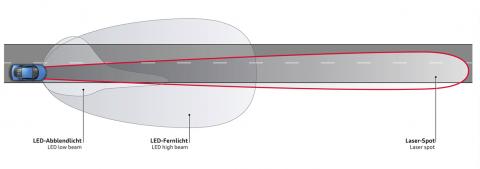
With the laser high beams, one laser module per headlight generates a cone of light with twice the range of the all-LED headlight. Each module comprises four high-power laser diodes. With a diameter of 300µm, these generate a blue laser beam with a wavelength of 450nm.
A phosphor converter transforms this into roadworthy white light with a colour temperature of 5500K – suitable conditions for the human eye that enable the driver to recognise contrast more easily and help prevent fatigue. The laser spot, which is active at speeds of 60km/hr and above, supplements the LED high beam and enhances visibility and safety. An intelligent camera-based sensor system detects other road users and actively adjusts the light pattern to avoid dazzle.
