Protection packets
Noel Giamello explains how to meet power, protection, and interface challenges, including for HID lamps
The modern vehicle has developed into a collection of electronic systems that work together to perform engine control, safety and diagnostics, infotainment, and many more functions. As the list of features and level of sophistication escalates, so do the challenges associated with integrating and operating these various systems efficiently and reliably.
Each electronic subassembly (ESA) must be powered, protected, and connected to its respective interfaces within the overall automotive system. From one main battery, DC-to-DC converters translate voltages for numerous application power levels. Once powered and operating, the electronics must be protected adequately from various transient events.
Electrostatic discharge (ESD) threatens electronics beginning as early as circuit assembly and continuing throughout the lifetime of the car, and must be considered. With protection in place, ESAs can be connected to the system.
Electromagnetic compatibility (EMC) and common mode noise (CMN) considerations are required at each interface and at the system reliability level. Finally, the system must be re-examined after all interfaces are in place to ensure adequate isolation and protection.
Accurate and stable power conversion and robust circuit protection are two areas that help ensure effective and reliable operation of automotive electronics. This article will describe the power supply, transient, ESD, and interface challenges in the automotive environment. It also will discuss components with features that make them effective.
Power
In the power supply, various resistors and magnetics ensure stable voltage levels. DC-DC converters convert from the nominal 14V of the main 12V battery down to 3.3 or 5V, or to up to 60V or hundreds of volts, for example. A basic converter circuit includes a mosfet transistor, capacitor, resistor and inductor. When the mosfet is on, a sinusoidal voltage is induced across the capacitor with a peak amplitude twice the supply voltage. A resistor in series with the mosfet can protect it by dampening these oscillations. These power resistors often are thick film, non-inductive, and rated up to 50W. Isolation from the backplane can be an additional advantage with power resistors.
The choice of resistor depends on several application factors. High-frequency applications demand low inductance since parasitic inductance of the wiring combined with capacitance of switching components can interfere with the normal operation of the conversion circuit. Resistor pulse characteristics indicate whether the resistor supports current limiting or capacitor discharge applications. The maximum temperature of the resistor, listed on the datasheet, must exceed the sum of the operating temperature and peak surge temperature of the application. Also on the datasheet, the time versus energy curve indicates if the component can handle the instantaneous power expected by a surge.
Transients
Transient surges for automotive electronics are classified in ISO 7637 according to event type. Since transient surges can last up to several seconds and generate several hundred amps, each ESA must be designed to pass ISO 7637 test specifications. Designers comply with the requisite level of protection by adding components to limit the surge or clamp the voltage.
Polymer positive temperature coefficient (PPTC) devices are ideal for transient protection. During normal operation the PPTC device has an extremely low resistance and remains essentially invisible to the circuit. When the operating current reaches the device’s trip current, the device temperature and resistance rise non-linearly to create an effective open circuit. Selection of a PPTC device depends on the application’s operating voltage, operating current and trip time. Stable resistance over a wide temperature range is desirable as automotive electronics can require +125˚C ratings instead of the more common +85˚C ratings. Advanced manufacturing technology uses different polymer blends to create high current capability, low resistance, high operating voltage and high operating temperature capabilities based on the needs of an application.
No zapping
As the number of user interfaces increases, automotive electronics must be protected from the risk of ESD damage. An ESD event may be temporary but its effects can go undetected for some time. A well-known standard called the human body model (HBM) characterises the current versus time curve and electrostatic surge. ESAs must be tested thoroughly to ensure compliance. HBM tests simulate the energy transmitted by human contact handling on the assembly line and in use to help designers quantify the voltage suppression required.
In addition to performing as clamping devices in other areas of the automotive system, multilayer varistors provide continual ESD protection based on the ESA voltages and trip characteristics. The varistor clamps the voltage to a safe level any time an overvoltage condition arises. Low capacitance and leakage characteristics ensure it remains invisible to the circuit during normal operation. Such automotive approved varistors are qualified using tests 1-3b of ISO 7637.
Working as a system
Adequate protection as a standalone unit is the mere starting point when introducing an ESA to the automotive system. Once connected, an ESA can cause or be susceptible to interference and reliability issues with other ESAs. For instance, to remain within the stringent emissions guidelines specified by the vehicle manufacturer, most ESAs connected to a Can network contain a CMN inductor. This inductor limits unwanted high-frequency noise on the communications bus, improves the transceiver EMC immunity and reduces electromagnetic interference (EMI). With all its benefits the common mode inductor can induce a high voltage across the Can transceiver, which must be clamped to protect ESAs from overvoltage damage.
Shielded high current inductors at the power supply interface and the Can transceiver help achieve the required low EMI levels. Common mode inductors connect each winding in series with an input line and phasing is arranged such that the flux created by each winding appears to cancel the flux of the other in the absence of CMN. The opposing flux generated in the core ensures that virtually no voltage is induced in either winding, so the current can pass through the common mode inductor with almost no power loss.
However, unwanted CMN can appear in one or both input lines. The CMN current returns to the noise source through the ground connection, and this current sees the full impedance of one or both windings of the common mode inductor. The CMN voltages must be attenuated in the windings of the common mode inductor to reduce unwanted noise on the return lines.
Advancements in inductor technology such as flat wire conductors and powdered iron cores help achieve high efficiency in compact packages. Flat wire raises the use of surface area to increase conductivity and handle high frequency switching. The type of core, wire and construction of the chosen inductor as well as the current determines the ESA’s electromagnetic emissions.
In action
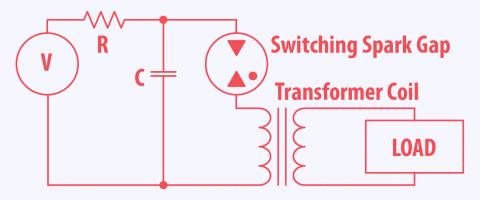
In many cases, new technology is necessary to meet demanding requirements of applications such as DC-DC conversion for high intensity discharge (HID) lamps in vehicle lighting systems. HID lamps require a very high ignition voltage pulse of several thousand volts followed by a constant voltage. To provide this high ignition voltage from the nominal car battery, a transformer coil and a switching spark gap are used as illustrated in the diagram. High voltage switching spark gap devices are designed specifically for voltage controlled switching of capacitive discharge circuits where high energy, low loss and fast rate of switching are required.
Design success
Designing a stable and reliable system begins with understanding the power supply, threats and interfaces. Along with stable, robust power conversion design, circuit protection is necessary to ensure the electronics are not affected by outside surges, human interaction or other electronics in the system.
Automotive electronics can be protected by PPTC devices for transients; multilayer varistors and clamp devices for ESD; and common mode chokes for EMI. Advancements in technology are making it possible to meet increasingly complex requirements. Taking advantage of efficient features and components for power supply, transient, ESD and interfaces, designers can focus on the design.
Noel Giamello is marketing director for the consumer segment at Bourns
