Armed and ready
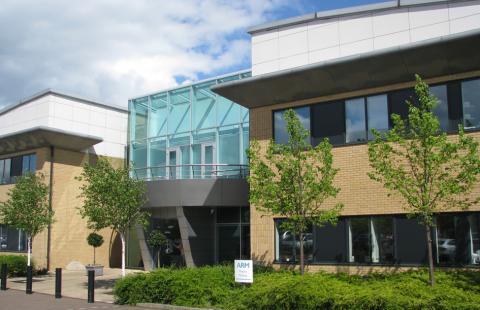
Steve Rogerson visits Arm’s Cambridge headquarters to hear about the company’s plans to be a major player in the automotive market
When the 2020 model year cars roll off the production lines, the expectation is that we will see the most dramatic increase yet in driver assistance and other electronic control functions as the car manufacturers are targeting that year for the fruition of much of their current research and development. One company aiming to take advantage of that is Arm, looking to become an essential part of the electronics in vehicles in the same way it has in smartphones.
This would be a remarkable achievement for a company whose share of the automotive MCU market was effectively zero five to six years ago and today is still less than ten per cent. True, there are Arm products in various parts of a new car’s electronics and it is a growing area of the Cambridge company’s business, but as of yet it has not broke through in the crucial applications. This though it hopes will soon change.
Boosted by Freescale’s announcement in March this year of targeting its Cortex M0+ based Kinetis EA series at automotive body applications, the company now sees it only has to win over Renesas and Infineon to the automotive potential of its products and it will be well on the way to achieving its goals.
“Most of our microcontroller value has been outside of automotive until now but we are the point where that is starting to change,” said Richard York, director of product marketing. “It is starting to ramp up with STM and Freescale, but it is so difficult to predict. Once a partner is established outside of automotive, it makes sense to adapt their products for automotive.”
He said this would be made easier if the push by Broadcom and Freescale to make Ethernet the dominant car network was successful.
“We are dependent on companies such as Freescale to take their products in the general-purpose space into automotive,” said York. “They are starting, but until the other guys do the same it will be difficult to predict.”
The main target areas are adas, in-vehicle infotainment, dashboard, power train, chassis and sensors and the recently announced v8-R architecture was designed with the automotive segment in mind.
“People know our architectures,” said Chris Turner, senior products marketing manager. “They have a consistency so they know they will run whatever the target processor we use. As such, our architectures move quite slowly.”
The company is only on the eighth version of the architecture stretching over a period that has seen hundreds of different processor cores.
“This is a key part of the value proposition to our semiconductor partners,” said Turner. “They can take our chip and not have to worry about whether debuggers and compilers are available. There are multiple choices for them. The chip makers know we have a big enough ecosystem that wherever they go there will be software there to support them.”
The company moved from version seven to version eight for app processors a couple of years ago and last year shipped the first IP that supported that architecture. Last year came v8-R for real-time applications. Unlike the app version, this is not at 64bit but at 32bit because the company believes that for embedded and automotive applications this is more than sufficient.
Virtualisation
What is more important for automotive is its capability for virtualisation. However, there is still some work to be done before the real-time version will be seen in actual products.
“The first IP using v8-R will not be yet,” said Turner. “Our engineers are in discussion with some of our leading partners to define exactly what the processors will look like. But it is important to announce the architecture early on because we want to tell people what we are doing. We are flying the flag, creating demand and building interest.”
The other reason comes back to the ecosystem. A lot of companies are working on virtualisation in conditions that are not designed for that.
“There are companies such as Green Hills Software and Mentor Graphics with virtualisation in the field with significant room for improvement if we give them support with the underlying architecture,” said Turner. “This is what v8-R does. So we have released advanced copies so they can see what we are beginning to build.”
Virtualisation is becoming a key element in automotive because of the increased concentration on safety that came with the release of ISO 26262. Here again the use of Arm cores in non-automotive applications could be an advantage.
“The cost of ISO 26262 is high,” said York, “but the similarity between it and some non-automotive standards is good. Our app processors will also crop up more and more in automotive in infotainment and some of these could also be used for adas processing.”
This is a big plus for the virtualisation capability because it allows a complete on-chip separation between the infotainment and adas functions. It also brings with it extra safety and reliability features.
“There will be more fault detection and management features in v8-R than we have ever done before,” said Turner. “You can use the hypervisor to switch in and out of real-time control with a real-time interrupt to switch back to a rich operating system when needed. This allows you to have a rich and a real-time operating system on the same system.”
Even though safety is a system wide property and ultimately the responsibility of the OEMs, ISO 26262 has meant part of that responsibility now lies in every stage of the supply chain and each link expects the link before it to have considered the safety implications in the design of their products, right the way down to chip level.
“The OEMs will add ISO 26262 to their requirements to the tier ones who will in turn put that as a requirement to their suppliers,” said Lauri Ora, functional safety manager. “That will trickle all the way down to us. We can’t solve this ourselves but we can support that with the right information and the right product. We have to develop safety applications without knowing the entire system. We have started supporting safety from the bottom up.”
A big part of this is how Arm passes information to its licensees, which means documenting all the assumptions that have been made about the functionality of the cores.
“We have to say how we expect them to use our IP,” said Ora. “We say we assume you will do this or that if you expect the system to work.”
Arm also provides its silicon providers information on what level of safety analysis has been carried out.
“We have engineers going through the design to say what will happen if certain parts fail and then pass this information along,” he said. “This helps the silicon providers in their activities.”
The company also believes the virtualisation in v8-R will cure a problem with Autosar in which the hardware did not match the software consolidation profile.
“The original version of Autosar was done to enable software consolidation but the hardware hasn’t been up to the job,” said York. “This is about fixing that.”
Targeting 2020
The target is for the IP using v8-R to be released in time for the chip makers to produce devices so the tier ones and OEMs can have products ready for 2020 model year cars.
“We are looking at the automotive business in 2020,” said Soshun Arai, embedded segment manager. “We are talking with silicon providers to optimise the SoC for dedicated areas. This will be a big model year.”
One key area is in-vehicle infotainment, which Arai says needs to move to a much higher performance as smartphone developments have raised customer expectations.
“Drivers have their smartphones and the OEMs want to fill the gap between them and the car,” he said, “so the tier ones want to bring more sophisticated CPUs into infotainment. This used to be a generation behind the consumer market but now it is moving to mostly the same.”
The problem is that automotive has a much longer development cycle.
“This is a big challenge for OEMs and tier ones,” said Arai. “We will see cars being upgraded over the internet or by dedicated Ethernet so we now are talking to car makers about our security technology. A lot of OEMs are looking at security for infotainment.”
The next targets are electric and hybrid electric vehicles for motor control and battery management applications.
“HEVs and EVs are more established in Japan but not in the USA and Europe,” said Arai. “Everyone is on the starting line so you can get business from this area. Our cores are very low power so battery management makes sense for them. We are looking at Arm cores running the cell balancing and so on. In automotive, this will grow from the 2020 model year.”
This he described as “a game changing year” when what he says are the big three – Renesas, Freescale and Infineon – will have to change their offerings.
“They will consider how to change the game and that is where we come in,” he said.
This is why Arm sees the Kinetis EA announcement from Freescale as so important.
“Freescale’s move with EA is big for us because we see one of the big three putting our cores into automotive for body applications,” said York. “They are focussing on the core applications for automotive, and this is an area where really we haven’t been in. This is quite exciting. It shows there is no inherent reason why Arm doesn’t apply to these areas. We should see more announcements in the next few years from other vendors. The question is not how but when.”
