From the dealership to the road
Andreas Kohn looks at how M2M and the internet of things are accelerating embedded automotive applications
The automotive industry continues to adopt machine-to-machine (M2M) communications at a very fast pace. High-speed cellular networks and more powerful M2M microprocessors are empowering OEMs and tier-one suppliers to bring more sophisticated software and services to the vehicle.
From geo-fencing applications that tie digital services to real-time geographic locations, to in-car infotainment systems, to predictive analytics and safety services, the sky is the limit. All these innovations are helping the automotive industry truly to embrace the internet of things (IoT) and play a key role in realising the opportunities that the connected world offers.
But one barrier has put the brakes on automotive M2M deployment: the complexity of developing connected applications.
Automotive M2M systems have been largely custom-made. With no universal standard for M2M, software applications are designed for a specific vendor’s hardware and chipset, with little ability to move from one platform or network technology to another. As a result, OEMs have to develop connected applications for each market and customer from scratch.
That means devoting countless engineering hours and huge financial resources to build and rebuild basic M2M functions – integrating processors, modems and memory; piecing together all the software components for the application; testing and validating – for each new product or market. And, once suppliers choose a proprietary platform for their connected application, they are effectively locked into that vendor (and that vendor’s pricing and product roadmap) for the long term.
Device and hardware compatibility is just one of the issues caused by the rollout of apps and services from a multitude of providers. Additional challenges can arise when new in-vehicle apps are not compatible with the existing features, forcing M2M app developers and car manufacturers to build dedicated services for each proprietary vendor and platform from scratch. As a result, automotive electronics manufacturers need to spend even more time and engineering resources on performing basic system integration tasks, which slows down the rollout of new applications and services.
To be able to make the most of the IoT opportunity, organisations need to create a more flexible M2M ecosystem that fosters faster development of new products and services.
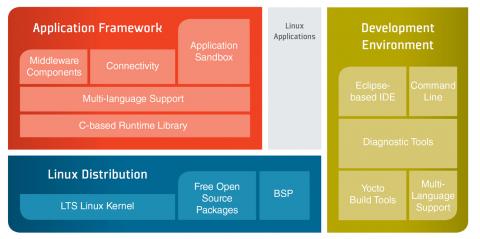
Open source platforms provide a great opportunity to achieve this, as they can enable faster time to market for new products and services. This approach enables the development of a universal application platform where vehicles are like smartphones, running common applications across different types of hardware. To be able to achieve that, this open source technology needs to have a comprehensive set of capabilities including:
• Ready to run pre-integrated features that enable faster development time;
• Ready to build open-source application environment that includes all the building blocks developers need to create advanced automotive applications – this platform needs to be fully customisable to accommodate the growing need for flexibility of app developers; and
• Ready to connect featuresto make it easier to deploy, manage and upgrade devices.
These capabilities let suppliers bring new connected applications to market much faster and at a much lower cost. With an open-source, Linux-based platform, organisations can reuse the same application across multiple hardware platforms, easily scale up and down services, and change components without having to rebuild the whole system.
Another key factor is ensuring that embedded M2M applications and devices can be used effectively in the long term. Considering the longevity of a car, it’s important to ensure that investments in development are protected by providing effective ways to manage and update applications long after the vehicle has left the dealership and is out on the road. Security protocols, for example, only remain effective if they can be regularly updated. To be able to manage connected applications and services across hundreds of millions of vehicles, car manufacturers need flexible and scalable platforms that allow them to push out service updates and track the performance of all connected devices in real time.
Cloud-based management platforms, for example, are a great way to manage and monitor millions of connected devices remotely and scale up and down the provisioning of M2M services depending on customer demand. This approach simplifies the management of M2M apps and lowers the costs of maintenance, allowing service providers to deliver more competitive products to end customers.
These cloud platforms can deliver even more value by managing the delivery of real-time traffic alerts based on pre-configured requests, up-to-date status on nearby parking spot availability, or news and information services.
Beyond operational benefits, open source M2M development platforms have the potential to enable new revenue models and business partnerships for automotive suppliers. Some open source technology, for instance, has an application sandbox, which can run multiple applications on the same module. Using strong security, the sandbox allows developers to control tightly the resources that any application can use while ensuring that external third-party applications or services can’t access sensitive data or critical automotive and safety functions.
For example, a European supplier might be building a telematics control unit (TCU) to comply with the EU’s e-call mandate, equipping vehicles to contact emergency services automatically after an accident. A supplier can use this strictly for this purpose, and quickly create a Linux-based e-call system that can scale to any market the supplier serves. But for little or no additional cost, the supplier can also use the same technology to bring diverse, new connected services to the vehicle, securely, through the same platform.
The supplier can now support a fleet management application for a large rental car customer, and can partner with an insurer for a pay-as-you-drive insurance application. They can support eco-drive applications that track and optimise fuel efficiency. They can allow drivers to view diagnostic information from an app on their smartphones. These, and many other possibilities created by the supplier or third-party partners, can all run on the same TCU, without compromising security or performance.
The rapid growth of connected devices will create a set of opportunities for car manufacturers and automotive electronics engineers. According to Gartner, the IoT will see 26 billion connected devices by 2020. To be able to take advantage of this IoT revolution, all players in the automotive industry will need to work together with third party technology partners and service providers to create a healthy M2M ecosystem that fosters business growth and innovation.
This could be achieved by simplifying the development and the management of connected devices and the services they enable. Open source M2M development platforms can address the key pain points of M2M development, including the technology fragmentation and the lack of interoperability between proprietary firmware and software components. This will enable automotive electronics engineers and car manufacturers to roll out new services and products faster than ever before, while keeping development costs down.
This, coupled with adopting a cloud-based approach to managing M2M devices, will enable car manufacturers to achieve great scalability and drive innovation and business growth.
Andreas Kohn is director of automotive and transportation at Sierra Wireless
