Etas and IPG collaborate on virtual software validation
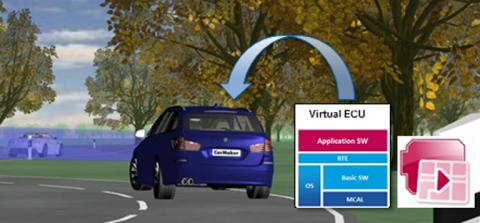
Two German companies are collaborating on virtual ECU software validation. Stuttgart-based Etas and IPG Automotive, headquartered in Karlsruhe, both have many years of automotive expertise as well as portfolios in embedded software and driving dynamics simulation.
Now they are bringing this know-how together in joint work for validating software during early stages of the development process. The method is based on taking virtual ECUs on virtual test drives.
Prompting this is not only the continuously growing complexity of what automotive ECUs must do, but also their shortened development cycles. One of the key forces behind this growing complexity is the trend towards autonomous driving, which brings with it a perpetual increase in the number of assistance functions.
When it comes to developing these functions, there is no real prototype available some 60% of the time and less than 10% of engineers can carry out validation activities in the complete vehicle. Automotive manufacturers and suppliers both have a vested interest in improving this situation and being able to test new functions early on, independent of hardware, in a virtual environment in a complete vehicle.
Etas and IPG are addressing this issue and enabling the early virtual validation of ECU software. The main ingredients of their joint work are the Etas Eve virtual ECU and IPG’s Carmaker open integration and test platform.
Eve is a PC-based platform for virtual software integration and validation. Unlike previous virtual products, the ECU production software is used with RTA-Os and under realistic conditions. This enables validation of application software, basic software or even the complete ECU software to take place within a virtual environment.
Testing can be conducted in real-time and non-real-time modes and supports different applications that provide consistency across the various stages of development.
For its part, Carmaker provides the simulation environment for virtual test driving. The platform allows the integration of models from various modelling tools, thereby solving potential interface problems in the process. Simulation results are drawn from precise non-linear vehicle and trailer models and are reinforced by the option of carrying out complex driving manoeuvres in various situations, such as testing adas with many road users.
Carmaker covers a broad spectrum of applications and allows functions to be developed and secured using model-, software-, hardware- and vehicle-in-the-loop at any time during the development process.
The combination of these two tools makes it possible to carry out realistic and hardware-independent software validation early within a virtual environment. The process starts with the integration of production software components into the virtual ECU. Afterwards, Eve can be exported as a functional mock-up unit and integrated into Carmaker via the standardised functional mock-up interface. Carmaker is then used to put the software through its paces as part of virtual test drives before the software is approved.
Since tests can be carried out in a complete vehicle context, the hardware-independent and early validation of ECU software also improves quality. What is more, this ensures that car manufacturers can incorporate their own specific test scenarios.
