Microcontrollers: Free fuel?
Jeff Loeliger from Freescale explains how MCU development is helping to reduce fuel consumption in modern vehicles
The idea of free fuel may seem far-fetched but that is exactly the effect vehicle manufacturers need to achieve if they are to meet future global emissions and fuel efficiency regulations. Legislation has driven the need for radical changes to the way manufacturers think about fuel and the speed at which the world is using it up. The challenge is to make fuel go further but at no extra cost to the consumer. In effect – free fuel!
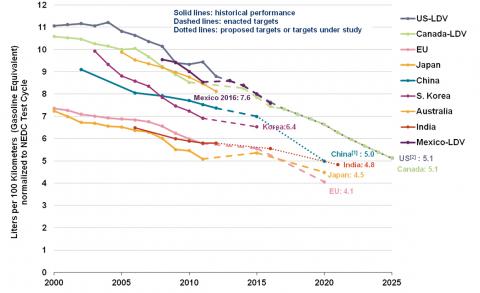
While different regions have different levels of emissions and efficiency requirements, there is a constant global trend downwards.
New and emerging markets are typically believed to have low emissions standards and poor targets but, as shown in the diagram, this is just not the case. The graph, showing litres of fuel required to drive 100km on the new European drive cycle (NEDC) test, demonstrates that many of the emerging market targets are just as stringent as those of the developed regions. China and India, for example, are targeting to be close to Europe and Japan by 2020.
Fuel efficiency
There are two ways to measure fuel efficiency; government specified tests and customer experience. There is some concern that, in recent years, the fuel efficiency test improvements on new vehicles are not in line with actual customers’ experiences. For example, in Germany, a recent study showed the difference between test mileage results and customers’ actual experience was 7% in 2001, but in 2011 that figure rose to 23%.
The feeling is that standard tests do not always represent real customer driving experiences and that vehicle manufacturers are getting better at testing their vehicles. This does not necessarily mean they are cheating or breaking the rules but that they are managing to optimise the test methodologies to suit their needs. For example, in many tests, some features such as stop-start engine operation are over represented. This gives a good reduction in fuel consumption test results but the same improvement is not necessarily seen in normal driving. Getting good at testing helps but it is, however, the inclusion of new electronic technology that has provided the greatest increase in engine efficiency and reduction in emissions.
There has also been much unequivocal advancement in fuel efficiency improvements through mechanical optimisation. Mechanical changes, such as mass reduction, the use of new lubricants and refrigerants, and lowering aerodynamic drag, have all helped to cut fuel consumption.
Direct injection
The single biggest change to increase engine efficiency is the move to direct injection. By injecting the fuel directly into the cylinder during combustion, rather than into the inlet manifold prior to compression, the fuel is burnt more effectively and great engine efficiency improvements can be achieved. Direct injection is, however, also the most expensive change to the engine as it requires the addition of a high-pressure fuel pump and peak-and-hold fuel injectors.
In diesel engines, up to 20% efficiency can be gained by moving to direct injection. All modern, diesel passenger cars use direct injection.
Diesel is challenging, due to the higher engine compression and the fact that it does not burn as well as petrol. This leads to the need for a very high-pressure fuel supply and multiple fuel pulses during the combustion. Today it is common to have up to 2000bar of fuel pressure and in the future this will be increasing. The higher pressure helps produce better atomisation of the fuel, which in turn ensures a better, more efficient burn.
To allow precise control when working with the high-pressure fuel, the fuel injectors need to be able to open and close very quickly. This is achieved by using high voltage on the fuel injectors of up to 80V. This requires a current of up to 25A, which in turn means a switched power output of 2kW. The first direct injection diesel systems used three fuel pulses during a combustion event but current systems use seven or more pulses. The higher number of pulses allows for a smoother burning combustion and provides features that help reduce the amount of soot produced.
In petrol engines, up to 12% efficiency can be gained by moving to direct injection. This move is not as clear-cut for petrol engines as it is expensive to do and the benefits are not as great as diesel. Petrol direct injection is, however, cheaper than diesel direct injection. This is because high-voltage injectors are not always needed and lower pressure is used. The reason for this is that petrol burns easier than diesel.
For both the diesel and petrol engines, the control of the fuel injectors is the main challenge for the electronics. The key issue is that the injectors need to have a 1µs closed-loop control time to control the current as it changes extremely quickly. A large amount of power is required to get the fast operation of the injectors; however, it is essential not to put too much power into the injectors, as it would permanently damage them. This is why peak and hold control is required.
Most systems today implement the closed-loop control of the injectors with a custom asic. The asics use programmable analogue comparators to implement the closed-loop control. Some new MCUs are integrating the closed-loop functionality on chip. The MCUs use ADCs and custom timers to implement the closed-loop control. The advantages of using ADCs and timers are reduced cost, increased flexibility and reduced development time because a custom asic does not need to be developed. The new approach also provides the opportunity for new features using diagnostic and feedback information that can be obtained from the ADC values; this cannot be done with the analogue comparator in the asic.
Future
As we move towards 2025, automotive manufacturers will continue to improve efficiencies through downsizing of engines, turbo-charging, direct injection, advanced transmission and valve control. The great news is no new breakthrough technology is required to meet 2025 requirements. Instead, the challenge is to find cost effective ways of implementing existing features. Electronics has a key role to play in this by allowing more accurate control of simpler mechanical systems to keep costs down but efficiency up.
The move to bigger, more complex MCU devices sees ever increasing control being given to the MCU. The key features used to enable an improvement in efficiency and emissions are the multiple fast cores, large amounts of memory, the ADCs and timers. The faster cores and bigger memory work together allowing more complex algorithms to be run and enabling more IO to be managed.
These are essential attributes. Where engines in the past might have had five or six features to help increase engine efficiency, future engines will require 25 to 30 features specifically designed to improve efficiency. The most notable of these features are direct injection, integrated starter-generator with stop-start, advanced valve control and electrification of ancillary pumps.
One feature recently being included on powertrain MCUs is sigma-delta ADCs. The ADCs are proving essential because of their high-speed and high-resolution. They provide accurate measurement of the knock sensor signal in petrol engines allowing a greater control of engine combustion. The knock sensor is the main feedback signal from the engine and is used to analyse the combustion in the cylinder. Sigma-delta ADCs are also required for in-cylinder pressure sensors, which are starting to be used. Pressure sensors can provide information on pressure during combustion in the engine. These features, in turn, ensure emissions are kept down.
Conclusion
The future sees electronics playing even more of a role in the constant challenge of increasing global efficiency and emission standards. The relentless advancement of MCU development continues to provide increasing performance, memory and features while reducing overall system costs.
Jeff Loeliger is an automotive MCU systems engineer with Freescale Semiconductor
