Vehicle Networks: Crash course
There’s plenty of scope for sensationalising automotive connectivity but, for both the automotive and IT industries, there remain serious issues on how to ensure safe, practical methods within a vehicle and for external connections, according to Peter Nicholson from Spirent Communications
The buzz-phrase “connected car” is catching on; Fig. 1 gives some idea of how much. And it is still rising fast, with Juniper Research predicting that nearly 100 million cars will have internet access by 2016.
Much of the public’s interest has focussed on external connection – to the internet, to intelligent traffic signalling, and between vehicles – but for the automotive industry the term connected car also has major implications for connectivity within a vehicle.
Vehicles have always been internally connected with internal linkages and wiring to deliver monitoring, diagnostic and control functions to the dashboard or between systems. In today’s connected car, however, these separate functions increasingly converge towards a single network – as has happened elsewhere.
Enterprises also experienced a proliferation of electronic networks at the end of the 20th century: a corporate Ethernet lan, a telephone network, one connecting burglar alarms, one connecting fire alarms, maybe another connecting access security on some doors, another providing environmental monitoring and control – let alone the machine control networks also required on a manufacturing site. But now all these independent networks are converging onto the Ethernet system, and a host of different wiring networks are being replaced by a single IT network that allows all the separate functions to continue as if they still had their own independent wiring system.
The same convergence has been happening in the car. When once there would be separate sets of wires going to the brake lights, fuel gauge, indicators and so on, increasingly these are using different protocols to share a common network.
However, the challenge in any complex system is that it is very difficult to predict exactly how it will behave when new factors are added. The Ethernet packets carrying voice messages on the corporate network have very different needs to the signals carrying a fire alarm, for example; so if the one network is going to serve a host of new services then the only sure way to know that it will continue to work under all circumstances is to test it rigorously under all realistic and extreme operating conditions.
The same will apply as cars become more connected.
Externally connected
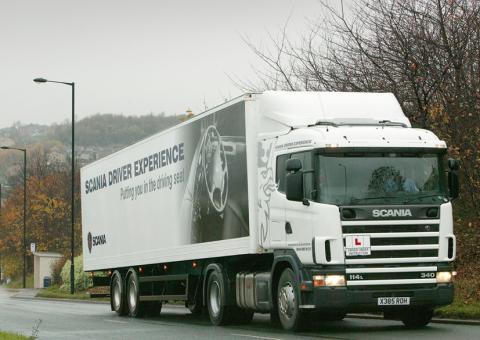
For at least five years it has been possible for fleet operators to buy large lorries with their own connection to headquarters. Automatically feeding back information about the vehicle’s position, speed, fuel levels, tyre pressures, engine temperature, and so on, allows the operator to monitor the driver’s behaviour – whether breaking any health and safety regulations by speeding or not taking a break – and provides advance warning if the vehicle needs servicing.
The big manufacturers such as Scania, Volvo and Renault all developed their own proprietary communications technologies to maintain competitive advantage, and these have typically relied on the existing mobile phone networks. As proprietary systems, there is little scope for interconnecting them, so the fleet operator might now have to cope with several different communications systems.
In addition to this one-way flow of information to HQ, there have been other links towards the vehicle. Global navigation satellite systems (GNSS) and other positioning signals can provide navigation and telematics; Bluetooth can enable hands-free telephone use and media; and RDS can broadcast warnings of weather or traffic information over radio frequencies. For private motorists these X2car communications have become the norm, while car2X services, where the car communicates outwards, or even car2car exchanges between vehicles are a relatively new development,
In Europe, for example, an e-call system is being rolled out to contact emergency services automatically in the event of a crash and send event information and location. Similar capabilities exist in North America with GM’s Onstar service, while Russia’s ERA-Glonass system is said to be fully interoperable with e-call. Meanwhile, a 1100km co-operative intelligent transport systems (C-ITS) corridor is being developed between Rotterdam, Frankfurt and Vienna to enable two-way communications between vehicles and the surrounding road infrastructure. This will begin with simple warnings such as road works ahead and anonymised data gathering for road operators, then be extended through sensor fusion to more advanced assisted driving services in coming years.
Of particular interest to the driver is the potential for internet connection. So far this has mostly been served by routing an internet connection via a secure virtual private network (VPN) tunnel to the vehicle manufacturer’s dedicated data centre. As the technology becomes more mainstream, this would overwhelm available bandwidth, so vehicles will increasingly have their own, direct connection to the internet – with all the attendant opportunities and security challenges.
Internally connected
Convergence within the car is starting to replace independent wiring systems with internal networks, using different protocols to deliver key electronic, monitoring and diagnostic functions. This internal connectivity presents immediate challenges for OEMs to launch new vehicles that will be on the roads for the next ten years – whereas the more radical car2car systems will take longer; market surveys suggest that their true benefits will only be realised after reaching a critical mass of more than 20% of users.
Currently, the Can bus is most often used as an automotive backbone network, despite its speed and load limitations, while Lin provides a low-cost network for vehicle body applications, Most fibres deliver in-vehicle media, and high-speed Flexray enables x-by-wire capabilities, such as brake-by-wire, along with other functions where speed and reliability are paramount.
For next generation vehicles, however, Ethernet will provide the network backbone, as in the corporate network but also as a means to reduce weight. Vehicle weight is becoming increasingly important, leading to the use of lighter materials such as aluminium and carbon fibre while even Ethernet has been pared down to automotive Ethernet, developed to run on unshielded twisted pair wiring to weigh less than traditional eight-wire Ethernet cable. To create an industry standard, the Open Alliance has adopted the Broad R-Reach (OABR) two-wire automotive Ethernet as the de-facto physical layer standard, clearing the way for its widespread adoption.
By simplifying a vehicle’s wiring loom, with less copper and duplicated network hardware, OABR is significantly lighter than equivalent existing technologies. It also reduces connectivity costs by 80% and improves vehicle efficiency. It can still deliver 100Mbit/s, and this capacity will be needed as advanced driver assistance systems (adas) and connected car functions escalate demands for complexity and bandwidth. BMW has already achieved cabling cost reductions by using Broad R-Reach Ethernet to deliver vehicles with all-round camera coverage, and expects to make growing use of the technology. ABI Research predicted that Ethernet penetration in new cars worldwide would grow from 1% in 2014 to 40% by 2020.
One downside of the growing complexity made possible in vehicle computing, infotainment and security is that future connected vehicles will require software updates on a regular basis. However, what would be an all-day garage task on the current Can network could be carried out over Ethernet while the owner waits – or even conducted over-the-air with no need to visit a garage.
Automotive Ethernet
The application of any new technology – especially where safety is involved as in a moving vehicle – raises the question whether it can be relied upon to work at all times.
Ethernet is already well established in the IT sector and OEMs are able to purchase confidently systems that have been tested by vendors and debugged through years of extensive use. So little conformance testing is needed during product development phase. But the same cannot be said for automotive networks. OABR automotive Ethernet has just started to be adopted and it would be unwise to rely too heavily upon these new bus systems without thorough testing. Vehicle manufacturers also have greater responsibility for safety and reliability than in the IT industry.
With brand reputation, multi-billion dollar recalls and, ultimately, customers' lives at stake, automotive companies must place even greater importance upon testing at every stage within the supply chain. The system needs to work under all likely environmental conditions – during rain, snow, high and low temperatures and levels of vibration seldom experienced in ordinary IT networks. The car industry is accustomed to recreating that sort of test condition, but Ethernet testing presents a new challenge. As well as being a new technology, it faces a range of hacking and denial of service attacks that have grown up in the IT environment. The risk of cyber-attack brings automotive into the frontline of the world of IT security – a problem that is probably evolving faster than any other aspect of vehicle development.
Although automotive networks have very specialised requirements, the broad framework for testing automotive Ethernet can be developed from well-established best practice for network testing in the IT industry. Four types of test are needed:
• Conformance testing ensures protocols function correctly and meet approved standards. This will remain important until OABR is so well established that OEMs can leave it to their vendors.
• Negative testing confirms how the system responds when it encounters errors, unexpected or nonstandard signals, or no signal at all. This includes fuzzing to test every possible permutation close to the expected action – such as a driver missing the correct button and hitting an adjacent one. Exhaustive negative testing is particularly important in automotive scenarios, where a vehicle must remain safe at all times.
• Performance testing checks how much load the system can bear, and what happens when this limit is exceeded. For example, when faced with a sudden surge in demand for network bandwidth, can a vehicle still identify, prioritise and deliver the most important messages, such as brake function?
• Security testing is becoming increasingly important for the automotive industry. Although Can and other bus networks can be compromised, the specialised interface restricts the practical threat to an extremely low level. However, the standardised nature of Ethernet means that hacking tools and techniques are widely available and attacks could be made through any external connections.
Conclusion
Connecting vehicles will enable the automotive industry to provide users with new features to improve driving and travelling experiences. Some new features, such as video cameras and other driver assistance systems, are already starting to appear in current models, while others, such as fully autonomous driving, will take a lot longer to implement.
To deliver these new features, vehicle manufacturers will need to embrace more new technologies that have been developed in the IT industry. Some, such as Bluetooth and GPS, are already incorporated, but others, such as automotive Ethernet and Wifi, will become critical to the development of connected cars. As a vehicle becomes more like a computer network on wheels, ensuring these new features work properly presents a new challenge to the auto industry.
The good news on Ethernet is that the principles behind the underlying technology are already well understood in the IT industry and specialist test tools and techniques have been developed and are available in increasingly simple, easy to use formats. Work has already started on adapting these to OABR and the specialised needs of the automotive industry – for example there is already an interface card available to connect two-wire OABR to the most sophisticated network test devices, allowing all the above types of test to be customised to match realistic and extreme operating conditions in the vehicle.
Peter Nicholson is general manager of the automotive business unit at Spirent Communications
