Software tools: Keeping it simple
Cloud-based computer-aided design tools are helping bring a revolutionary car from idea to production
The effects on the environment of transportation has become a major influence in designing modern vehicles. But one company is taking this to new lengths. This is Riversimple, a company set up with the sole purpose of eliminating the environmental impact of personal transport.
As such, the company has designed a car that should be available next year that emits nothing but water yet will be capable of doing the equivalent of 70km/litre, about 200mpg.
“We’re designing a radically new car, which will be in market trials late next year,” said David Rothera, vehicle electronics engineer at Riversimple. “It emits nothing but a tiny amount of water and will do more than the equivalent of 200mpg.”
The UK-based business has as its chief designer Chris Reitz, who has assembled a design team in Barcelona. Reitz was the original designer of the Fiat 500. Many team members have worked in Formula One.
The car is said to break new ground in fuel efficiency and environmental performance. It’s powered by a hydrogen fuel cell, and has been designed from scratch with lightweight but strong composite materials. It weighs less than half as much as a conventional car, and is highly aerodynamic and stable.
The technology demonstrator, which is on display in the Atmosphere gallery of London’s Science Museum, achieves the equivalent of 300mpg and emits nothing more than a teaspoonful of water on long journeys.
What will also be different about Riversimple is that the company will not be selling the cars, rather offering what it calls mobility as a service. Customers will pay a fixed monthly fee for the car; the fee will include fuel, insurance and maintenance.
“We believe that this leasing-rather-than-buying concept could change how the world uses and values its reducing resources,” said a Riversimple spokesperson. “It aligns our business interests with the environment’s. That is why we are adopting it right through our supply chain and are pushing for it to be adopted in other industries.”
How the car works
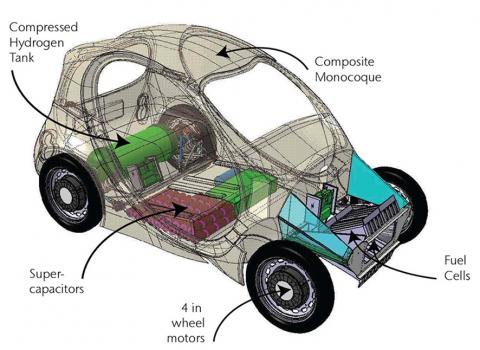
The car uses what the company calls a network electric platform. There are four electric motors, one in each wheel. Each motor is capable of regenerative braking to generate electrical energy when the brakes are applied. Super capacitors store this energy and provide most of the power for acceleration.
Low-powered hydrogen fuel cells and a body made of lightweight composites give the efficiency and range that would not be possible from just inserting the fuel cells into a conventional vehicle.
Decoupling acceleration and cruise power requirements means the fuel cell needs only to be sized to meet the maximum steady demand when cruising. This is usually only about 20% of the maximum power required when accelerating.
In a conventional car, the engine provides the power for acceleration and cruising; but as a car is only accelerating for about 5% of the time, and the power needed then is five times what it is when cruising, it means that for 95% of the time the car is carrying around an engine and transmission that is five times larger than necessary.
In this electric vehicle, almost all braking is done by the electric motors, capturing the energy of the car in motion, rather than using conventional brakes that just waste the energy as heat. This energy is then stored in a bank of super-capacitors. Because super-capacitors can be both charged and discharged very rapidly, they can provide 80% of the power required for acceleration. Therefore, only a fifth of the power is required from the fuel cell that would be required if it alone was replacing the engine in a conventional car, which leads to a large reduction in its cost.
Mass decompounding is an emergent property of whole system design rather than attempting to squeeze a fuel cell into a car architecture that is designed for a combustion engine and then trying to persuade it to behave like one. The reduced size of the fuel cell, and elimination of a gearbox and driveshafts, results in weight reduction. This leads directly to a lighter chassis, as this is usually designed to hold on to a heavy engine and gearbox in accidents.
This in turn means less power is needed, which means lighter components, and so a lighter chassis, meaning less power and so on, and this effect is magnified by using lighter materials, composites, for the chassis as well. Furthermore, all these weight reductions lead to narrower tyres and make power assisted systems for brakes and steering redundant; this virtuous circle of mass decompounding leads directly to significant improvements in efficiency.
Design tools
Riversimple adopted the Cadonix Arcadia cloud-based automotive harness cad tools to develop the road-going version.
“The Arcadia tool is excellent in several respects, but what really stands out is the enthusiasm and support of the Cadonix team,” said Rothera. ‘This will be key for us as we address the very specific challenges of creating a ground-breaking vehicle and delivering it on time.”
He cited the tight integration between the circuit design and the harness tools as a strong point for Arcadia.
“Cloud based design is new for us,” he said, “but even at this early stage we’ve come to appreciate the flexibility of being able to access the design from anywhere.”
Research and development of the two seater vehicle is taking place in Wales. The team is aiming for a fuel efficiency of more than 70km/litre, a range of 480km, 0-48km/hr in 5.5s, and a cruising speed of 88km/hr. The lightweight composite body is key to achieving this performance, but inevitably makes the electrical design more complex as it does not offer a return path.
“Arcadia is a flexible and intuitive tool, which will be fully able to address the need to include a return path, and other issues specific to the design of this unusual vehicle, said Rothera.”
Andrew Armstrong, managing director of Cadonix, added: “Riversimple is developing a pioneering vehicle which may well set the tone for the automotive industry of the future. We are proud and delighted that they have chosen the Cadonix Arcadia environment for their hydrogen cell powered car. We look forward to working with them on this project.”
Arcadia is a software tool providing schematic design, animated circuit simulation and analysis, electrical networking, harness design and full design rule checking for wire harness layout and manufacture. Using the integrated simulation capabilities, engineers can ensure their design intent is carried through into the physical implementation. It interfaces with the most popular 3D mcad and enterprise wide PLM and ERP tools, allowing projects to transition easily and smoothly into manufacture. Users can import databases and designs from many legacy systems.
How Arcadia works
A key advantage of cloud technology is that it lowers the dependency on capabilities of both the designers and their workstations. All the processing power that is needed for schematic routing and simulation, harness design rendering, database operations and reporting is at the server end. High-bandwidth networking means users only need a modern web browser to send commands to the server and respond to its outputs. This platform-agnostic approach means harnesses can be designed on any desktop, laptop or mobile device, anywhere that has an internet connection. There is no software needed and designers can log in and work from the office, at home or anywhere.
Designers using cloud-based cad can tap into a lot of computing power from the server. For example, Arcadia delivers schematic design, animated circuit simulation and analysis, electrical networking, harness design as well as full design rule checking for wire harness layout and manufacture. Users can select from around 12,000 components in the standard database and import many thousands more from their existing data and newly created catalogues.
Cloud-centric cad provides virtually limitless storage, allowing designers to monitor the ever-expanding range of connectors, fuses, switches and other circuit components coming onto the market. Bundles can be created in the harness editor, either from existing schematics or as new designs. Sleeves, connectors, terminals and seals can all be incorporated. Legacy designs from older software can be incorporated into the system, complete with their bill of materials and component data.
Integrating schematic layout with electrical simulation lets the user verify harness designs, checking voltages at any node and ensuring that components are performing well inside their limits. A set of reporting options helps new and modified designs satisfy statutory scrutiny.
Conclusion
Computer-aided design has become an increasingly important factor in improving quality, driving down costs, lowering time-to market and maintaining a competitive edge. As Riversimple has shown, emerging cad technologies are set to raise the bar even higher: to the cloud, in fact.
