Audi A7 drives 900km on autopilot to reach CES in Las Vegas
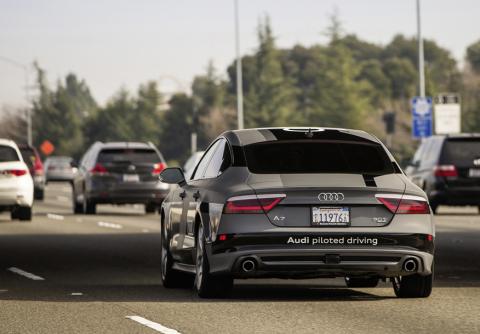
Following an epic 900km journey – much of it driven on autopilot – the Audi A7 Sportback piloted driving concept vehicle has arrived in Las Vegas for this week’s Consumer Electronics Show.
Starting in California’s Silicon Valley, the Audi A7 3.0 TFSI Quattro long-haul test drive was witnessed – mostly hands-free – by members of the media. It proved itself capable of providing a comfortable drive in real world, everyday driving situations, particularly in the kind of traffic that drivers encounter on a daily basis.
“The results of the test drive underscore our piloted driving competency”, said Ulrich Hackenberg, Audi board member for technical development. “I’d like to thank the team of Audi engineers, VW Group R&D and the Electronics Research Laboratory for making it such a great success.”
The test drive resulted in actionable data to help further development of Audi piloted driving. It involved the longest drive undertaken so far by Audi at full road speeds with members of the public behind the wheel, each of whom was able to experience piloted driving in 160km stints in various traffic situations on public highways.
In total, the drive was 900km long and, as required by state laws in California, was accompanied by an experienced Audi test driver who monitored proceedings from the passenger seat.
The concept vehicle uses various production-ready sensors as well as sensors integrated into production vehicles today that accurately detect the vehicle’s surroundings. Adaptive cruise control and side assist long-range radar sensors as well as mid-range radar sensors at the front and the rear of the vehicle that are directed to the left and right provide a 360˚ view of its environment. Laser scanners are integrated into the front single-frame grille and the rear bumper to provide additional detailed recognition of static or dynamic objects.
The validity of the sensor data is assured by a continuous plausibility check during piloted driving to ensure the correct decisions are being made by the vehicle and the driver. Four smaller cameras at the front and rear of the vehicle provide short-range information about the surrounding environment. The wide-angle 3D video camera, which will first see production in the Audi Q7, observes the traffic surrounding the vehicle. The sensor it uses meets all the requirements necessary for inclusion into future products and is close to reaching production.
The concept relieves the driver of driving duties at speeds up to 110km/hr. The car can initiate lane changes and passing manoeuvres as well as accelerate and brake independently. Before initiating a lane change to the left or the right on US highways, the vehicle adapts its speed to surrounding vehicles. If the speed and distance calculation is deemed safe, the vehicle initiates the lane change with precision and in a timely manner.
Before the piloted driving system reaches its limitations, in city environments for example, the driver is requested to take control of the vehicle to ensure proper safety. Multiple warning signals work in unison: coloured LEDs at the base of the windscreen, signals in the driver information display, a central status indicator and an acoustic warning indicator alert the driver when he or she is required to retake control.
