Jaguar and Intel team up for driver monitoring at CES in Las Vegas
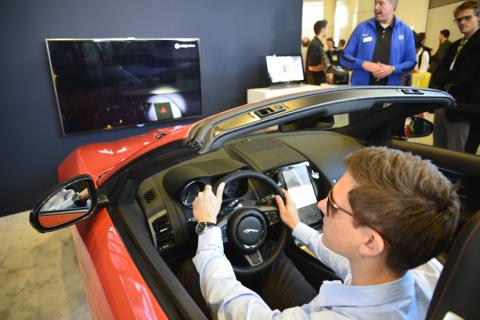
Jaguar Land Rover is working with Intel and Seeing Machines to develop sensing technology that monitors the driver's face and eyes to reduce distracted and drowsy driving. At this week’s Consumer Electronics Show in Las Vegas, Seeing Machines demonstrated its DMS driver monitor system in a Jaguar F Type prototype.
This was developed jointly with Intel at Jaguar Land Rover’s R&D facility in Portland, Oregon.
Seeing Machines develops computer vision related technologies that help machines understand people by tracking and interpreting human faces and eyes.
"The algorithm we have developed for DMS has the potential to seamlessly enable a host of safety and autonomous driving features and reduce the potential for accidents caused by the driver not paying attention,” said Nick Langdale-Smith, vice president at Seeing Machines. “DMS is unique because it is the only driver monitoring system that can achieve this even if the driver is wearing shades, or in full sunshine.”
DMS uses attention-monitoring sensors in the dashboard to detect eye and facial movements so it can identify if the driver has become inattentive, either due to drowsiness or distraction. It can understand the state of the driver in real world conditions, including bright sunlight and if the driver is wearing glasses or sunglasses.
To deliver the processing power required by the system, Seeing Machines asked Intel to install hardware in the F Type prototype based on its Core i7 chips.
“By choosing Intel chips to power their compute intensive technology, Seeing Machines will be able to offer automakers like Jaguar Land Rover an enhanced experience for their customers in the future,” said Eliott Garbus, vice president of transportation at Intel.
Wolfgang Ziebart, Jaguar Land Rover engineering director, added: "The attention-monitoring technology we are showcasing at CES has huge potential for road safety. If the driver's gaze moves towards the infotainment screen or out of a side window, and the car identifies this, then the system could alert the driver to hazards earlier. DMS could even enhance settings in safety systems like autonomous emergency braking to reflect the driver's lack of attention. As the car drives up to a hazard, the brakes could engage autonomously sooner because the car realises the driver has not seen the danger ahead.”
DMS could also help the car share information with the driver more effectively. Jaguar Land Rover is researching a next-generation heads-up display that could use the full width of the windscreen. The idea is to present the right information to the driver at the right time, without having to take their eyes off the road.
“Whether we are projecting a transparent view of the bonnet, or helping the driver to navigate by following a ghost car, it would be very useful to understand exactly when the driver's eyes aren't actually looking at the windscreen to see this information, so it can be repeated or shared in a different way," said Ziebart.
