Connectivity, safety and emissions head priorities for Seat
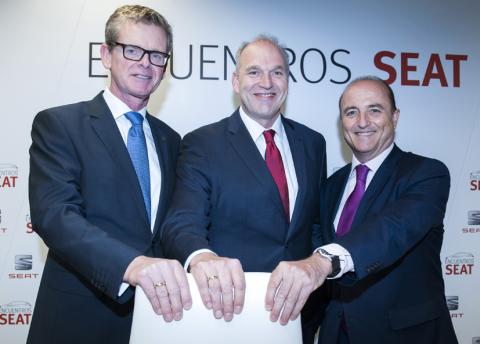
Car connectivity, enhanced active and passive safety measures, and reducing CO2 emissions are the three main priorities facing the automotive industry, according to Seat executive vice-president for R&D Matthias Rabe, speaking at the second Encuentros Seat forum this week in Madrid.
Rabe pointed out some of the achievements already made by Seat in these areas. As an example, “between 2006 and 2014 Seat lowered CO2 emissions by 21 per cent, partly due to innovations such as engine optimisation, improved aerodynamics and by producing more lightweight vehicles”. He said the company already sold vehicles fuelled by compressed natural gas and it possessed the technological know-how to promote electric vehicles as soon as market conditions were favourable.
Seat, he said, would be featuring developments in connectivity in upcoming models, and went over the latest driver assistance safety systems.
He stressed the car maker’s role in promoting innovation in the automotive sector in Spain. It designs and develops its cars in a facility at the Martorell factory site. The technical centre is celebrating its 40th anniversary this year.
“Seat is the largest industrial investor in R&D in Spain and having these facilities makes us fully prepared to address the challenges of the car of the future,” he said. In the past five years, Seat has invested more than €1400m euros in R&D.
At the forum, Seat executive committee president Jürgen Stackmann highlighted last year’s performance figures by announcing that the Martorell plant closed 2014 with a total of 442,677 vehicles produced, an increase of 13.5% over 2013. This annual growth is the fifth in a row and the highest production volume in Martorell since 2002. Furthermore, the plant also produced more vehicles than any other in Spain in 2014.
Stackmann underlined that, “thanks to the increase in production, last year we hired more than 800 temporary workers and, since January, 350 of those workers have signed permanent contracts”. He went on to say: “We are looking forward to 2015 with optimism. We are going to open more than 100 dealerships, 90 per cent of them in Europe, and our objective is to consolidate the sales growth of the last two years.”
Stackmann also stressed the importance of “an appealing and ambitious industrial policy that focuses on enhancing innovation, technology and training” and made claims for a “solid alliance among the public administrations, businesses and unions” to rise to the challenges in the automotive sector.
Also present at the round table was Miguel Sebastián, former Spanish minister for industry, tourism and commerce, who contributed with his vision for the future of the automotive industry by pointing out the need for collaboration between the public and private sectors to ensure ongoing investments in innovation.
