Geneva Motor Show Preview
IHS Automotive principal analysts Tim Urquhart and Stephanie Brinley give their analysis and commentary on the Geneva Motor Show, due to be held from 5 to 15 March 2015
Many of the launches that will debut at the Geneva Motor Show will reflect the shift from conventional passenger car body styles to SUVs and crossovers in Europe. No OEM wanting to have serious volume and share in Europe, and specifically Western Europe, can be without a SUV-C and, increasingly, SUV-B offering, many of which are taking the form of more crossover-based vehicles. Some of these crossovers are based on existing passenger car designs, although European customers increasingly want the higher driving position and perceived extra utility of such vehicles.
Along with mainstream offerings, there will be a raft of ultra-luxury and hyper-car launches at Geneva, which indicate the growth in the ultra-premium market as a result of rising levels of the global super-rich. Cost-effective compact crossover and SUVs and a proliferation of very high-end vehicles are likely to be on-going trends in the global industry going forward.
Model launches
There will be a number of important model launches at the show from mainstream OEMs aimed at boosting their presence in Europe and responding to changing consumer trends. Among the most important of these launches will be the Renault Kadjar, while the company is looking to use the model to spearhead its efforts in China, with the Kadjar being the first Renault-badged model to be built in the country. The Kadjar's styling builds on the design established by the Clio and Captur and is a noticeably more stylish proposition than the bulky and ill-proportioned Koleos – Renault's first attempt at a crossover.
Another key launch in a similar vein will be the all-new Hyundai Tucson, which will revert back to its previous name after carrying the ix35 nameplate in Europe during its current iteration. Both the original Tucson and its ix35 replacement were key in increasing Hyundai's share and presence in Europe and the new model will be a further step up in quality, equipment and styling. The new Tucson is larger in all directions and is 4475mm long, 1850mm wide, and 1645mm high, with a 2670mm wheelbase. Honda will also be present with the European debut of the firm's new H-RV. Honda last offered a vehicle in Europe with that nameplate in 2006 and the new model is a different concept to the original H-RV, which will compete in the increasingly crowded SUV-B market in the region.
The premium OEMs are also moving into this territory and Infiniti will show the concept version of its QX30 crossover, which is the key model for the brand's efforts to establish itself in Europe, which have so far been underwhelming. In advance of the show, the brand has revealed images of the QX30 Concept. According to the car maker, it "combines the sleek lines of a coupe with the distinguishing features and higher stance of a crossover" and uses the design theme "stylish protection".
It is not just the mainstream European and Asian OEMs that are looking to enter the segment; Ssangyong has announced that it is planning to use the event for international introduction of its B-SUV Tivoli, which was launched on its domestic South Korean market last month. Chinese brand Qoros will attempt to reinvigorate its efforts to make inroads in Europe with the Qoros 3 City SUV, which will be its third production vehicle. The model is a crossover based on the Qoros 3 and boasts well-proportioned, if conventional styling.
Other launches
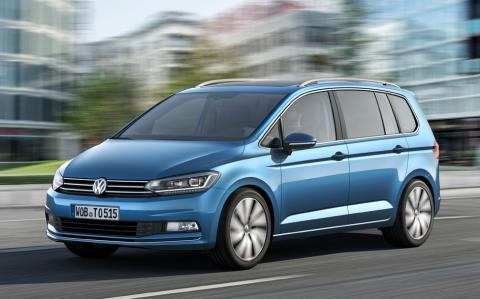
There will be a number of other key mainstream model launches at the show, including the new Volkswagen Touran. The model will replace the successful Mark 1 Touran and will be based on VW's new modular mid-sized front drive MQB vehicle architecture, which will cut as much as 100kg of the model's curb weight depending on the variant, according to media reports. Styling will be heavily influenced by the Mark 7 Golf and it is set to have a longer wheelbase than the Golf to create clear space between it and the high-roofed Golf SV. The model will be rivalled by the new BMW 2-Series Gran Tourer. The model is a seven-seater multi-purpose vehicle (MPV) that is based on the same UKL1 platform that is used on the Two Series Active Tourer, and features styling similar to the Active Tourer, with an extended rear section required to accommodate the extra row of seats.
Skoda will launch the eagerly anticipated new Superb model, which will be the third generation of the firm's flagship. According to a press statement, its wheelbase has been lengthened by 88mm, while the front overhang is shortened by 61mm, giving it a more "dynamic appearance". It will be available with eight engine variants, five direct-injection turbocharged petrol engines producing between 125 and 280hp, and three diesel engines, with will have a power output in the range of 120 and 190hp.
The star of Opel's stand at the showwill be the all-new Opel Karl, a sub-€10,000 entry that will look to expand the brand's reach and retain Chevrolet buyers, as that brand has been pulled from the Western European market. Along with the subcompact Karl, Opel will expand on the Corsa reveal of the Paris Motor Show by bringing the fifth-generation Corsa OPC. The new Opel Karl offers an inexpensive point of entry, though three trim levels will be offered. The only powertrain is Opel's new 1.0-litre Ecotec 3-cylinder petrol engine, mated to a five-speed manual transmission.
At the same time, a stalwart of the European mid-market in the shape of Ford will show a performance brand builder in the form of the Focus RS, and this time to make it a global model, with sales extending to the USA. The company teased the introduction with a web reveal earlier this month.
Outlook and implications
Many of the new models that will be launched at Geneva are further evidence of the shift in consumer tastes in the European market, with the shift from conventional hatchback and sedan body style to compact crossover and SUV body styles. The SUV-B market continues to have huge growth potential, in particular, and more and more OEMs are entering the segment, including in the future the leading European premium OEMs, with Audi set to debut its Q1 crossover next year.
The shift in market dynamics is illustrated when one looks at the evolution of B and C car segment sales in the EU28 group of countries in comparison to combined SUV-B and SUV-C sales during the same period. The combined B and C car segment sales during this period will remain relatively stable, rising from 4.7 million to 5.3 million units over the decade. However, combined SUV-B and SUV-C sales will rise from 1.1 to 3.2 million units, with both SUV-B and SUV-C adding around a million units each in the region during the decade.
There is no doubt that customers are increasingly looking for the enhanced road presence, higher driving position and perceived extra utility of such models. For OEMs, they have the advantage of being able to use, in many cases, lightly modified conventional passenger-car architecture and powertrains, for relatively low additional development costs.
At the other end of the spectrum, another trend that is set to be in evidence in Geneva is the launch of a number of high-end performance cars and ultra-luxury models from storied brands. Ferrari will debut a comprehensively re-engineered version of the 458, which will go by the 488 GTB nameplate. It will be the second turbocharged Ferrari in the current line-up, using a 3.9-litre turbocharged V-8 engine that produces 670 CV at 8000rpm and up to 760Nm at 3000rpm. It is said to be capable of accelerating from 0 to 200km/h in a scarcely credible 8.3s and reaching a top speed of over 330km/h. It will be rivalled in the super-sportscar class by the second-generation Audi R8, which will also debut at Geneva. The model will retain the same V8 and V10 powertrains as well as share its architecture with the Lamborghini Huracan. McLaren will also debut its track-only P1 GTR hyper-car, which will act as a rival to Ferrari's FXX track-based programme.
In terms of the ultra-luxury market, Mercedes-Benz will debut the Maybach Pullman, a stretched high-end variant of the S Class that is expected to sell for at least €500,000 and which will nominally be the replacement for the defunct Maybach 62 model, while Bentley will debut a coupé concept. Further model-range diversification is likely to be a growing feature of ultra-luxury and performance brands such as Ferrari, McLaren, Bentley and Rolls-Royce, as a result of the growing ranks of the global super-rich created by economic growth in, especially, the USA, China, India and the Middle East.
