IC simplifies cell balancing
A simplified and more robust method of implementing cell monitoring and balancing in lithium battery systems is available from AMS, formerly known as Austria Microsystems.
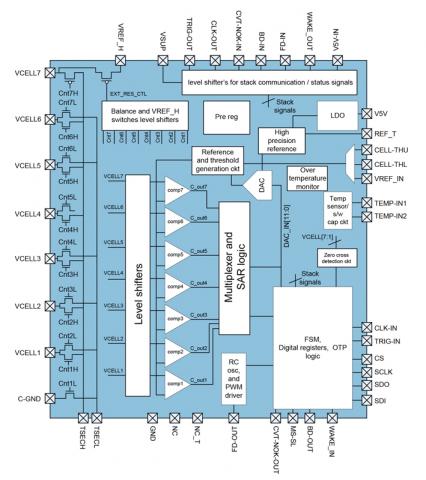
The architecture has been implemented in the AS8506 chip to perform distributed cell monitoring and balancing operations for stacked cell modules, including safe operating area checks and passive or active cell balancing. It is suitable for all lithium-based cell chemistries, such as those found in hybrid and fully electric vehicles, as well as for EDLCs, also known as supercaps or ultracaps.
In conventional systems, a complicated algorithm running remotely on a high-end microcontroller decides which cells have to be balanced. This architecture can control balancing locally at the cells, enabling designers to implement a more streamlined cell management system that eliminates the host controller, complex software and vulnerable serial communications links.
The AS8506 can implement passive and active cell balancing autonomously, or it can support a microcontroller-based system via its serial peripheral interface.
An analogue circuit in the device compares up to seven cell voltages against an internal or external reference with an accuracy of 1mV, to support cell-balancing and cell-monitoring functions. Cell voltage measurements can also be digitised with an accuracy of 5mV and reported to a host controller.
Active and passive cell balancing use a similar circuit design, but active balancing requires an additional flyback transformer. The control circuit is integrated in the device, which also has internally or external adjustable upper and lower cell voltage limits. Temperature measurement is carried out through two external NTC sensors.
