In-Vehicle Computers: From plane to train
How an in-vehicle computer originally developed for the Airbus A400M aircraft is helping train management in Australia
For rail operators, safety is a crucial factor. What has become known as functional safety has seen new technologies in electronics ensuring ever-increasing reliability and safety in trains and rail vehicles. In addition to the safety aspect, modernisation can also increase cost-effectiveness and efficiency.
Automatic train operation (ATO) and automatic train protection (ATP) play an important role in this. Automated operation has many advantages – accidents caused by human error are significantly reduced, maximum permitted speeds can be fully exploited and train frequency on the tracks can be increased.
To guarantee reliable operation, ATP systems monitor all relevant functions. Data from both systems are usually recorded in higher-level automatic train control systems in the control centre, where employees can intervene and take the appropriate action in case of an emergency.
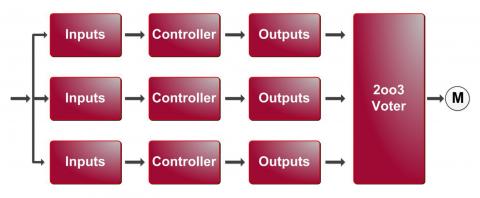
Redundant computer structures are used to guarantee the safety and availability of the systems. Different redundancy configurations can be used depending on the desired outcome. A 2oo3 or even a 2oo4 system is typically chosen by those who wish to achieve a high level of safety and availability, see diagram.
A voter is an integral part of such a complex system. It continuously compares and evaluates the calculated results. In cases of inconsistency, the voter recognises the defective CPU, but the system can continue to run with the two remaining components.
If you use a modular system, for example Compact PCI, building a structure such as this is, mechanically speaking, relatively simple – you simply triple all the cards. However, three computers also need space, have three times the power loss, and the software and the voter have to be more sophisticated.
Keeping it simple
To meet the safety standards for rail applications, such complex structures are unavoidable. However, the systems are also required to be increasingly faster, more advanced, better and more cost-effective. And so the question arises of how to achieve the same level of safety in less time and at a lower cost. The challenge is not to miss out on opportunities and to create clear advantages over existing designs using new ideas.
What would happen if everything could be a little bit more compact and if the computer didn’t have to be constructed using individual cards? If several processors were accommodated on one board? Would there then be enough space to handle overvoltage? Could overheating be a problem?
One company that has tried this is MEN Mikro. It has put three redundant processors onto a 6U Compact PCI card and a VME bus card. In addition to the three Power PC-750 processors, redundancy has been implemented for the main memory, the local power supply, the clock and the flash memory. The voter has been implemented as an IP core in an FPGA.
This requires much less power and space than three individual cards and simplifies the software. The three Power PCs work in a so-called lock step architecture. The processors behave absolutely synchronously. They constitute a single unit for the software – the redundancy is essentially invisible. Therefore, the software itself does not have to be redundant; this reduces the effort required to implement it and the development costs.
Originally developed for the Airbus A400M aircraft and therefore protected against cosmic radiation and in compliance with aviation standard DO-245, the Compact PCI version of the card is now also suitable for railway use, and was the foundation of an advanced train management system (ATMS) in Australia. The advantages provided by the ATMS include increased track use thanks to collision avoidance and therefore higher train frequency, greater schedule reliability, increased flexibility and efficiency of the rail network, cost savings thanks to lower fuel consumption, fewer instances of track-side maintenance, decreased wear of trains and, finally, an increase in safety.
The system controls vital and non-vital functions. The non-critical section is implemented with a hybrid system, configured with Compact PCI and Compact PCI-serial cards. The critical section is controlled by one or two of the threefold-redundant cards with a secure VxWorks certified operating system. As the fail-safe CPU cards were certified according to Sil 4 in their own right, time and costs were saved when certifying the whole system.
Compact and safe
After implementing most of the Compact PCI-based rail systems in 3U, it was only natural to transfer the idea of on-board redundancy to an even more compact format.
And thus followed a 3U Compact PCI Plus IO SBC, with three Intel Atom processors – but this time with twofold redundancy. While two control processors form the safe control unit, an independent IO processor takes over communications with the interfaces. Two independent supervisors check voltage, temperatures and frequencies, but also register internal errors in the relevant processor and can, like the software of every control processor, switch the card to a safe state. A discrete error-detection supervisor has also been assigned to the FGPA, which controls communications with the IO module.
With a QNX-BSP (Pikeos on request), both the hardware and software are completely certified according to Sil 4 – a corresponding certification package simplifies the process considerably for the final system.
Inspired by the opportunities posed by this compact rail computer, a concept for a complete Sil 4-certified system for safe train control was formed, and is in development.
At the same time the modular train control system (MTCS) not only claims to be another fail-safe control for dedicated applications, but also offers an open, freely configurable platform for implementing different individual functions or even controlling a whole train.
With specially developed, equally safe IO cards and a wide-range power supply unit suitable for railway use, the doubly redundant CPS card described earlier forms the heart of the MTCS. Should the system be used as part of an existing network infrastructure, a slot can be used for connecting typical railway-related Fieldbusses such as MVB, Canopen and Profinet. Communications between the units take place via real-time Ethernet and are ensured by safety protocols conforming to EN 50159 (black channel).
If the overall system including certification package for Sil 4 is not required, it is also possible to use just the fail-safe CPU cards with a certification package for hardware and/or software or similarly the fail-safe IOs.
Conclusion
The developers have understood the market requirements and have done real pioneering work to meet as many of the demands for train control systems as possible – safe, compact, flexible and therefore cost-effective – specially tailored to rail applications and thus conforming to EN-50155 and suitably robust. All aboard for a safe, modern future!
