Simulation & Modelling: Getting Real
Real-world driving conditions can be key to improving real-world fuel efficiencies, as a recent collaboration discovered
If the automotive industry is to reach EU targets for reducing carbon emissions, firms must be prepared to expand current methods for testing fuel efficiency to consider the broad spectrum of real-world driving conditions and not single legislative drive cycles.
This was the finding of a study by Loughborough University and Romax Technology. It revealed that fuel consumption in the automotive industry can differ by as much as 20 per cent when comparing real-world drive cycles to that of rig and simulated tests based on legislative drive cycles, demonstrating the significant variances that exist when it comes to fuel efficiency.
The findings are part of a three-year investigation into the factors that influence energy consumption across hybrid electric vehicles, and how real-world driving differs from legislative test cycles. The project stemmed from impending legislations from the European Union, which is setting mandatory emission reduction targets for all new cars.
This legislation is the cornerstone of the EU's strategy to improve the fuel economy of cars sold on the European market. The fleet average to be achieved by all new cars is 130g of CO2 per km by 2015, and 95g/km by 2021, phased in from 2020. Manufacturers failing to comply face fines of €95 for every gram over target per vehicle. The commission's impact assessment states the 95g CO2/km limit would save European drivers approximately €25bn a year in fuel costs. This is putting strain on automotive manufacturers and in light of pressures from the EU, car makers need to make better use of the data streams available to them.
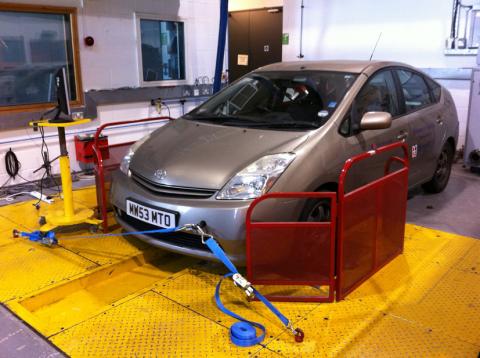
This particular project was carried out by Matthew Lintern, a PhD research student with a degree in automotive engineering at Loughborough University. Romax and the Engineering & Physical Sciences Research Council (EPSRC) jointly funded the project. Using a Toyota Prius test vehicle, with GPS data logging capability, the car journey data were used to develop urban drive cycles to represent the usage patterns of the car. These were used to carry out repeatable testing on a chassis dynamometer, and to run vehicle simulations over the same drive cycles. Comparisons were made between testing in laboratory conditions and in the real world, and also with the simulation results.
The results revealed that the fuel consumption on real-world cycle tests was 20 per cent higher than on the standard European ECE-15 urban drive cycles. Additionally, real-world on-road driving fuel consumption was over 20 per cent higher than in tests on the equivalent real-world cycle on the chassis dynamometer. The most significant factor in this was determined to be the use of climate control auxiliaries and associated ambient temperatures. In comparing dynamometer test results to those simulated, the research focussed on the vehicle’s battery degradation by carrying out laboratory testing of the high voltage battery pack, which was found to have a noticeable influence.
Barry James, head of R&D at Romax, said the joint project demonstrated Romax’s commitment to driving innovation.
“R&D is core to our business model,” he said. “Every year we aim to make a significant year-on-year investment into driving industry innovation. Reducing carbon emissions is a big strain facing the automotive industry, and in light of this it is imperative that we work with partners in academia and industry to explore all relevant avenues for fuel efficiency improvements.”
He said that traditional design tools used by manufacturers tended to focus on efficiency against a single drive cycle.
“They don’t account for the robustness of a vehicle’s performance against a set of drive cycles or against external factors such as locational influence,” he said. “Tests are carried out in a very regimented environment and rarely account for outside influences and, as a result, the data achieved from this are rarely put to effective use. The work with Matthew Lintern and Loughborough University sought to address this very issue and we are thrilled with the results.”
Rui Chen, professor of low carbon engineering at Loughborough University, added: “For car makers to take those first steps in becoming compliant with impending new fuel efficiency targets, it is important they are able to maximise new data streams, that ultimately provide us with information needed to get a clearer picture of real-world drive cycles. Matthew’s project addresses this very issue, providing the necessary information to make calculated assessments on where fuel efficiencies can be made. Our relationship with Romax provided us with the expert advice needed to ensure that this became a reality.”
Founded in 1989, Romax provides software and services for the design, analysis and optimisation of transmissions and drivelines for the automotive, bearings, wind energy, off road, rail, marine and aerospace sectors. It is headquartered in Nottingham, UK, and operates through 12 offices globally.
