Live and kicking
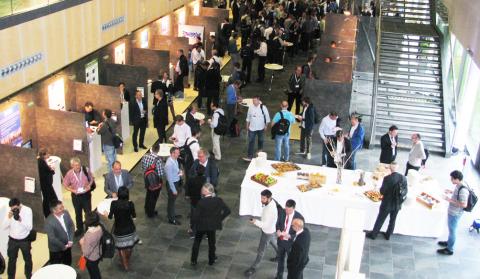
Steve Rogerson reports from CDN Live in Munich in April 2015
There are three major trends driving the automotive industry – economically friendly cars, adas and the move towards autonomous driving, and creating a seamless consumer electronics experience. This was the message from Lars Reger, NXP’s vice president in charge of automotive, in his keynote speech to Cadence’s CDN Live user conference last month in Munich.
“Cars are getting more and more like robots on wheels,” he told the delegates. “But within 30 seconds of a car moving, the driver is thinking about what to do next, whether to call someone or listen to something. The driver wants to use more driver assistance systems to avoid actually driving.”
NXP, he said, was already number one in car entertainment and the company’s proposed takeover of Freescale would position the merged company as the new major force in automotive semiconductors.
“Freescale has an almost 100 per cent complementary platform in automotive to us,” he said. “That is why we intend to merge.”
Within a vehicle, he said the wiring harness provided the biggest challenge for designers. It is the second heaviest component after the engine block and that can only be brought down by reducing the amount of copper cable.
“We are looking at what parts of this network can become wireless,” he said. “Ethernet is coming into the car because we want to adopt something that has been used in other industries. One problem is that Ethernet has four wires so we need to do this over normal twisted pair cable.”
For Cadence, the increased use of semiconductor technology has meant that the importance of automotive is increasing.
“A lot of our growth is in automotive,” said Anirudh Devgan, Cadence’s senior vice president, in his keynote speech. “There is a lot of momentum in automotive.”
One cause of this is infotainment. This has forced the automotive industry to change the way it operates as it tries to keep pace with the fast changing consumer market.
“Infotainment runs at a much faster pace than engine systems because you need to connect with the latest mobile devices,” said Robert Schweiger, Cadence’s director of automotive technology. “People want to bring their own devices into the car.”
As to the move towards autonomous driving, he said: “That is a big driver for the car industry. The move from semi-autonomous to full is creating more adas applications.”
And bringing all that together is the increased connectivity both within the car and with other cars and the infrastructure.
“These are all linked together,” said Schweiger. “The adas in one car can connect to another car and the information it receives is displayed on the infotainment screen.”
The underlying hardware to support all these features is seeing much tighter integration. ECUs are being combined into SiPs or SoCs.
“These have several advantages,” he said. “For one, it produces better IP protection because you can’t look into the chip and see what is what. They also have less weight and consume less power. And it is smaller, and that is very important for OEMs. There is limited space to put additional ECUs into a car.”
From 2012 to 2015, the computing power in a car has tripled, and Schweiger believes this rate of change will increase over the next couple of years. Traditional microcontrollers though are running out of steam – they are not fast enough for adas applications. This is driving the move to multi-core CPUs and DSPs acting as a coprocessor to get the increased performance.
Networks
Network bandwidth is also increasing in the car, and Schweiger believes that means that Automotive Ethernet will become the standard for communications within a car as speeds moves from 100Mbit/s to 1Gbit/s.
“Automotive Ethernet is the biggest change in the architecture of cars,” he said. “The main car network will still be a Can bus but it is not sufficient for the high data rates for things like cameras and radar. All the infotainment vendors are updating their systems to Ethernet.”
This he believes will lead to the decline of alternative network standards such as Most.
“Most will not go away completely,” he said. “But if you go to the annual Most conference, there is a decline in attendees, which shows the trend. Most is proprietary whereas Ethernet has an IEEE standard behind it and that fosters a culture of multiple suppliers. With a proprietary system, you need to license it and pay for it. That is why Ethernet will be successful. Ethernet is even well known among students. There is a complete ecosystem.”
Semiconductors
The volume of semiconductors in a car is massive. There are between 6000 to 8000 semiconductors per car and Volkswagen alone ships ten million cars a year.
“The volume of chips that goes into cars is heavily increasing,” said Schweiger, “ so you have to use advanced process technologies. The chip makers can integrate a lot of stuff in a chip, but this means that system design and verification have to be done in a very different way.”
For a start, technology is needed to simulate a system before the hardware is available. This involves testing the software on virtual processors or FPGAs. The problem, said Schweiger, is that while the chip vendors were using this technology within the car industry itself the tier ones and OEMs were not, and that he said had to change.
“That has to change and that will change,” he said. “Only the OEMs know the whole system of the car. So, if you want to combine technologies you need to define how the architecture will look, so they need to get more involved in the architecture.”
Also within a car there are specific IP and requirements that are needed, such as defined by ISO 26262 for functional safety.
“We have developed a functional safety simulator to support this,” he said. “There are specific requirements for the automotive vertical market segment.”
So why does IP matter for tier ones and OEMs? Schweiger believes there are a number of reasons. First, is that 90 per cent of innovations within a car are enabled by electronics. IP enables the features that the end customer can experience.
“IP vendors deliver to the semiconductor makers who deliver to the tier ones who deliver to the OEMs who deliver to the customers,” said Schweiger. “But the customers look at the options, so can opt for a feature enabled by the IP and that can be ordered by the end customer. So the OEMs need to define this IP. But you don’t want to overdesign because that increases cost.”
This means the hardware needs to be configured to match the requested software. Once the software is defined, then the EDA scripts and RTL can be generated to make the chips.
“It is not so easy to get the OEMs to see this,” he said. “Some are more open to this methodology. But others? Time will tell. But it is a clear trend.”
Security
Security is another issue the automotive industry is having to grapple with, especially with the increased communications within a car and externally for vehicle-to-infrastructure networks.
“You have to trust that the messages that a car is sending are real messages,” said Reger. “You could with V2X re-programme your car so it appears as an ambulance and then all the traffic lights go green. Or you could programme it to say there is an accident outside your house so all the traffic would go away.”
The answer, he said, was to take the security methods that existed with credit and bank cards and use them in automotive.
Conclusion
As the automotive industry continues its trend to use more electronics and more software, the pressure on the designers of these systems increases. This means new techniques will have to be developed and the OEMs will have to play a greater role in the development of even the basic components.
