Simulation & Modelling: New direction
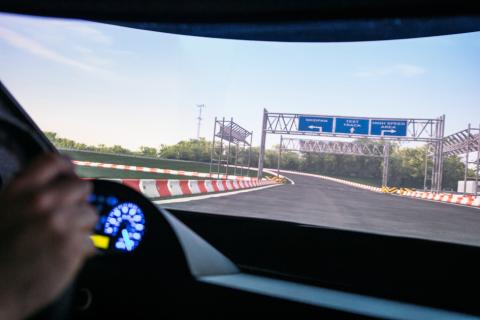
Phil Morse from Ansible Motion explains how driver-in-the-loop simulators have evolved into a serious engineering tool
Driver-in-the-loop (DIL) simulation has long been regarded as an effective tool for vehicle and component development but it’s fair to say that not all engineers have completely embraced the virtual world. For example, those who have experienced motion sickness and the phenomenon called simulator adaptation syndrome (SAS) may harbour a general distrust of DIL technologies.
Now, a very different, emergent approach to DIL simulation, with more emphasis on the human element, is starting to attract enough of a following that DIL simulation is earning a trusted position as a vehicle development tool.
Develop for driver
The ultimate design goal of any vehicle is to satisfy the driver for whom the vehicle is being designed. The driver, being an individual embodiment of a particular market segment, might seek a luxurious and comfortable experience or simply pure performance. As the driver himself or herself is an inseparable part of the vehicle experience, real-time physical and subjective feedback is crucial when developing any car. This has led to the increased use of DIL simulators over the past decades, often complementing or replacing traditional proving ground vehicle tests. DIL simulators can be defined in standard electronic terms as a closed loop feedback system, where the controller (the human driver) closes the loop on a plant (a vehicle physics model).
Stimulate to simulate
To control a virtual vehicle properly, a driver must be informed of its behaviour at every moment in time so as to react appropriately to situations by steering, braking and so on.
Sophisticated and expensive DIL simulators have thus evolved that try to replicate real driving experiences. Unfortunately, many of these simulators fail to engage properly the highly skilled drivers who are such a critical part of vehicle developments. Since skilled drivers have such refined expectations of what real cars feel like, industrial DIL simulators can inadvertently induce motion sickness. In part because they are heavy, large and slow, often relying upon legacy technology from the aviation industry such as hexapod motion machinery and cinema-level image generation.
Interestingly, engaging skilled drivers in a DIL simulation does not require the exact replication of a real vehicle’s physical movements and accelerations, nor does it require the massive motion machinery and dome-style graphics that one might associate with legacy simulators.
In fact, rather than stimulating muscle memory or the like, it is the mental engagement of a driver that needs to reach a high level to trick both the brain and body into thinking that they are experiencing the sensations required for sensible control of a real vehicle. For these necessary perceptions of spatial orientation, movement and world-space to be achieved, the human vestibular system needs to be effectively convinced by carefully co-ordinated cues.
Human factor
The human vestibular system is essentially a miniature organic six-degree-of-freedom gyroscope in the inner ear. It detects accelerations in the vertical, lateral and longitudinal directions as well as yaw, pitch and roll. During any movement, this information is transmitted to the brain via nerve impulses. The vestibular system needs to believe that it is moving and spatially oriented in a sensible way.
Understanding this in relation to vehicle dynamics, engineers can ensure accurate motion cues are achieved in a DIL simulator, thus stimulating the driver’s vestibular system into the necessary realm of perception. In the aforementioned emergent class of DIL simulators, the sensory cues that are needed to stimulate the vestibular system are translated from mathematical models, which are integrated directly into the simulator’s motion control systems.
Travel sick
Correct stimulation of the driver’s primary senses not only improves the realism of a DIL simulator for the benefit of driver feedback systems and interaction, but it also addresses head-on the elimination of unwanted side effects such as motion sickness, which has perhaps been the main criticism of simulator technologies to date.
Drivers experience motion sickness when, for example, there is an asynchronicity between visual cues and vestibular cues, which results in confusion and disorientation. Experienced drivers are particularly susceptible to this phenomenon as their expectations are highly refined and can therefore be more easily disturbed.
Eradicating motion sickness resulting from simulator usage is linked to the brain’s perceptions. Motion sickness is a result of expectation conflict; the brain’s failure to accept as real the virtual environment in which it has been placed. A proper DIL simulator has to make a driver believe he or she is engaging an actual car on an actual road. This involves playing tricks on multiple human senses responsible for optical (vision), haptic (touch), audio (sound) and vestibular (movement) reckoning.
Engineering class
Experience demonstrates that the some of the most important motion cues for the driver of a ground vehicle are those related to maintaining directional control – that is lateral and longitudinal motions along with yaw rotations. As such, it became clear to forward-thinking DIL simulator manufacturers that to deliver the motion and vestibular cueing required in the automotive sector, the traditional hexapod-based motion architecture needed to be replaced. Their resultant concept, one that is finding favour with OEMs, is a six degree of freedom stratiform machine that emphasises ground plane movements – horizontally, longitudinally and rotationally – while still pivoting on the three additional axes. To represent the driver’s immediate surroundings and tactile experiences, a low mass vehicle cabin is mounted directly to the machine, and drivers view the world as projected and blended images on large screens out beyond the eyes’ perception of infinity.
Further enhancements offer a more immersive experience, examples being various in-cockpit tensioning motors that amplify the sensation of acceleration and deceleration for the driver, and high performance image generation and refresh rates.
All the characteristics add up to fully integrated DIL simulators that are truly suitable for vehicle development work, and are thus termed engineering-class simulators. Such simulators can achieve a correlation of over 80 per cent with acquired key data traces of actual vehicles during ride and handling tests – providing an excellent laboratory tool for the automotive sector, one that allows real drivers to interact with imagined vehicles, components and roadways.
Cost and time
The emergence of engineering-class DIL simulators is enabling automotive OEMs to perform virtual test drives of anything from chassis fundamentals to advanced driver interactive systems. What once took ten days of in-car testing for a prototype subsystem such as electronic stability control can now be completed within three days as the required test matrices for performance tuning and failsafe testing are reduced to the thirty-odd parameter sets that require physical verification.
The recent advances in system responsiveness and latency now mean these DIL simulators can also be used to validate vehicle responses to monitor and explore unpredictable situations. This has opened the doors for OEMs to test active safety systems as well as develop sophisticated systems for semi-autonomous vehicles.
Now, DIL simulators have evolved into to being the comprehensive and advanced engineering tools for ground vehicles that they were always intended to be, providing a useful and practical testing platform for vehicles and components alike.
Phil Morse is technical liaison manager at Ansible Motion
