Video decoder suits rear camera displays
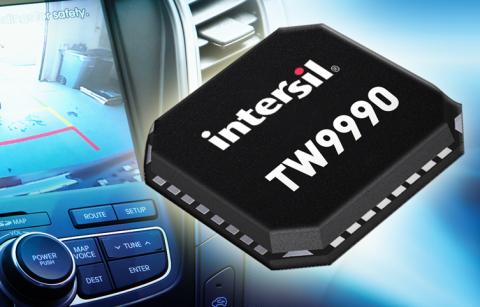
An integrated analogue video decoder that eliminates the need for external op amps while enabling performance advantages through programmable short-to-battery and short-to-ground detection has been introduced by Intersil. The TW9990 video decoder is suitable for automotive rear camera displays and other camera systems.
Automotive rear camera displays have become a popular driver safety feature. According to Edmunds market research, 70% of 2012 vehicles were outfitted with rear cameras. Also, market research firm ISuppli reports that nine in ten new cars have console screens as an option.
The quality of the video – along with the cost and footprint of the camera system – are critical factors when adding this safety feature to new vehicles.
The low power analogue video decoder supports NTSC, Pal and Secam single-ended, differential and pseudo differential composite video inputs as well as S-Video. A single 27MHz crystal is all that is needed to decode all analogue video standards.
Typical power consumption is about 100mW for composite inputs. A power-down mode further reduces consumption.
Most automotive analogue cameras are cabled as differential twisted pair to reduce common mode noise. Traditional analogue video decoders only support single-ended inputs, meaning automotive system designers must place a video op amp in front of the decoder to convert differential signals to single-ended.
The TW9990 eliminates the need for the external op amp as it supports differential composite video signals directly, and has built-in programmable short-to-battery and short-to-ground detection. This is an essential functionality required by OEMs when supporting a differential signal input.
AEC-Q100 grade two qualified, it comes in a 32-lead 5 by 5mm WFQFN in bulk tray packaging.
