Mentor Automotive Forum: Coming together
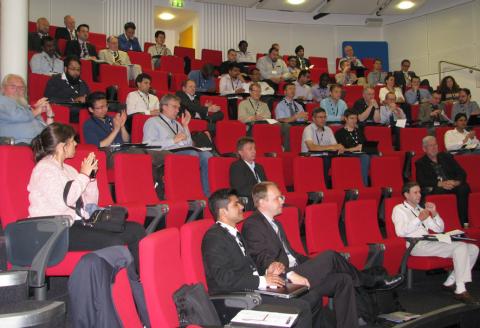
Different domains in modern vehicles must come together to meet customer demands, was the clear message from June’s Mentor Automotive Forum, as Steve Rogerson discovered
The software content of a modern vehicle has become a big part of the decision-making process when buying a new car. Consumer expectations are rising as they see other electronic products updated every year. This was the view from Nigel Hughes, product marketing manager for Mentor Graphics, as he opened the company’s automotive forum at the University of Warwick in Coventry, UK.
“It is a lot less ‘here’s the car, where’s the customer’ and more ‘here is the customer and where is the car to satisfy them’,” he said. “All the domains must be brought together to keep pace with the customer expectations of modern vehicles.”
The level of complexity this involves was aptly illustrated by Gunwant Dhadyalla, principal engineer at the University of Warwick, who pointed out that a premium car today could have 100 million lines of code, compared with just 6.5 million on a Boeing 787. And that 80 to 90 per cent of vehicle innovations come via the electrical and software systems. A half to two-thirds of R&D costs for embedded systems are software related as are 40 per cent of production costs.
“Yet we cannot deliver systems to the customer if they are not dependable,” he said. “As we move to connected and autonomous vehicles, ISO26262 has to be revised and reassessed as to how we deal with functional safety.”
But he said that when designing modern vehicles, the human-machine interface and the way humans behaved in a vehicle were important elements.
“The interaction between the human and the vehicle is critical,” he said. “You can’t divorce the two.”
Ahsan Shamin, field project engineer at Mentor Graphics, also acknowledged the growing complexity.
“The electronics and electrical systems will need to address the challenges of complexity if we are going to reduce time to market and reduce the costs,” he said. “But we don’t want to compromise on quality.”
Electrical systems are also the third most popular reason for a recall, behind seatbelts and speed control, and are involved in some of the other reasons.
“The complexity in vehicles is going out of control,” said Alec Sinclair, lead engineer at Tata Motors’ European technical centre. “Every time you add a new feature, you double the complexity.”
He said there was constant pressure to increase quality levels but also to be closer to the customer.
“You need to be more flexible to bring in changes when you need to,” he said.
Shamim proposed using variants to focus on reusable components and build scalable architectures.
“A luxury car could use the same ECUs and platform as a compact car,” he said. “Some of the basic features will be the same.”
One way to consolidate the different domains, said Martin Wennberg, transportation applications engineer at Mentor Graphics, was to use a reference platform.
“The trends in automotive,” he said, “were to reduce costs, increase performance and quality, increase safety with reference to ISO26262, and shrink the time to market. But what is consolidation? In a vehicle, there are different functions with different networks. The idea of consolidation is to put the different domains in the same box.”
The problem has arisen because of disconnected development and design, said Thomas Heurung, technical manager at Mentor Graphics.
“It is important to change that so you don’t keep building up and building up,” he said. “Being data driven is the key aspect to eliminate the tsunami and produce a small wave that hopefully we can ride.”
He said that platform level engineering was the way to connect the domains as elegantly as possible.
“It is possible to move to a functional-centric universe,” he said. “This is what is needed to optimise the whole system. This lets you make educated designs rather than designs based on gut feelings. The key aspect is digital continuity from function to implementation across domains and with design automation.”
Hughes added: “Platform level engineering lets you correct mistakes as they are introduced. It fundamentally changes the game. And a data-centric flow is critical to stop these errors creeping back in during the flow.”
Domains
The four domains considered at the conference for consolidation were in-vehicle infotainment (IVI), driver information, adas and the ECUs.
Infotainment combines audio and video but with no real safety implications.
“The kids may be upset if their game is lagging, but that doesn’t create a safety problem,” said Wennberg. “But with driver information, there is a safety issue. Warning lamps can’t fail. Adas is the new area; everybody is talking about it and there are demands for performance and safety. The ECU domain is the focus for all the domains. Autosar links it together, but there are mixed topologies with Can, Lin, Flexray, Ethernet and so on.”
With infotainment, the human-machine interface is normally controlled by the car manufacturer. The applications are usually a combination between the OEM and the tier-one suppliers. The third segment is the embedded software platform,
“This is where Mentor Graphics operates,” said Wennberg. “This is the tier-two segment. The fourth segment is the SoC choice.”
But the infotainment and driver information segments are already merging.
“We are moving more towards a complete graphical environment,” he said. “The set up for the instrument cluster is very similar to what we see for infotainment. The difference is the safety requirements.”
On adas, the focus is on active safety. “This is a very hot topic at the moment and does impact safety requirements very much,” he said.
He said the different domains would, in the future, be connected by Autosar. “There are a lot of benefits,” he said. Autosar can manage complexity, simplify integration, allow design reuse, provide functional safety certification, aid maintenance throughout the vehicle life, automate design, and provide supply chain efficiency.
“Complex in-car systems need to communicate efficiently,” he said. “There is a plethora of buses with different bandwidth requirements. Less hardware means less cost. With the new, powerful SoCs, we believe Autosar is the platform we can use to bring it all together. But, of course, there are challenges.”
The first of these is safety related. Putting different domains into one ECU means combining different safety requirements and managing inter-domain communications. Sharing the software and hardware resources can be quite complicated.
“One way to resolve this is to use a multi-core SoC,” he said. “You can, say, divide it into two cores where one has the safety class function and the other is the non-safety-critical side. And you combine these into a safe graphics driver.”
There are also different ways of adding Autosar to the different domains. It could be bare metal on a separate core, but connections would be needed. Another would be to use a hypervisor to share resources. Or the Autosar could be run by Linux. The downside is that the start-up time would be a little longer, which makes it not suitable in many cases.
And Shamim added: “Autosar is one of the standards that specifies how to handle variants.”
Networks
The move within automotive to Ethernet as the main communications network is gaining traction. Its speed of 100Mbit/s scores much better than Can’s 2Mbit/s or Flexray’s 10Mbit/s, which are not enough for many modern communications needs within a vehicle.
“The bandwidth of Ethernet can be achieved at a reasonable price,” said Tibor Kovacs, automotive network designer at Mentor Graphics. “It is more expensive than Can and Flexray but it is much faster. And the speed of Ethernet will be extended.”
Apart from providing a high bandwidth at a moderate cost, protocols are available out of the box and it is easy to connect to external networks and consumer devices. There is also a lot of industry knowhow.
Can and Flexray use shared communications channels whereas Ethernet uses a switched channel. The scalability with Ethernet is also very good. Can and Flexray have a static configuration whereas Ethernet can be static or dynamic. The message size with Ethernet can be big rather than small or medium with Can and Flexray.
“Analysis with Ethernet is more complex,” said Kovacs. “It is not as simple as with Can. Ethernet can be used for connecting multiple domains. Ethernet is an emerging, cost efficient but complex technology. There is hardware, software and tool support available. Everything is ready to start working with Ethernet.”
One possible challenge though is Most at 150Mbit/s, and it is designed for automotive. But Kovacs does not see it as a threat to Ethernet.
“I see Most as fading out,” he said. “It is expensive and I think it has reached its limits. It is not as easy to deploy in the car. And Ethernet has the potential to become faster.”
Changes
During the design process there are always going to be changes, but the trick is to manage these changes. The earlier in the design process, the easier it is to make changes, but systems should be in place to handle late changes.
“At the start, there is a high degree of flexibility and you can change the design as you want,” said Chris Shaw, applications engineer at Mentor Graphics. “But as more is added to the design, that flexibility goes away; it become harder to make changes and it costs more. Late changes can also lead to mistakes being made. Fixing those mistakes can have a huge effect on cost.”
Hughes added: “The cost of solving a problem is about 30 times more if found at the recall stage rather than early in the design cycle. It also gives you a poor reputation for quality in the market.”
Changes, though, said Shaw, were inevitable.
“All the processes you put in place are not going to stop changes happening,” he said. “The answer is to put a process in place that manages the changes.”
Here, feedback is important. It must be quick and automatic to let the engineers understand the different cause and effect mechanisms.
“Feedback must be focussed,” he said. “And it must be right there, not on a different computer, so the engineer can focus on the task in hand without breaking the thought process.”
Finally, the feedback must be flexible and presented in a natural way with tables and graphs that best inform the engineer.
Though simulation sounded an obvious route to solving problems early, typically, said Hughes, there were a small number of simulation experts and lots of people throwing data at them. But tools such as design rule checkers, he said, were a “great way” of catching errors as they were made.
Conclusion
Though technologies such as simulation and analysis can help engineers optimise a system, they are not the whole story. And while design rule checks help catch errors early, to eliminate errors a correct-by-construction process is required.
“This frees humans to innovate,” said Hughes. “A data-centric flow is essential for keeping errors out.”
