Digia aims to make user interface designing easier
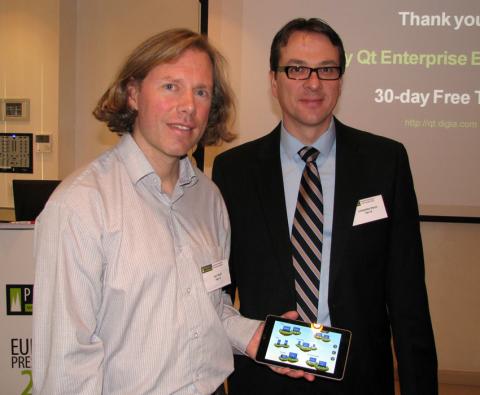
Designing user interfaces on embedded devices could be made easier thanks to Qt Enterprise Embedded, the latest version of Digia’s software development platform.
“The challenge in embedded is not longer about hardware,” said Digia’s CTO Lars Knoll. “The challenge is about the user interface. You want something that looks as cool as the IPhone or Android tablets.”
Able to work with Android or embedded Linux, it contains all the tools needed for fast, easy, fully-integrated embedded device application development, allowing users to get up and running and focussed on writing their own application from day one.
“You can get up and running with the embedded device in less than a day,” said Knoll. “It lets you build advanced user interfaces faster. It is very intuitive.”
Qt Enterprise Embedded comprises two main parts: a development environment and a software stack, called Boot to Qt. The self-contained development environment is installed and updated through a single online installer and features a full Qt Creator IDE.
Development is done with Qt Enterprise libraries and device deployment can be achieved with one click directly from Qt Creator to a target connected via USB or network. Alternatively, the application can be deployed to an emulator on the host system that is running the same software stack as the target device.
“It makes it fun to develop,” said Knoll. “Developers really like using it.”
The Boot to Qt software stack is a lightweight, Qt-optimised, full software stack that is installed on the target hardware. Installation is accomplished by copying a pre-built image from the development environment on to the target device’s memory card or directly to the device’s internal memory.
The embedded Android variant, which is based on the Android kernel and selected middleware, is a lean software stack where Qt/QML replaces the entire top Java layer including graphics and the Dalvik VM. It also has the Zygote process layer and Android home screen removed, enabling better customisation of the device’s user experience. The embedded Linux stack uses the traditional Linux kernel and is built using the Yocto Poky reference system.
Qt’s ability to deliver impressive graphics is enhanced by the use of Open GL ES 2.0, the version of the graphics application programming interface designed specifically for embedded systems and mobile devices. This makes it easier to develop and deploy rich graphics with velvet-like animations and transitions as well as smoothly rendered 2D and 3D animations on devices with relatively limited performance. In addition to the versatile cross-platform Qt APIs, applications built with Qt can also use platform and device-specific APIs directly, giving the developer the freedom to integrate any functionality their application requires.
The Qt Enterprise Embedded development environment runs on Ubuntu Linux 64bit 12.04 LTS or later. Target hardware supported as standard at time of launch includes: Google Nexus 7 tablet (Tegra 3, Arm Cortex A9); Beagle Board xM (Arm Cortex A8); boundary devices Sabrelite (Freescale i.MX 6); Raspberry Pi Model B (Arm 11); and Beaglebone Black (TI AM335x). Digia is also able to port the software stack to custom hardware.
The company sees automotive dashboard user interfaces as a key market.
“If you buy a €40,000 BMW and the touchscreen is slow and crappy, it destroys the value of the whole car,” said Juhapekka Niemi, Digia’s vice president of sales and marketing.
