Wireless: Too close for comfort
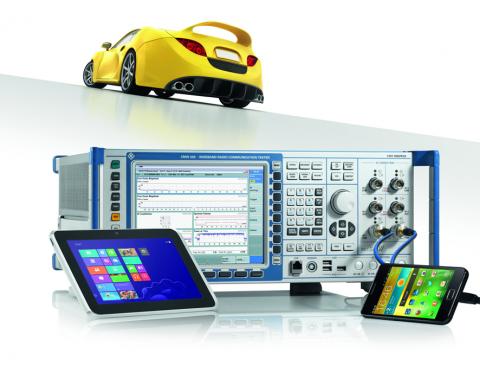
Christoph Wagner from Rohde & Schwarz explains how to prevent interference when different wireless standards coexist within the same vehicle
More and more of today's cars include infotainment systems that allow occupants to communicate with the outside world. Good reception in cars is ensured by an increasing number of transmit and receive antennas from various radio systems located close to one another. However, mutual interference is an inherent risk with this type of in-car coexistence, and that must be prevented during development.
According to a study by Accenture, more than 48 per cent of car buyers today are more interested in electronic features such as driving assistance and infotainment than they are in driving performance. Traditional car manufacturers have long had a presence in Silicon Valley as they worked towards early adoption of intelligent, networked mobility, with a view towards enticing especially young buyers into an automobile purchase. The melding of automobile and modern information technology into a smart car is no longer a vision for the future, but rather is now a reality on our roads.
An important function of the smart car is the ability to connect smartphones wirelessly to the vehicle infotainment system using non-cellular wireless technologies such as wlan or Bluetooth. This connection is used to sync data from a mobile phone – such as contacts and music – with the on-board unit so it is available to the car occupants while driving.
Car manufacturers offer integrated wlan hotspots for connecting smartphones and tablets to the internet. Cellular standards such as WCDMA and LTE can be used to establish a connection to the mobile radio network. The Bluetooth standard is operated in the licence-free ISM band from 2.402 to 2.480GHz. For the wlan standard, country-specific frequencies are available within the 2.4 and 5GHz bands. The use of multiple wireless communications standards such as LTE, wlan and Bluetooth in parallel is known as coexistence. Leakage into adjacent channels can lead to quality problems, a reduction in data rates or even to a complete failure.
Tight spaces
Simultaneous collocation of various radio systems is a longstanding issue that is regulated by international frequency plans and technical specifications. What is new, however, is these systems must now both transmit and receive in extremely close proximity.
The primary independent standardisation bodies working on this topic are the Third Generation Partnership Project (3GPP) for cellular standards and the Wifi Alliance for the wlan standard. These groups specify, among others, limits for RF leakage into other frequency ranges, which are defined by the adjacent channel leakage power ratio (ACLR), for example.
This parameter specifies the ratio between the transmit power of the wanted signal and the lowest possible power that is leaked into the adjacent channel. Another important parameter when verifying radio standards is the spectrum emission mask (SEM). This parameter uses tolerance characteristics to describe the permissible signal level versus time both inside and outside the transmission band allocated to a standard to limit the interference in the adjacent channels and in other frequency bands.
The passenger compartment in a car poses a particular challenge for developers because of the increasing number of transmit and receive antennas that are collocated in very close proximity in a mostly shielded space. An additional consideration is the associated reflections. A transmit signal will always affect other systems more here than it would in an open area or a larger space. This is particularly problematic because the described non-cellular standards are operated in frequency bands that lie very close to one another. The LTE standard will also fall within this range depending on which frequency bands are used.
For example, LTE time division duplex (TDD) band 40 lies only 1MHz below and the LTE frequency division duplex (FDD) band 7 uplink only 17MHz above the 2.4GHz wlan band.
As a result, transmit signals can show up as interference in adjacent receivers and cause overdrive, making it impossible to receive wanted signals. The use of the various LTE bands varies by country and network operator and, because there is no way to predict when or where a car might pass into an area serviced by a different band, developers must take all possible scenarios into account to ensure interference-free operation. And the list of potential interferers is expanding, as the satellite-based navigation systems (GNSS) such as GPS, Glonass and Galileo found in vehicles can also be impaired by LTE bands 7, 13 and 14.
Digital dividend
To address the need for additional frequencies for mobile internet access, in 2009 the International Telecommunications Union (ITU) released the 800MHz band for mobile radio applications, followed this year by the 700MHz band (digital dividend two) which previously had been reserved exclusively for broadcasting. This means car radios and entertainment systems that receive terrestrial TV signals can be impaired by mobile radio signals. As a result, it is essential that developers include all broadcasting signals in any comprehensive test scenario.
There are several possible approaches for improving the reception quality in automobiles. Physically distancing the transmitter from the receiver, that is decoupling the antennas, is not practicable because the lack of space is at the root of the problem in the first place. The usual RF shielding methods are likewise not sufficient to resolve the problem. On the other hand, it is possible to use additional bandpass filters on the transmit antennas for wlan and Bluetooth to reduce RF leakage into the at-risk LTE bands.
The transmit powers of the individual applications can be reduced as a result of the limited space, thus also reducing any possible unwanted emissions. In the case of non-cellular standards, this can be implemented on an individual basis. This is not an option for cellular standards, however, because the transmit power is controlled by the base station.
The essential difference between wlan and Bluetooth – besides the range – is that wlan uses fixed frequencies while Bluetooth employs frequency hopping. The Bluetooth signal switches randomly between 40 possible channels in a 2MHz grid (BT4.0) up to 1600 times per second. This prevents the signal from permanently affecting a fixed wlan signal in the 2.4GHz band.
The reception quality within the vehicle can be further improved both in the frequency and the time domain. The highly integrated computer chips found in today's infotainment systems incorporate the various standards. The frequencies to be used for the various applications are already known in the baseband of this chip. This means that a black list can be defined for the Bluetooth signal's frequency hops, listing the channels that could be impaired by an LTE signal and therefore should be avoided. This process is known as adaptive frequency hopping.
To prevent impairment of GNSS signals by LTE, it makes sense to employ early detection of data transmissions in the time domain. For example, if an LTE chip is aware that a GNSS packet with a length of 20ms will be transmitted, the chip can interrupt its own activity for, say, 15ms so as not to disrupt the entire transmission, while keeping the interruption short enough that it is not perceived by the subscriber.
The receive quality of audio and video systems in cars can be improved by using flexible diversity reception. The signal is received and assessed by up to three RF tuners, with only the best signal being processed. An additional antenna (three-plus-one principle) is used to monitor the frequency spectrum. This antenna gathers information about possible interference as well as improved reception on other frequencies, which it then passes on to the other receivers so they can switch frequencies.
Uninterrupted detection
A spectrum analyser can be used to capture and display the parameters of unwanted signals in the frequency domain. This information can be used to determine the origin and type of unwanted signal. In practice, these signals can also be very brief in duration while having the same effect.
This is why a real-time spectrum analyser is often used. Such instruments measure continuously in real-time operation, thus capturing every event for analysis, no matter how brief. Spectrogram mode is especially suited to verifying the frequency hopping of Bluetooth signals, as it depicts how the signal's spectrum fluctuates versus time. This provides a good overview of the signal behaviour and allows assessment even for brief signal impairments. Only additional testing can determine the extent to which the individual radio systems are impaired.
Receiver sensitivity
Coexistence measurements are used to determine the degree of desensitisation, that is the decrease in receiver sensitivity as a result of strong RF leakage in an adjacent signal. An important assessment criterion in determining the sensitivity of a receiver is the bit error rate (BER).
The device to be tested receives a certain number of bits within a defined time frame, which are then compared against a reference signal. For wlan and Bluetooth, this is known as the packet error rate (PER) and for LTE it is the block error rate (BLER). With this measurement, the error rate can be seen to increase below a certain receive level. If an additional unwanted signal is received at the receiver input, the curve slowly shifts to the left. The sensitivity of the receiver decreases dramatically.
Multi-standard-capable radio communications testers are especially suited to coexistence measurements. These can provide a test platform that can measure all major cellular and non-cellular wireless communications standards for multiple radio systems simultaneously. As a result, both the wanted and the unwanted signal can be generated using a single instrument.
To ensure a realistic simulation of the signal propagation within the passenger compartment along with any reciprocal interference, the test setup must always include a connection via the air interface instead of the more easily implemented cable connection. For small setups, a compact test chamber can be used for this purpose.
A further multi-standard platform is recommended for simulating diversity reception of broadcast signals. Broadcast test centres are available that use two independent real-time signal paths and up to eight arbitrary waveform generators to generate all the required RF signals for international TV and broadcast standards, including the relevant interferer signals. As a result, developers have access to signals from local public networks as well as those from other countries required for a globally valid scenario.
Outlook
The described scenarios are not only about permitting users to make phone calls from the car or to connect their portable devices to the vehicle infotainment system. Future cars will have a fixed connection to their environment.
This connection can provide quick access from the car to the company server or the home air-conditioning system or from the automotive service centre back to the car to permit remote fault diagnostics.
Wlan standard 802.11p permits the exchange of information between vehicles, for example, to provide a warning about an accident, roadwork or icy road surfaces. Europe, the USA, South Korea and Japan have already allocated frequency bands for this purpose.
To optimise reception in the car further, future automobiles are planned to be equipped with their own mobile stations (LTE hotspots). These hotspots, which are already being used in buildings, not only ensure a good connection between the car antenna and the wireless devices, but also permit individual adjustment of the transmit power to reduce interference within the vehicle.
Christoph Wagner heads business development for the automotive market segment at Rohde & Schwarz in Munich
