Bosch to announce hybrid powertrain at Frankfurt Motor Show
Bosch has developed a hybrid powertrain that makes economic sense even in smaller vehicles. The system will go into production with the next vehicle generation and is said to cost a fraction of today's hybrid systems.
“The boost recuperation system is the hybrid for everyone,” said Rolf Bulander, member of the board of management of Robert Bosch.
At the same time, drivers benefit from the advantages of a hybrid, which make the car more fuel-efficient. This, says Bosch, makes it possible even for modern vehicles to operate 15 per cent more economically, not only in controlled tests, but also in everyday driving situations.
In addition, petrol and diesel engines are capable of more dynamic acceleration thanks to the electronic boost feature. The electrical powertrain provides the combustion engine with an additional 150Nm of support during acceleration. That corresponds to the power of a sporty compact-car engine.
Unlike conventional 400V hybrids, the system is based on a lower voltage of 48V and can therefore make do with less expensive components. Instead of a large electric motor, the generator has been enhanced to output four times as much power. The motor generator uses a belt to support the combustion engine with up to 10kW. The power electronics forms the link between the additional low-voltage battery and the motor generator.
A DC-DC converter supplies the car's 12V on-board network from the 48V vehicle electrical system. The newly developed lithium-ion battery is also significantly smaller.
“The entry-level hybrid with 48V is going to become an attractive option for drivers in Europe, North America and Asia,” said Bulander. Bosch expects some four million new vehicles worldwide to be equipped with this type of hybrid powertrain in 2020.
At the Frankfurt Motor Show IAA, Bosch will also be presenting a second generation of the entry-level hybrid that is still in development. In the prototype, the more powerful motor generator is connected directly with the powertrain rather than with the combustion engine.
This allows the entry-level hybrid to provide all-electric driving even at low speeds – such as in stop-and-go traffic – in addition to immediate electric support for a short period of time.
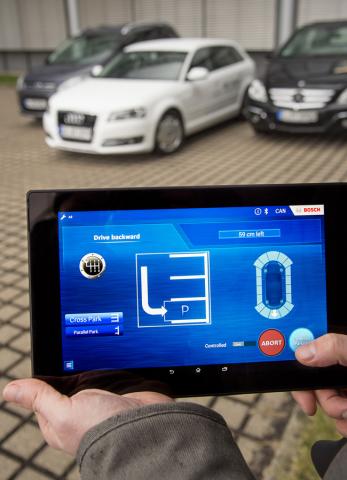
The new hybrid makes it possible to include in compact cars a function that will celebrate its debut in premium vehicles at this year's IAA: a remote-controlled parking assistant that allows drivers to direct the parking manoeuvre from the pavement. The fully automatic parking assistant steers the vehicle into tight parking spaces and garages safely and conveniently, without any stress or hassle.
The assistant uses ultrasonic sensors and is based on the fully automatic parking system found in vehicles with an automatic transmission. Thanks to the built-in electric motor, the system can accelerate by itself and independently shift between forward and reverse gears. And because the parking process is started by pressing a button on the ignition key, drivers do not even have to be in the vehicle. Bosch has also developed a smartphone app that allows drivers to operate the parking assistant from outside the vehicle.
