Driver assistance: Coming revolution
The three major trends of electrification, connectivity and autonomy all have software in common, according to Thomas Gage and Jonathan Morris from Marconi Pacific
We are on the threshold of a radical change in vehicle technology. No, it’s not automation, although that will come very soon. Instead, change is being driven by the underlying technology for automation that is already here and advancing rapidly; that is, crash avoidance technology delivered by advanced driver assistance systems (adas).
Adas makes safety and marketing sense. Whether it is Daimler, Toyota, Ford, Nissan, GM, another vehicle OEM or even Google, none are going to put vehicles on the road that can steer, brake or accelerate autonomously without having confidence that the technology will work. Adas promises first to reduce accidents and assist drivers as a copilot before eventually taking over for them on some of and eventually all their journey as an autopilot.
As for how quickly the impacts of this technology will be felt, the adoption curves for any new technology look very similar to one another. For example, the first commercial mobile-phone network went live in the USA in 1983 in the Baltimore-Washington metropolitan area. At the time, phones cost about $3000 and subscribers were scarce. Even several years later, coverage was unavailable in most of the country outside of dense urban areas. Today, there are more mobile-phone subscriptions than there are people in the USA, and more than 300,000 mobile-phone towers connect the entire country. Low-end smartphones cost about $150.
Vehicle technology is moving forward at a similar pace. And, because transportation is so fundamental to how we live, the disruptive effects are likely to be astoundingly large.
Three vehicles
The development of automation and adas is not the first trend to upend the auto industry status quo. International competition and liberalised trade forever altered the automotive OEM landscape, eroding the US sales market share of the big three car makers from 72 to 45 per cent in the past 20 years. And while vehicle technology has advanced enormously, the basics of driving have not changed much in the past 40 years.
Now, every day in California’s South Bay, you can commonly see three vehicles representing three world-changing trends in the automotive industry – a sleek Tesla S rolling quietly past, a late-model sedan with an Uber U in the back window picking up a passenger and a heavily modified Lexus SUV with a spinning lidar on the roof, driving itself down the street while a Google employee (or an employee from an auto OEM in one of their vehicles in other parts of the world) collects data.
These daily sights represent three technology-driven trends that are simultaneously arriving to disrupt the automotive status quo: electrification, connectivity and autonomy. Each trend is moving at a different pace, but all three have one thing in common: it’s all about the software.
Software
Since 2004, the costs of electronics in an average vehicle have doubled from 20 to 40 per cent. Today’s luxury vehicles commonly contain 100 microprocessors and run 100 million lines of software code, controlling everything from engine timing to infotainment systems. We are now at an inflection point where software, sensors and processors are delivering entirely new areas of vehicle functionality, and not simply transitioning conventional functions from mechanical to electronic control. Both the adas of today and the autonomous driving systems of tomorrow will rely completely on software to make sense of a slew of data from sensors, cameras, the internet, infrastructure and other vehicles.
The increasing complexity of vehicles has already shifted the automotive value chain. The trends of electrification, connectivity and automation will only accelerate this shift in value toward those companies that create electronics and software, and away from OEMs that fail to innovate.
This shift will have two effects. First, software will become a critical market differentiator, pressuring OEMs to shorten product cycles and provide support and updates for legacy systems. To meet consumer demands for current technology, OEMs are now forced to modify significantly or introduce new models after only three or four years, while previous product cycles averaged five to eight years. This leaves OEMs with many challenges including rapid innovation, complex QA testing, higher development costs, less time to amortise R&D and the need for new sales and vehicle-ownership models.
Secondly, the shift to software allows new entrants to innovate in an industry with notoriously high barriers to entry. After decades of the same players dominating the industry, Google, Apple, Tesla and Uber are all poised to remake the automotive landscape through software, a thought that would have seemed highly unlikely even five years ago.
In a typical adas-equipped vehicle, applications such as forward collision avoidance (FCA) are enabled by a set of sensors that provide data on the external driving environment to an electronic control unit (ECU). This unit then uses software to determine whether a threat is present and operates brake actuators or, potentially, other countermeasures to mitigate the threat.
The sensors available today for driver assistance applications are the hardware foundation for autonomous vehicles. But tomorrow’s sensors will necessarily be smaller, faster and cheaper. For example, Continental’s sensors and processors can transmit and recalculate algorithms needed to understand the driving environment every 10 to 60ms, while the human brain can pass a message from a sensory neuron to a motor neuron in only a few milliseconds.
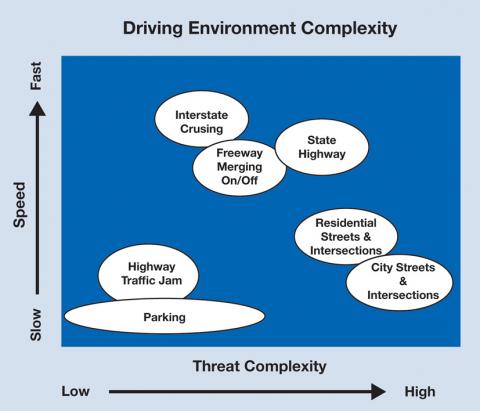
But the real gap between adas today and the fully autonomous systems of tomorrow is seen in software. Regardless of how fast inputs can be processed, the software algorithms that will allow vehicles to drive themselves more efficiently and safely than human drivers in complex driving environments remain the biggest challenge. Complexity is defined by both the number of threats, characterised by the types of threats that a driver can encounter on different road types – for example, pedestrians, vehicles traveling at a right angle to the vehicle, bicyclists – and the speed at which the vehicle is driving (see diagram).
As they race to improve their software, vehicle OEMs and their suppliers are introducing their technology to the market in three distinct ways. OEMs such as BMW, Daimler and Nissan have already begun to sell moderate-functionality adas designed to operate in simple driving environments such as interstates. Without needing to account for traffic signals, turns or multidirectional traffic, these vehicles automatically steer, brake and accelerate in lower-speed situations using systems such as traffic jam assist, a trajectory represented by the blue line in Fig. 3. Eventually, systems will operate at higher speeds or in more-complex urban settings, and offer additional functionality such as the ability to merge, change lanes or negotiate an intersection. A subset of these OEMs, such as Volvo and Ford, are introducing moderate-functioning systems for defined geographic areas (typically geo-fenced), such as a particular stretch of an interstate between two cities, to take advantage of laser scan mapping data. Over time, system functionality will increase and the number and complexity of geographic areas available to the system will expand. Finally, Google’s approach has been to develop a highly functioning, fully autonomous vehicle from the outset (in geo-fenced areas and for low-speed city or campus driving), then test and refine its capabilities in increasingly complex environments.
Adoption and diffusion
While OEMs are choosing different strategies to bring adas and vehicle autonomy to market, adas-equipped vehicles of increasing capability have already been introduced nearly every year since 2010 and continue to roll out annually. In 2013, fully 29 per cent of passenger vehicle models offered optional forward-collision warning and, of those, 12 per cent had autonomous braking. This year’s Mercedes entry-level premium CLA sedans come standard with a forward-collision prevention system, and Volvo has made its City Safety braking system standard on its XC60 since 2010. Now that the early generations of this technology are available, how fast will consumers adopt it?
To understand the adoption of adas-enabled and autonomous vehicles, it is instructive to look at adoption rates of other technologies. As a general trend, modern technologies such as the mobile phone, internet and PC have been adopted at a much faster rate than older technologies such as the VCR or TV. Cars have conventionally been one of the slower technologies to be adopted. This is largely due to their high relative cost as compared with consumer electronics, and to the need for highways to be constructed. In contrast, the smartphone is considered to be the fastest-adopted technology in history, on track to reach saturation in a decade. Mobile phones – largely what we today call feature phones – took 20 years to reach saturation and conventional landlines took a century, largely because of the need to build out the landline networks.
Adas-equipped and autonomous vehicles likely will be adopted at rates slightly slower than other modern technology due to vehicle costs, but they will still be adopted much faster than were conventional automobiles. As with the uptake of other new technologies, we expect a wave of first movers and early adopters to drive early sales of adas-equipped vehicles, followed by gradual adoption by the majority of consumers once the safety benefits have been proven.
Importantly, the current additional cost of a typical adas suite of equipment is only about $3000 (declining at about seven to nine per cent per year), or about ten per cent of the cost of the average vehicle sold in the USA of $33,560. For luxury vehicles, the adas equipment cost represents only two to three per cent of the vehicle sale price on average.
Consumer research into adas and autonomy indicates that consumers will be initially drawn to the safety and convenience of this technology. Safety will be a large motivator for families as they begin to hear that adas-equipped vehicles avoided crashes that might have injured or killed the vehicle’s occupants. But the big driver will be time recapture. Being able to cruise along a motorway – and soon other road types – while paying limited attention to the road will be a significant accelerator of demand.
A diffusion model can help better understand the pace of introduction of the technology and the uptake by consumers. The model is scenario based, with numerous inputs. A few key factors are annual vehicle sales, adas technology introduction dates and fleet turnover forecasts. The results are striking. In one run of the model, by 2035 more than 50 per cent of vehicles and 85 per cent of new-vehicle sales across all segments had one generation or another of adas-equipped or autonomous vehicles. Of course, different levels of adas and of autonomy will have different impacts on society, including different levels of total annual crash reduction, different impacts on traffic congestion and different impacts on shared-vehicle, Uber-like services.
Ecosystem implications
The automotive sector and adjacent industries form a large ecosystem with pervasive reach across the global economy; in the USA, transportation represents just under ten per cent of GDP. As innovation in the form of electrification, connectivity and automation disrupts the status quo, the effects will be felt not just by OEMs, but also by numerous other sectors and businesses that have previously been structured around conventional personal vehicles.
Car makers have many opportunities as the race to deliver advanced functionality accelerates. These include more luxury vehicles and features, more telematics and infotainment, and new driving experiences. But there are also risks regarding competitive timing, technology capability (hardware and software), complex sourcing, technical selling capability of dealers and brand differentiation. Automotive OEM, component and aftermarket suppliers also are likely to have increased product liability risks as their technologies assume direct responsibility for more of the driving.
Auto parts and component suppliers and adjacent industries have their own opportunities and risks. Chip makers and security companies have significant opportunities to enable and secure this functionality. Telematics content and platform providers, as well as telecoms network operators, have opportunities in areas such as mapping, car sharing, parking apps, infotainment, vehicle-to-X communications and vehicle-to-web integration.
Traditional vehicle hardware suppliers are likely to be price-squeezed as value moves to software and infotainment. Auto insurance companies will need to develop new business models as crashes diminish in both frequency and severity, with corresponding reductions in premiums. Property developers, garages, transportation engineering and construction firms, and transit agencies must all consider how transportation will change as vehicles become safer, perhaps owned less by individual families and ultimately are fully automated.
The three technology-driven trends that are simultaneously arriving to disrupt significantly the automotive status quo – electrification, connectivity and autonomy – are here today. Companies that move quickly to take advantage of the opportunities are likely to succeed. Laggards – well, history has shown what usually happens to them.
Platforms for adas and beyond
The basic goal of adas technology is to make drivers more aware of their environment so they can drive safely while enjoying the driving experience. Around ten years ago, luxury OEMs began to offer the first adas products in the form of backup radar and lidar sensor-based systems that would simply beep if they detected an object behind the vehicle. Over time, these systems advanced to multi-sensor versions that fused radar with cameras and even lidar, to give drivers not only a view of what’s behind them but also detect if something is coming up from the side.
In subsequent years, the adas sensor arrays morphed from doing one task at the back of a vehicle into networked sensor arrays that see 360˚ around and even inside an automobile, with each sensor performing a number of tasks. Today’s high-end automobiles can include adas products with not only highly advanced rear-camera systems, but fusion-sensor systems that simultaneously perform multiple tasks such as blind-spot and lane-departure warning, pedestrian and sign detection, automated cruise control, forward-collision warning and even drowsy-driver detection and warning. The latter system monitors the driver’s eyes to detect eye patterns that may indicate he or she is falling asleep at the wheel and needs a sonic alert or even a puff of smelling salts.
What’s more, over the past five years, an increasing number of features once offered only in premium vehicle lines are quickly becoming standard in even economy lines. In short, OEMs are leveraging adas as competitive selling points for their vehicles.
Today, OEMs are moving above and beyond the adas warning features and are starting to network adas into the controls of the vehicle to take charge actively and momentarily. Adaptive cruise control, intelligent speed control, lane-keep assist, collision avoidance and even automated parking are available in many models. And these remarkable technologies represent the first steps in the automotive industry’s race to offer consumers fully autonomous, self-driving vehicles in which the driver is essentially the copilot. What’s more, these technologies will also be leveraged heavily to facilitate vehicle-to-vehicle and vehicle-to-infrastructure (V2X) communications designed to enable governments to build smart infrastructure – streets, traffic signals and so on – to streamline traffic flow in real time, making transportation safer, more efficient and economical, and better for the environment.
At the heart of many of these systems are programmable devices such as Xilinx’s Zynq SoC range, and these are quickly replacing much less versatile ASSPs. The combination of such Arm-based processors and FPGA logic on the same device has enabled OEMs to build highly sophisticated, all-programmable adas platforms that can scale with automotive product lines and be upgraded with new enhancements to suit demanding and ever-evolving customer requirements.
Automotive OEMs leverage such devices in many platform configurations. A device can serve as a multi-sensor, multi-feature driver assist platform, a high-resolution video and graphics platform, a vehicle networking and connectivity platform, and an image-processing and recognition platform. In these applications, users implement algorithms for their design’s most complex and compute-intensive functions in the logic portion of the SoC and implement serial processing functions in the onboard Arm processing system. They leverage the SoC’s high-speed IO to link to sensors and create highly reliable connections to automotive networks. They can also leverage IP and design sites such as Xilinx’s Vivado to develop adas platforms quickly.
Xilinx has a rich history in the automotive market, but over the past four years and with the commercial launch of the Zynq-7000 all programmable SoC in 2011, the company has quickly become a platform provider of choice in for much of the adas market. Companies such as Mercedes-Benz, BMW, Nissan, VW, Honda, Ford, Chrysler, Toyota, Mazda, Acura, Subaru and Audi are among the many OEMs that have placed these FPGAs and SoCs at the heart of their adas products.
Thomas Gage is CEO and managing director and Jonathan Morris senior associate, both at Marconi Pacific
