Simulation and Modelling: Cool sounds
How Continental is making automotive multimedia systems cool with thermal simulation
Modern multimedia systems – entertainment, radio, navigation and communications – for automotive applications are highly complex with various mechanical and electrical components and assemblies. The design has to meet stringent requirements from mechanical stability and thermal management to electromagnetic compliance and illumination objectives.
It requires the interdisciplinary knowledge of mechanical, electrical and software engineers. Multimedia systems have to be developed to meet quality, cost and design time requirements while enhancing OEM trust and confidence.
At Continental, engineers are working in multidisciplinary teams to find continuously better system designs. Up-front numerical simulations – also called virtual analysis – enable them to test and modify system and components as virtual prototypes before performing physical tests and building real prototypes.
Using 3D system-level modelling, with all thermally and air-flow relevant components included in the simulations, they cane gain a deeper understanding of product behaviour early in the design process. The engineers have considerable in-house know-how associated with building and validating thermal simulation models (Flotherm models) of such complex electronic systems and subsystems using computational fluid dynamics (CFD), allowing them to represent and analyse both the physical hardware and potential cooling.
One of the greatest challenges for designing automotive multimedia systems is that they have to operate under a wide range of environmental conditions, such as:
- • Temperatures from -40 to +100˚C;
- • Power supply voltages from ~4.5 to 16.0V;
- • Superimposed alternating voltages;
- • Electrostatic discharge (ESD) polluted environment up to ±15kV;
- • Humidity from 0 to 100 per cent; and
- • Chemical influences.
Automotive multimedia systems also have stringent design criteria such as mechanical strength and stability (static and dynamic) to withstand vibration and mechanical shock, limitations on size and weight, and requirements regarding risk of injury (head impact) as well as product integrity.
Modelling and simulation allows the engineers to ensure their designs meet such requirements before physical prototyping. The goal is to get the product right the first time, using simulation-based design decisions.
The geometry of the models is typically based on mechanical cad data; all relevant parts and modules are exported and imported from and to the cad system. However, representing the geometry in this way can result in simplification and idealisation, so they have to make sure the complexity of the models fits the simulation objective. Less detail is used for the analysis of various initial concepts, and more details are included in the model for a mature design.
All three principles of heat transfer, conduction, convection and radiation have to be included in the thermal design. Conduction is one of the first principles of heat transfer to consider for thermal cooling. Free convection is another, but it is somewhat slow to develop as the air heats and begins to rise. Forced convection, when a fan is applied, takes the heat away much faster. Forced convection typically gives an improvement of 10 to 20˚C. However, fans are not always reliable, and they cost money, so they want to avoid using fans in the design. Thermal radiation also plays a significant role in heat transfer for free-convection systems.
Simulation models allow them quickly to simulate the thermal design while considering the various modes of heat transfer. For complex products, they visualise, among others, the temperature distributions with surface plots and air flow with streamlines and, for example, determine the fan operating point.
For modelling, it is important to include all the relevant objects – such as geometry, heat sources and resistances – in the model, that is including everything relevant to heat dissipation, thermal behaviour and obstacles for fluid flow. The geometry can be based on cad data, or it may be native objects or SmartParts of the software. Depending on the maturity of the system and the focus of the study, they model everything from chips to the complete system, and what is around the system.
Thermal modelling is a complex task. Of course, uncertainties arise from the various unknowns at each stage in the design process, so modelling assumptions and simplifications are mitigated through validation.
Tuner module
A multimedia system’s tuner module can be modelled as a single block with homogeneous power dissipation distribution, as a detailed model with all the internal electrical components and shielding represented, or anywhere in between. A simplified model is often sufficient within a complete analysis (application). However, conclusions on the internal component temperatures are drawn from a reference simulation.
Chassis model
Simulation models serve as virtual prototypes and easily allow parametric variation and model exploration; this is one of the main benefits, to understand the effect and sensitivity of a specific parameter.
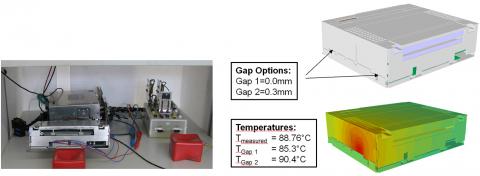
A part of the chassis is used as a heatsink for amplifier cooling. The extent to which the brackets on the top and bottom covers of the chassis are in thermal contact (related to manufacturing tolerances) is important. The diagram shows that scenario one (g1) considers the gap to be fully closed (perfect thermal contact), whereas scenario two (g2) has a gap of 0.3mm, so there is effectively no thermal contact between the covers. It can be seen that there is a 5K delta between no contact and perfect contact.
To improve the model fidelity, engineers measured a prototype of the product and compared the results against the simulation model. Compared with the measured case temperature, the results for scenario two (with gap) seem to be the best representation of the bracket’s contact. However, this may be an area that could be improved to provide better model performance, on the other hand, one measured sample has no statistical significance.
Beyond simulation
The focus on simulation does not stop at building and validating thermal models. Ways found to improve the thermal design affect the mechanical, electrical and EMC performance of the product. Faced with this problem, a major question addressed is how to achieve design flexibility and enable better design decisions before the freedom for such decisions is eliminated.
The answer requires analysis of the product’s behaviour for all disciplines as well as the identification of independent and coupled system variables. Continental uses multidisciplinary design optimisation (MDO) techniques with simulation, optimisation (with discipline-dependent objectives and constraints), design-of-experiments (DoE), and response surface methods. DoE tools are the foundation for concept exploration and robust design. Two major aspects of DoE are the planning and the statistical analysis of such numerical experiments, that is simulations. The possible number of discrete and continuous design variables can be extremely high. Screening simulations support the selection of the major factors (design drivers) to be included as design variables in the MDO.
Simulation also enables sequential design improvements. The engineers perform sequential improvements with parametric changes to the overall design, to find a compromise between the product’s structural, electrical and EMC objectives while satisfying additional constraints such as temperature limits, manufacturability or cost. For each area, these improvements can be evaluated against the base design.
In the case of the thermal design, results of parametric variations can be visualised as changes in monitor point temperatures. However, this sequential process does not include possible interaction effects between parameters.
Results from thermal CFD simulations provide the big picture of the system behaviour, for example sensor and surface temperatures, heat and volume flow, fan operating point, heat transfer coefficients, parameter sensitivities and so on. Locations for temperature sensors that will be used to instrument the physical prototype are identified or improved effectively and key sensor locations determined for thermal management through system software.
Conclusion
Up-front simulations early in the design process support deeper understanding of product behaviour and increased flexibility. They are simply a must to be competitive in a highly demanding market, and simulations lead to enhanced customer’s trust and confidence in the product’s quality. With each new step in a design, evolutionary or revolutionary, numerical simulation helps to identify critical design areas or potential risk, and different architectures and concepts can easily be compared.
Simulation models serve as virtual prototypes and allow knowledge generation and model exploration in less time and with less money spent. As the complexity in automotive electronic systems increases, so does the amount of modelling detail in the software.
The quality of the products depends on the interaction of software engineers, mechanical engineers, electrical engineers and the best decisions. Thermal analysis is a crucial part of the design process throughout analysis of the product lifecycle. Starting early with thermal design rules contributes to success. With simulation, development time has decreased significantly following the market’s demand and the engineers have reduced the number of physical prototypes.
