Power Technologies: Driving demand
Jeff Gruetter from Linear Technology explores how automotive electronic systems are driving demand for multi-channel synchronous buck converters
As automobiles continue to add a higher density of electronic systems to enhance safety, comfort, efficiency and performance, it is not surprising that they require both smaller and higher performance power conversion. Today, multi-channel power management needs to deliver up to four independent power rails usually to power Vcore, VIO, Vmem for microprocessors and generally a fourth 5V rail to power a Can transceiver.
According to Strategy Analytics, the demand for enabling semiconductor devices is expected to grow at a compound average annual growth rate (CAGR) of five per cent over the next seven years, with the total market worth over $41bn by 2021, compared with $30bn in 2014. It also identified that demand for microcontroller and power semiconductors will drive over 40 per cent of revenues.
Strategy Analytics provides a quantitative description of forecasting the growth of electronics content in automobiles, but more interesting is the prevalent role that power ICs play in this growth. These new power ICs must provide:
• Multiple voltage rails from a single power management IC;
• Robust performance across a wide range of voltages, including cold-crank and stop-start scenarios from less than 4V to load dump transients in excess of 36V;
• Outputs ranging from 5V down to less than 1V;
• Ultralow electromagnetic interference (EMI) emissions;
• The highest efficiency possible both to reduce thermal issues and optimise battery run-time;
• Ultralow quiescent current – less than 10µA per channel – to enable always-on systems such as security, environmental control and infotainment systems to stay engaged without draining the vehicles battery when its engine (alternator) is not running;
• The smallest footprints, often requiring multiple voltage rails to reduce space required for power conversion circuits; and
• Switching frequencies of 2MHz or greater to keep the switching noise out of the AM radio band and to keep footprints very small.
The goal of the increased performance levels of power ICs is to allow the design of increasingly numerous and complex electronic systems found within automobiles. Specific applications that are fuelling the growth for electronic content in cars are found in every aspect of the vehicle. For example, new safety systems including lane monitoring, adaptive safety control, automatic turning and dimming headlights. Infotainment systems (telematics) that continue to evolve and pack more functionality into an already tight space must support an ever growing number of cloud based applications. Advanced engine management systems with the implementation of stop-start systems, electronically controlled transmissions and engine control. Drive train and chassis management aimed at simultaneously improving performance, safety and comfort.
A few years ago these systems were only found in high-end luxury cars but now they are commonplace in automobiles from every manufacturer, further accelerating the automotive power IC growth.
Smaller circuits
There are a few ways to make power conversion circuits smaller. In general, the largest components in a circuit are not the power ICs, but the external inductor and capacitors. By increasing the switching frequency of the power IC from 400kHz to 2MHz, the size of these externals can be dramatically reduced. However, to do this effectively, the power IC must be capable of delivering high efficiency at these higher frequencies, which historically has not been feasible.
Nevertheless, using new process and design techniques, synchronous power ICs have been developed that can deliver efficiencies in excess of 90 per cent while switching at 2MHz. The high efficiency operation reduces power loss, eliminating the need for heat sinks. It also has the added benefit of keeping switching noise out of the AM frequency band, which is critical in many noise sensitive electronic systems.
Another way to make power conversion circuits dramatically smaller is to use multi-output converters in lieu of multiple single devices, when several unique output voltage rails are required. For example when powering a microprocessor, most designs require three independent outputs to power Vcore, VIO, Vmem for microprocessors and a fourth 5V rail to power a Can transceiver that enables the microprocessor to communicate with the rest of the system electronics.
A properly designed quad converter IC is only moderately larger than an equivalent single converter whereas its footprint can be less than half the size of four separate single converters. This size improvement is especially compelling when comparing a quad output regulator using a switching frequency of 2MHz with four singles that run at 500kHz. Additionally, quad output converters are designed to reduce unwanted crosstalk between the channels, whereas crosstalk between four adjacent single converters can be problematic, unless they are all synchronised to a common clock. Adding an external clock and synchronisation increases size, complexity and cost to the circuit.
Low EMI
Because the automotive electrical environment is inherently noisy, with many applications being susceptible to EMI, it is imperative that switching regulators don’t exacerbate these EMI concerns. Because a switching regulator is typically the first active component on the input power bus line and, regardless of downstream converters, it significantly impacts overall converter EMI performance. So reducing EMI is imperative.
Historically, the answer was to use an EMI shielding box, but this adds significant cost and size to the footprint while complicating thermal management, testing and manufacturability. Another potential method within the power management IC is to slow down the switching edges of the internal mosfets. However, this has the undesired effect of reducing the efficiency and increasing the minimum on-time, which compromises the IC’s ability to deliver low duty cycles at switching frequencies at, or above, 2MHz.
As both high efficiency and small footprints are desired, this isn’t viable. Fortunately, some recent power IC designs have been introduced to enable fast switching frequencies, high efficiency operation and low minimum on-times concurrently. These designs can offer low EMI emissions even with 2MHz switching frequencies and over 90 per cent efficiency. These performance levels are accomplished with no additional components or shielding, offering a significant breakthrough in switching regulator design.
Alternative
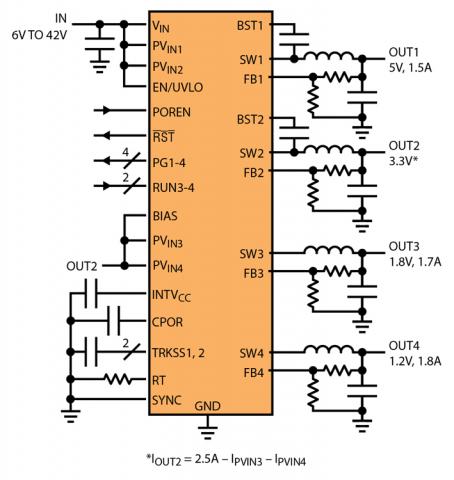
For example, a 42V input capable, high efficiency, quad output monolithic synchronous step-down switching regulator with a 3 to 42V input voltage range is suitable for automotive applications that must regulate through cold-crank and stop-start scenarios with input voltages as low as 3V and load dump transients in excess of 40V.
As can be seen in the diagram, its quad channel design combines two high voltage 2.5 and 1.5A channels with two lower voltage 1.8A channels to deliver four independent outputs delivering voltages as low as 0.8V, enabling it to drive the lowest voltage microprocessor cores currently available. Its synchronous rectification topology delivers up to 94 per cent efficiency while burst mode operation keeps quiescent current under 30µA (all channels on) in no-load standby conditions making it suitable for always-on systems.
For noise sensitive applications, such a device, with a small external filter, can use its pulse-skipping mode to reduce switching noise and can meet the Cispr 25, class five EMI requirements.
The switching frequency can be programmed from 250kHz to 2MHz and can be synchronised throughout this range. The 60ns minimum on-time enables 16Vin to 2.0Vout step-down conversions on the high voltage channels with a 2MHz switching frequency. As the high voltage Vout2 channel feeds the two low voltage channels (Vout3 and Vout4), these can deliver outputs as low as 0.8V while also switching at 2MHz, offering a very compact (about 25 by 25mm) quad output.
As well as reducing the footprint, the 2MHz switching frequency enables designers to avoid critical noise-sensitive frequency bands, such as AM radio. Each channel maintains a dropout voltage of only 200mV at 1A under all conditions, making it suitable for scenarios such as automotive cold-crank. Programmable power-on reset and power good indicators for each channel help to ensure overall system reliability.
Conclusion
The rapid increase in the number and complexity of electronic systems in automobiles has necessitated even higher demands on power management IC performance. By having quad output power ICs, automotive designers can dramatically reduce the space required by their power conversion circuits. Combined with switching frequencies of 2MHz, the size of the external components, namely the inductors and output capacitors, can also be dramatically reduced offering a very compact quad rail footprint.
These compact designs are also very rugged, able to withstand the required transient behaviour found in stop-start, cold-crank and load-dump conditions while accurately regulating all outputs. Additionally, ultralow quiescent currents make them suitable for always on systems.
As more electronic systems are added into ever shrinking spaces, reducing the footprint while increasing efficiency is also critical. Fortunately, multi-output power ICs that meet these demands are already available paving the way for even higher electronic content in future vehicles.
Jeff Gruetter is product marketing manager for Linear Technology
