Arm adds automotive functional safety packages for Cortex A processors
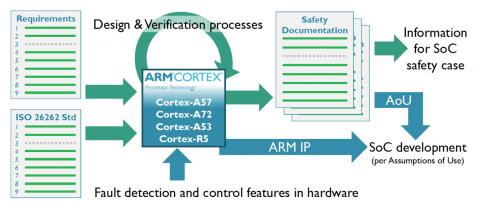
Arm is broadening its functional safety packages to cover the Cortex A family of processors just three months after doing the same for the Cortex R family. This, said the company, was the result of more than three years of investment in internal processes, training, verification and documentation flows, requirements tracking, and safety management.
“A lot of the buying decisions now are around the safety side of the vehicle,” said Richard York, Arm’s vice president for embedded. “The car manufacturers want the safety features across the range and not just at the high end. We can now apply what we did with the R5 to the applications processors as well.”
He said the Cortex A was more complex and harder to provide the safety documentation.
“There are more requirements,” he said. “It makes it harder to document and track and trace the requirements.”
He said the aim was to help the development and safety assessment of SoC designs to meet the goals of functional safety standards such as ISO 26262 and IEC 61508.
“There are cameras in the vehicle monitoring the driver and passengers and there are cameras pointing outside,” said York. “There are more and more of them. This means a huge amount of data and what is being processed is more demanding. There are lots of different vehicles going at different speeds. There are wing mirrors and traffic signs. And all this has to be processed with different visibilities and weather conditions. The companies developing these systems can use as much processing power as we can provide them and more.”
He said the company’s silicon partners were waiting for Arm to do this for the Cortex A series because it made it easier for them to design with functional safety in mind.
The first processor to receive the functional safety treatment is the A53 with the A72 later this year.
“The safety package needs to be available when the chips are being built,” said York. “It is hard to do this for products that were designed a long time ago, before ISO 26262 was stabilised, so we are focusing on the newer processors.”
He said the plan was to make functional safety packages available for most of the cores going forward, though not all as some were focussed purely on the consumer market.
“But the majority will have some kind of functional safety,” he said, “including all that we expect to go into automotive.”
Currently, companies must build complete safety cases on a chip-by-chip basis, duplicating effort and increasing industry costs.
“We believe safety features that enable adas and automotive cockpit systems are becoming an essential element and functional safety is engrained in the nature of Renesas,” said Masahiro Suzuki, vice president and chief of the automotive information system business division at Renesas Electronics. “We are expanding our strategic partnership with Arm to achieve a safer, more secure and comfortable driving environment powered by Renesas automotive products. ”
And Nick DiFiore, director of the automotive segment at Xilinx, added: “Arm’s announcement and investment in functional safety is very welcome as we work closely with our automotive customers at the silicon and system level to clear the hurdles associated with the ISO 26262 automotive safety integrity levels.”
Arm also said it would expand its safety support for the Cortex M7, it’s highest performance Cortex M processor, and Cortex M0+, M3 and M4 processors that are widely used in microcontroller applications later this year.
