Autonomous Vehicles: Pastures new
William Barne from Lycetts looks at how drones and autonomous vehicles are changing the world of farming
Agricultural practices will need to continue developing and becoming more efficient, if the findings of recent research is anything to go by. For instance, PwC has reported on expert views that agricultural consumption will need to increase by close to 70 per cent by 2050 to account for the world’s growing population, projected to hit nine billion people in the same year.
While not as high, the World Bank has predicted that those across the globe will need to produce 50 per cent more food by 2050 should global population continue to rise at its current pace.
Fortunately, technology is constantly advancing, with various developments being made to aid the agricultural industry. Two main areas of interest are drones and autonomous vehicles.
Farming drones
Drones have become a very lucrative market, with global market revenue from the sales of such gadgets expected to increase by 34 per cent to reach over £4.8m in 2017. US technology research company Gartner has predicted that drone production figures will jump by 39 per cent this year compared with 2016.
Drones can take the stress out of planting and looking after produce, thanks to systems that have been created by start-up companies that can achieve an uptake rate of 75 per cent and reduce the costs of planting by as much as 85 per cent.
The idea is that the technology sees drones shooting pods with seeds as well as plant nutrients into the soil, enabling plants to receive the nutrients they need to sustain life.
To avoid wasting water around a farm, drones can be fitted with remote sensing equipment – think multispectral, hyperspectral or thermal sensing systems. The idea is that the technology will quickly and easily identify the driest sections of a field and then allow farmers to allocate their water resources more economically.
Crop spraying and crop monitoring are two practices that many in agriculture will already be very familiar with. However, drones can improve both of these common practices.
In regards to crop spraying, drones can effectively scan the ground of a farm and then spray the correct amount of liquid once the distance from the ground has been modulated; even coverage will be achieved while the amount of chemicals penetrated into groundwater will be reduced.
When it comes to crop monitoring, time-series animations through the drones will be able to display the exact development of a crop and detail any inefficiencies with production. These kinds of insights would have previously only been gained by satellite imagery; while very advanced, this technique could only be used once a day. Monitoring through drones can be used whenever a farmer wishes.
Autonomous vehicles
Just like drones, the market for autonomous vehicles is looking very bright with many forecasts of a growing number of cars available that will have either semi-autonomous or fully autonomous capabilities. From a more general perspective, management consulting firm Bain has estimated that the global opportunity for assistive and autonomous technologies for the business-to-business market will be somewhere in the range of $22bn to $26bn per year by 2025.
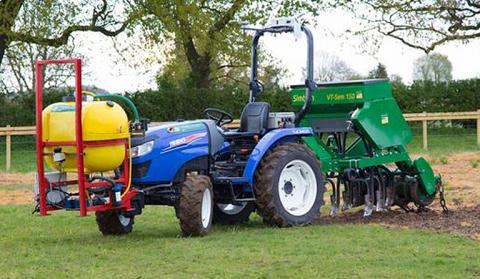
Steps have already been made to showcase how autonomous vehicles can assist those in agriculture. For instance, a team of agricultural engineers from the Harper Adams University in Shropshire, UK, have set about creating an autonomous tractor that can perform tasks such as the drilling, seeding and spraying of land while being steered by a farmer who is positioned not behind the vehicle’s wheel but in a control room. The same team – made up of Johnathan Gill and Kit Franklin, and Martin Abell from Precision Decisions, the project’s industry partner – are also looking into how an automated combine harvester could be used to then harvest the same field.
“Although the system sounds very technical at the moment, and a lot of work has gone into making it work, we do hope that in the future systems based on this concept will exist,” said Franklin, agricultural engineering lecturer at the university. “They’ll be easy enough for a farmer to use by simply inputting what they require in their computer and the robotic vehicles will go off and do it. I believe that farmers will be able to concentrate on agronomic and business decisions, while overseeing and managing a number of smaller automated machines, instead of sitting in a large tractor with 300 plus horsepower driving up and down the field.”
These small autonomous machines could facilitate high resolution precision farming, where different areas of the field, and possibly even individual plants can be treated separately, optimising and potentially reducing inputs being used in field agriculture.
“The tractor is able to navigate the hectare using an autopilot system for drones,” said Abell. “This allows it to follow a pre-determined path in the field. It runs entirely on GPS and follows the requested route making its way between waypoints. The waypoints are digital GPS markers created using our software that we have positioned at the ends of the field for the tractor to navigate to; like a more advanced version of dot-to-dot. Our waypoints for the drilling also incorporated lifting and lowering signals that picked the drill up at one end and place it back down once it had turned around.”
The SimTech Aitchison drill used is normally for drilling in-between the vines of vineyards to plant cover crops used as green manures to help fertilise the vines naturally.
“It suited us perfectly as it’s a conventional agricultural system, just on a smaller scale; like our whole project,” said Abell.
To get to where they are now, the three engineers have had support and assistance from a number of people in different areas in agriculture. The third member of the team, robotics researcher at Harper Adams University Gill, said: “So far everything on the Hands Free Hectare project has been a real team effort.”
For the drilling it had Simon Clarke from SimTech calibrate the drills, also setting the seeding along with Kieran Walsh from Hutchinsons, who’s the Hands Free Hectare agronomist. In addition, Precision Decisions' Harry Cadwallader set-up the spraying system for the liquid fertiliser that was placed while seeding.
“Now we have to start thinking towards the future,” said Gill. “The seeds are in the ground and we’ve got to consider the agronomy; how’re we actually going to do that? We have to start thinking about using our ground rover to produce visuals for Kieran. We also have to start using the drone to capture our multispectral imagery to see where the first emergences are going to be and how we’re going to start treating our crop.”
Meanwhile in the Burgundy region of France, inventor Christophe Millot has been successful in creating a vine-pruning robot. Developed as a counter to a shortage in farm labour, the latest-generation model of the four-wheeled gadget is made up of six cameras, two arms and a tablet computer found inside the robot. These features combine in a way that the machine can learn as it goes about its task so to trim grass around each vine with a cut every five seconds.
William Barne is a director at insurance broker Lycetts
