Body Electronics: Body language
Stello Matteo Billé, Doriana Montella and Romeo Letor from ST Microelectronics discuss the main trends and innovation drivers in automotive body electronics
The way the electronic systems in today’s vehicles evolve is essentially the result of different requirements, which drive product innovation and the roadmaps of the semiconductor industry. The content of electronics in modern vehicles is continuing to augment the annual growth rate of global electronic systems demand in automotive – estimated to be stable at about 7% for the next five years; body electronics are forecast to experience basically the same growth.
Innovation driving factors can be clustered into four main categories – not always sharply distinct:
• Requirements of international standards and regulations: Applied to car gases emissions, electronic systems, and single component level;
• Application specific requirements: Includes the requirements for higher reliability, smarter diagnostic capability, and smaller dimensions and weight;
• Systems cost optimisation: Reduction of the overall system cost to improve the competitiveness and ease of design for further penetration of electronics; and
• New applicative domains.
Standards and regulations
Other than the well-known AEC-Q100 standard – which sets the minimum qualification requirements of electronic devices used in the automotive industry – electronic components must also comply with a huge number of additional regulations.
As a general consideration, these regulations each shape the development of the new product and impacts the entire development cycle, from design rules through packaging technology, up to device qualification.
As an example, electro-magnetic compatibility is regulated by several specifications both in terms of electro-magnetic emissions and of immunity to disturbances. Some of these specifications are peculiar to car makers, others refer to international (Cispr and ISO) or geographical standards (SAE in North America).
International standards also set the conformance tests for Lin and Can transceivers whose certification is indispensable for guaranteeing – for instance – the inter-operability of devices from different electronic suppliers.
Also, RoHS restrictions on the use of hazardous substances applied to electronic devices has required the elimination of lead from any electronic devices, forcing the development of new packaging technologies capable of combining the needs of miniaturisation efforts and higher power density dissipation together with respect for the environment.
What makes things even tougher is that the norms themselves evolve, thus obliging the semiconductor industry to align in one of two ways: the ones following the pace established by the new regulations; and the ones who – going beyond the pure norms – become an active part of the legislating community.
On top of those specifically applied to electronic systems and single components, world-wide local legislations that introduce limits on vehicles’ emissions of both pollutant substances and CO2 are modifying cars’ architecture with regards to the supply of power loads and adoption of more efficient electronics.
Although these new standards especially impact powertrain systems where, for instance, what were belt-driven loads are now becoming electrically powered, and pumps and fans are run by highly efficient brushless BLDC motors, some influence is also seen in car body control modules (BCMs). As an example, the deeper penetration of solid-state intelligent power switches enables a significant saving in terms of wiring costs and weight: up to 50kg of cabling according to one report, resulting in saving up to 3.5g/km of CO2 emissions.
Application specific requirements
Led by such features as active and passive safety systems, enhanced human interfaces (head-up displays and touch screens for examples), and body convenience elements, the pervasiveness of electronics in the automotive market is forecast to continue increasing. In particular, because of the growing demand for higher quality and premium car sales in the Chinese market, the value of the electronics content per car in the Chinese market is forecast to grow annually by a 3.5% average in the years 2013 to 2018.
As a natural consequence, body electronic systems are subjected to an incessant increase of complexity that challenges the electronic systems’ architecture definition and design with application specific requirements and needs:
• PCB heat and power dissipation handling in a context where the number of loads increases and both the available space and target weight tend to decrease;
• Simplified diagnostics required for solid-state power switches to reduce the growth of both the number of connections on the PCB and the required resources to the application microcontroller;
• The optimisation and minimisation of the overall number of connections both between ECUs and between ECU and loads, to compensate for the copper content and weight increase linked to higher overall complexity;
• The optimisation and minimisation of the wire harness section (and thus weight) again required to compensate for the copper content increase linked to the higher overall complexity;
• The reduction of the stand-by current; and
• Increased reliability.
Body control module
As mentioned, the number of loads managed by the BCM is increasing just as the requirements for BCM box weight and size are decreasing. This dramatically increases the power density the BCM manages, which in turn makes it extremely important to measure load power consumption and the temperature of the PCB and devices – with the final aim of keeping system performance under control. The task of monitoring both of those values requires a supervising application microcontroller with very high computational power.
This means the PCB design can be made simpler due to the lower number of additional external components and needed interconnection on the PCB between control and actuation stages. The simplification of BCM thermal performances’ optimisation is thanks to being able to perform a thermal map of the PCB through power devices during the development stage.
The soldering process may be verified after the modules’ production. A smart power distribution may be implemented by selectively turning off selected loads in case of module over-heating. Real-time enhanced diagnostics even in off-state could provide, for example, anomalous warming of devices in off-state.
This also reduces the number of connections and wire harness content.
An accurate design using electronic switches rather than electro-mechanical relays could use a wire harness up to two times thinner. The reduction in the number of fuses needed in the BCM also benefits the design process in terms of space and weight saving.
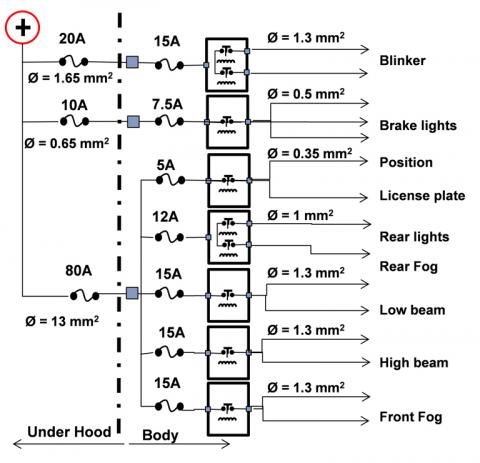
Consider the typical connections diagram for lighting systems using relays shown in the diagram.
To limit the number of fuses required, loads are normally clustered so that multiple loads are protected by one fuse. As an example, consider the two blinker lines. It’s clear that to allow normal operations of all the loads at the same time, the fuse must be chosen so as to sustain the maximum amount of current. Due to this, and to guarantee that cables are protected by the fuse, the harness itself must be properly chosen to sustain a short circuit current higher – in any conditions, for example, for any short circuit current – than the rated fuse current. For this reason, this process results in a cabling that is chosen based on the overall load and not on the single line load.
Clearly, the problem may in theory be resolved by using one fuse per load, but this would be very demanding in terms of cost, weight and space, especially considering the afore-mentioned increase in the number of convenience loads per automobile.
Cost optimisation
Recently, the complexity of the BCM and the requested system functionality were limited to driving a few loads and basic diagnostic requests. Due to this, the pressure for system cost reduction was focussed on the mere cost of the silicon devices needed to drive the few loads. As mentioned earlier, this situation is quickly changing.
The number of loads driven by the body computers together with the pressing requests from car makers for better diagnostic and safety has increased the system complexity and moved the focus of cost reduction onto the overall system cost of ownership, rather than on the pure silicon device cost.
For a given PCB size, it’s clear that an increased module complexity needs higher integration inside the electronic components. For smart power switches, this trend is even more evident. Devices must integrate more and more intelligent functions – such as protection and diagnostics – while squeezing both the silicon and the package for overall PCB size, weight and cost reduction.
From the standpoint of the reduction of the overall cost of ownership, the support for the BCM is becoming a necessity for car makers, for example, the MQB modular transversal toolkit platform from Volkswagen. By enabling the re-use of the same PCB on different car’s segments and models, the modularity reduces the costs of design, qualification and production, while improving the quality and shortening the development time.
Applicative domains
And, finally, another factor driving innovation is new applicative domains for body electronics. Other than the replacement of halogen and HID lamps with LEDs, which is already considered a consolidated trend for the market, the introduction of electronic devices inside the power distribution boxes is considered the biggest opportunity for semiconductors beyond traditional perimeters.
Today’s typical power distribution boxes can contain up to 200 fuses and 30 relays resulting in 1.5kg pure hardware weight and not negligible physical dimensions. Additionally, the adoption of traditional fuses with related intervention time obliges the car maker to dimension the cabling based on fuse characteristics rather than nominal load.
To be successful in this market, the manufacturer must embrace this trend and own the necessary technologies to build its product line with dedicated features – such as low on-resistance, device in on-state in stand-by with low quiescent current consumption – and allow the replacement of both fuses and relays.
Stello Matteo Billé, Doriana Montella and Romeo Letor work for the automotive product group at ST Microelectronics
