Bursting the bubble
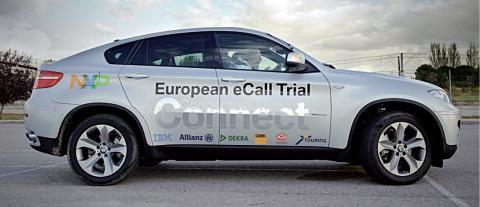
Dick Selwood explores how M2M technology is set to improve safety in modern vehicles
The very first cars were information bubbles, isolated from the world. Wireless began to bring the world into the car with a one-way feed; mobile telephony added two-way communications, both for the driver. Today not only the driver but the car itself is in two-way communications with an enormous range of applications. Driving this are machine-to-machine (M2M) communications technologies.
While many M2M applications have been gaining acceptance, the real catalyst for widespread take-up has been the EU’s e-call programme. This will require all new cars to be fitted with the ability to call for help after being involved in a serious accident. Serious is roughly defined as airbags having been deployed. The car will automatically send this information, together with GPS coordinates, to an emergency station, using an integral mobile phone system. The station will then send out emergency services, such as ambulance and fire brigade rescue teams. It is expected that there will be the ability for the emergency centre to talk to the driver, and so assess the severity of the accident, and that the car will transmit its make and model, so the rescue team has pre-knowledge of what action will be needed to free trapped passengers.
The exact date at which e-call will be implemented is still not entirely clear. As recently as 18th and 19th March 2014, while this article was being written, various levels of EU governance agreed that member states should have the infrastructure to handle e-calls in place by 1st October 2017. The date for all new cars to be equipped for e-call is currently 1st October 2015, but there are rumours this will be pushed back to match the infrastructure timetable.
Since the automotive companies are going to be forced to build-in this technology, they are looking at ways to get some return themselves. Some of the services they are looking at are not new, but the e-call requirement makes it easier to deploy them. In fact variants of e-call using text messages are already fitted to some cars from BMW, Volvo and PSA in Europe and from General Motors in the USA.
One service is for the vehicle to call the car manufacturer when it suffers a breakdown. For an annual fee, the system will diagnose the issue and the manufacturer will contact a repair service, who will attend with the relevant spare parts. This can be extended to servicing, with the requirement for the next service not an arbitrary mileage covered but the level of brake pad wear and other indicators of usage.
E-call is already tracking the car’s position, so adding maps and a display makes sense. Aftermarket navigation systems currently provide traffic information for an annual fee so this again is an addition to an OEM’s fee-based offering.
For some years various manufacturers have been offering a tele-concierge service – you contact them and they recommend a hotel, restaurant, flower shop or whatever. This again is another subscription service that can be grafted on to the e-call platform. And there is no problem in adding internet access and a range of apps, for example a subscription to a music streaming service. For a manufacturer, an expensive legal requirement has the potential to become a long-term revenue stream.
Commentators on M2M for cars are tending to divide applications into infotainment and telematics. The scenario above divides into both classes, with e-call, breakdown services and the servicing applications being telematics and the rest infotainment.
Other telematics applications include road tolling. Instead of just handing over cash at a toll booth, a vehicle can be tracked through GPS feedback and the operator charged for road usage. Europe is at the moment debating the basis for this charging for heavy goods vehicles, which since 2006 has been based on the time the vehicle has spent on motorways and instead is moving back to the distance the vehicle has travelled.
Similar vehicle tracking and location M2M systems are being used by fleet owners to improve their vehicle usage.
An experiment in Eindhoven used telematics based on silicon from NXP to monitor a small number of cars (around 200 taxis) to discover in real time the state of the road network. This was used to manage traffic flow both immediately, using road signs and in-car displays to route traffic around congestion and incidents. There is the potential to build a longitudinal study to improve traffic management in the longer term. Data crunching was carried out by IBM.
Real-time monitoring of vehicle behaviour is a double-edged sword. Anecdotally it was reported that the drivers who were monitored were driving better and using less fuel. Elsewhere, insurance companies are offering reduced premiums to drivers who are prepared to accept in-car monitoring, but drivers are concerned about the impact of this on their privacy.
Cars talking to other cars (V2V) is another area where trials are producing impressive results. Two cars merging into each other’s blind spots can alert their drivers before impact; information about accidents and road conditions can be daisy chained through vehicles to provide early warning for braking and other manoeuvres. There is even a new Wifi standard (IEEE 802.11p) for this and other aspects of what is being called intelligent transport systems (ITS).
ITS includes car to infrastructure communications (V2I or C2I). While V2V is valuable for dynamic issues, V2I is for longer term issues, for example warning of a dangerous bend or long-term road works.
M2M also takes place within the car. Over time there have built up multiple families of protocols and architectures, often originally optimised for a simple task but later extended to cover more issues. Perhaps the grandfather of the families is Can bus. Developed by Robert Bosch, it was seen as a physically simple M2M connection between intelligent nodes and still fills that role today. It is non-deterministic and not suitable for safety critical applications. Flexcan and Safecan are attempts to overcome that issue but they have not been wildly successful.
The Lin bus was intended to supplement Can by providing an alternative for low cost applications and low data rate applications, such as window opening and closing. For higher speed and increased security the Flexray protocol is becoming widely used.
ISO 26262: Road vehicles – Functional safety, is a safety standard for developing electrical and electronics systems within a car. While not yet a mandated standard, tier-one suppliers are increasingly demanding that their suppliers begin to use the approach. The same team that developed 26262 also developed Autosar in parallel with the standard, as an architecture that provides a platform on which to develop safety-critical control units and applications.
All these standards are for the operational areas of the car, but infotainment systems require massive amounts of data and the Most standard is widely use for communications between infotainment devices. Most is now being challenged by AVB (audio video bridging), a set of standards based on Ethernet.
The interface between the infotainment and control networks has been receiving considerable attention. Clearly infotainment needs to receive information about the operation of the car, but the infotainment section is open to a large number of different inputs, often having a USB or IPod interface, so communications from infotainment to control networks operations have to be very carefully managed if malware isn’t to affect the car. Indeed the whole area of security against outside influences is an area of widespread debate and research.
M2M, both within the vehicle and between the vehicle and other resources, is transforming the entire driving experience, providing better information to the car and its driver and greatly improving safety. And there is more to come.
Dick Selwood is a specialist technology journalist
