Combined instrument aimed at powertrain developers
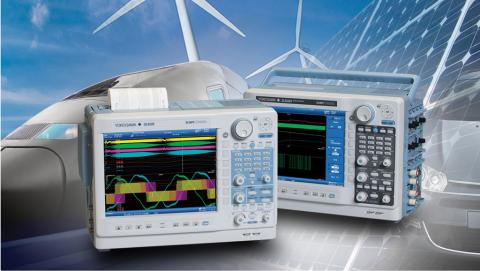
Engineers prototyping powertrains for hybrid electric vehicles are the target for the vehicle edition of the latest combined oscilloscope and data acquisition recorder from Yokogawa. The DL850EV Scopecorder can combine the electrical and other signals with information from a vehicle’s Can or Lin bus to give an overall synchronised view of a powertrain during prototyping.
A DC power option lets the unit be used inside the vehicle with power supplied from the vehicle’s DC battery. This means AC and DC power supplies can be used together; if the AC power goes down, it instantly switches to a DC input without interrupting the measurements.
The instrument is an enhanced version of the third generation of the product released in 2010, with the main difference being the addition of a G5 electrical power option. This means trend calculations such as active power, power factor, integrated power and harmonics can be carried out at data update rates up to 100kS/s using a dedicated digital signal processor that can calculate and display up to 126 types of electrical power related parameters in real time.
This enables the user to display raw waveform signals such as voltages and currents along with calculated power parameters as well as the capability to trigger on any or all of them. Trend waveforms of each order of harmonics, bar-graphs and vector displays can be displayed. Both RMS and power analysis modes are available. The option also contains all the functionality of the G3 real-time mathematics option.
“And on the vehicle edition you can add Can and Lin signals to the electrical and sensor signals,” said Kelvin Hagebeuk, product marketing manager at Yokogawa. “For prototyping electrical drivetrains, this can combine the different measurements in one synchronised view. This lets engineers get a much quicker understanding of the dynamic behaviour of the powertrain.”
The instrument can have up to eight swappable input modules with built-in signal conditioning. Users can choose from 17 types of module and they can be configured to provide up to 128 channels. The acquisition memory allows storage of up to 2Gpoint of data and sample rates up to 100MS/s on multiple channels simultaneously. A history function automatically divides the acquisition memory in up to 5000 history waveforms.
“But what makes this different,” said Hagebeuk, “is that you can capture the Can and Lin data and decode the messages that are transmitted. For example, RPM measurements. That information is in the Can bus. We can take that information and trend it as an analogue waveform on the screen.”
Up to 120 messages can be acted on in this way. These can be combined with the electrical measurements and sensor data to provide detailed information about the dynamics of the powertrain.
In a typical powertrain application, the combined data could include the decoded Can bus messages, temperature of the battery, DC voltage and current output of the battery, temperature of the inverter drive system, AC voltage and current output of the inverter, stress on the motor from strain and acceleration sensors, and data from rotary encoders measuring the motor output.
“With the Scopecorder, you can take these signals and have a synchronised overview to help engineers understand the dynamic behaviour of the drive,” said Hagebeuk.
The first delivery of the instrument is planned for mid-December.
