Connected Cars: Pay as you go
Mathieu Basiac from Flexera Software explores how an automobile can be turned into a continuous revenue stream
Car makers face a financial conundrum. They spend billions of dollars investing in new features and technology to keep customers in their showrooms, but they have a very narrow window of opportunity to turn that investment into revenue.
A typical family may purchase a car every four or five years. So during that time the manufacturer must wait, and wait some more, unable to delight that family with its latest innovations until a new purchase is in the offing. In the meantime, that same family is spending money on lots of other goods and services to address its constantly evolving daily needs. Car makers are losing out on this daily spending stream.
In fact, our fictional family’s automobile needs are shifting and evolving constantly over the life of the car. A vehicle is really a service – different family drivers have different needs, tastes and preferences – they use the automobile differently and value different aspects of the vehicle’s capabilities depending on what is happening at that particular time. The problem is the automobile manufacturing industry is not poised to take advantage of those shifting needs and profit from them. Not yet, anyway. But that is changing.
Automobile-as-a-service
What if a vehicle’s purchase represented the beginning of the manufacturers revenue stream and not the end? What if the vehicle could be continually enhanced, upgraded, downgraded and modified based on the evolving needs and tastes of the customer? What if it could become like a service, serving the needs of its owner in evolving ways over its useful life? What would that look like, and what do car makers need to do to make this a reality?
Consider the following scenario: our fictional family of four has a limited automobile budget and they’re in the market to replace their current vehicle. Their primary needs are modest – a safe, reliable vehicle to be driven mostly locally to get the kids to school and do the family errands. They purchase a mid-market sedan with a modest engine and a package of no-frill features including basic radio.
But over the summer, the kids leave for two weeks of summer camp, giving the parents an opportunity to take a romantic touring vacation through the Alps. Because it’s a vacation, the parents want to have a fun and exciting touring car for their adventure, so they leave the boring sedan at home and they rent a high-end sports sedan that has more power, GPS and satellite radio – all features that they wouldn’t splurge on for their quotidian family sedan.
This scenario is a perfect illustration of why a car is actually a service and not a static object. The family’s driving needs change according to who is driving and the purposes for which it is being used. With the kids away and the parents stealing away for an adventurous adult vacation, their needs and tastes have temporarily shifted. Because the family car no longer suits their temporary needs, they purchased a substitute – rental car.
The rental fee is lost revenue for the car maker. Why? Because the vehicle it sold could not be customised to accommodate the temporary needs of our child-free, adventure-seeking parents.
Historically, technology limitations made it impossible for manufacturers to accommodate the needs of the parents in this scenario. Under the traditional manufacturing model, the family sedan quite literally would have to be temporarily retrofitted with new hardware – a larger engine, GPS equipment, infotainment system that includes satellite radio – a scenario that would be unfeasible, prohibitively expensive and impractical.
Today, the manufacturer could accommodate our family’s needs and capture this revenue in seconds with a few clicks of the mouse.
In the above scenario, the car maker would need to do several things to capture the incremental revenue that the parents, instead, spent with the rental agency. How could this be physically and economically feasible?
The question speaks to the looming transformation of business models in the automotive industry. A business that is characterised by occasional vehicle sales today is soon to become the automobile-as-a-service, creating an on-going relationship between car makers and consumers with recurring revenues from sales of hardware upgrades, apps and services. The recipe driving the transformation of car makers consists of essential ingredients: platform plus apps plus service. This is delivered through a combination of hardware platform (the vehicle and its component parts), software applications that control features and functionality of the vehicle hardware, and software licensing and entitlement management which controls which features, functions and services customers can access based on what they’ve paid.
Ford Motor is heading in that direction. Ford Sync is an early example of a next generation connected software-driven dashboard or vehicle information and communications system. Ford offers Sync in four editions based on levels of features, bundled services and optional subscription plans.
Ford Sync illustrates several strategies to grow revenues from a platform plus apps plus services approach. It manufacturers a single infotainment model, containing all the features and functionality possible regardless of package purchased. This model can be likened to an IPhone, which contains all the features and functionality possible, such as camera, GPS, phone and so on. These features get activated through software licensing and entitlement management, depending on which apps are purchased.
Software is used to access the infotainment system. A single software product can be sliced and diced based on software features to create packages targeting specific consumer sectors. This helps Ford create offers at different price points based on customer need and willingness to pay, without having to acquire manufacturing costs for a specialised hardware model for each need. For example, the Wifi hotspot is available in one package but not in others, allowing car makers to generate revenues from customers that want such features without having to manufacture distinct hardware models. In addition, several services are bundled in Ford Sync; some require a subscription, while others are part of a package. For example, vehicle health reports, which send engine diagnostic information to the Ford portal, are available in packages. Personalised traffic alerts and satellite radio, on the other hand, require a subscription plan. Lastly, features such as HD radio are available as a pay-per-song model, similar to ITunes.
A platform plus apps plus services model allows a car maker endless revenue possibilities. For example, Ford has also partnered with an insurance provider to track and transmit mileage data, resulting in improved insurance rates for drivers. These creative services provide Ford with recurring revenues, in addition to an increase in customer loyalty for not only Ford, but for its entire network, such as its insurance provider partner.
Electric vehicle makers such as BMW have also embraced these ideas by partnering with automobile charging networks. The dashboard of these cars have services such as maps of charging stations, and include an option to reserve a charging spot at each station. In the future, drivers would be able to record and store their driving profiles in the cloud and download them to any vehicle they choose to drive, just as a smartphone records roaming history. In addition, drivers would be able to log into their car and receive the correct seat adjustment, thermostat settings, radio channels, games and more.
Internet connectivity anywhere, anytime in cars is the key enabler for this model. As Gartner points out, a connected vehicle experience provides the opportunity to move beyond a vehicle-sale-centric business model and towards various monetisation opportunities focussed on the sum of the automobile ownership, driving experience and user-related aspects.
Once a car maker upgrades its manufacturing supply chain to accommodate a software and licensing driven model, our fictitious parents taking their childless vacation would have had an alternative to renting a sports automobile for their adventure
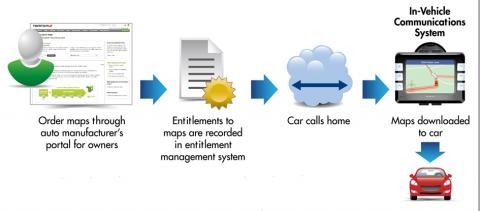
They simply would need to sign onto their vehicle portal and click on the upgrade features they wanted temporarily for their sedan – an engine upgrade from 200 to 500 horsepower, an upgrade in the infotainment system to include GPS navigation capabilities and maps, and an upgrade to the satellite radio package. They would specify the time duration (two weeks), and the portal would generate an invoice for the two week upgrade – say €300, which could be paid automatically. Once the transaction clears, the family’s temporary entitlements are processed and a signal is sent to the car, upgrading the software licences, unlocking the upgraded functionality for the specified time.
Supply chain
The transition to a software-driven business provides tremendous opportunity for car makers to grow revenues. So how do they make the transition? A software-driven business transformation would require car makers to re-think product packaging and business models based on how consumers want to use vehicles and related apps and services. As the Ford Sync example illustrates, car makers will need to segment their customers more and create tailored offerings at different prices points.
Every driver and vehicle could be configured differently based on the device platforms (for example, dashboard system), related apps and services. Layered on top are the different ways drivers might have purchased apps and services, ranging from try-before-you-buy, subscription models, freemium models, pay-by-use, outright purchases and so on. All this can become quite complicated very quickly, but tracking and managing consumer entitlements is an essential pre-requisite to making this real.
These lifecycle processes include: app installation and activation; subscription management; firmware and app updates; device platform provisioning, configuration management, device monitoring and remote management; app upgrades; and other changes to entitlements. Internet connectivity is a key enabler for automation of firmware and software updates, as it is for data uploads from and downloads to automobiles at the heart of many of these processes.
While some of this might still be hypothetical at this stage in the industry, the technology already exists and is being used in many types of intelligent devices across industry sectors such as telecoms, medical devices, oil and gas, test and measurement, and building automation.
Making cars more intelligent will extend their life, enable the creation of new revenue streams, automate support, reduce manufacturing costs and grow the customer base. In doing so, car makers will transform their vehicles into platforms, greatly expanding their marketplace, increasing profitability and achieving business goals.
Embedding software, controlled via licensing and entitlement management, is the enabling technology that can help car makers transform their vehicles into infinitely customisable, upgradable services that can generate revenue throughout their useful lives.
Mathieu Basiac is vice president of product management at Flexera Software
