Functional Safety: Flying lessons
Harnessing the experience of avionics development can yield significant productivity gains in developing automotive systems, says Mark Richardson from LDRA
With the cost of software recalls running in the billions of dollars, automotive companies have pressing need to build safety and security into their systems. To this end, the practices that have been in use for decades by the aerospace industry to ensure the safety of avionic systems were specifically called out in January 2016 by the US National Highway Transportation & Safety Administration (NHTSA).
This came about when they announced a pledge to work together with leading car makers to enhance safety and improve recalls, with a specific focus on addressing automotive cyber security threats.
Software development standards for building safety into software exist for the avionics and the automotive industries, and both are based on the same principles for building safety-critical software. The aerospace industry has adopted the RTCA standard DO-178C, while the automotive industry has adopted ISO 26262. The use of software traceability and testing tools in the development of avionics has proven to yield significant productivity benefits, and these same benefits can also be realised when developing software for automotive systems.
It is no coincidence that the contents of the functional safety standard ISO 26262 for the automotive industry are similar in nature to those used in other safety-critical sectors, including DO-178C. Automotive’s ISO 26262 is an adaptation of the IEC 61508 generic functional safety standard, which was designed for use as the foundation for other industry-specific standards.
ISO 26262 provides detailed guidelines for the production of all software for automotive systems and equipment by proactively addressing possible hazards due to malfunction. This is based on a risk-management approach that starts with a determination of risk classes, known as Automotive Safety Integrity Levels (Asils), which are similar in nature to the safety integrity levels specified in the IEC 61508 functional safety standard.
Four levels of Asil are defined by ISO 26262; Asil-A to Asil-D mark increasing levels of risk. Unlike DO-178C, Asil levels are not based on the impact of a whole system failure, but for failure of a specific safety function, for example when and where an electric park brake (EPB) will activate. Each safety function in a safety-related system needs to have an appropriate Asil assigned with the risk of each hazardous event – for example the EPB activating at highway speeds – evaluated based on the attributes of controllability, exposure and severity.
The values that are determined for these three attributes then, in turn, are used to determine the appropriate Asil for a specific functional hazard, which in turn determines the overall Asil for that safety function.
ISO 26262 translates these safety levels into safety-specific objectives that must be satisfied during the development process. An assigned Asil therefore determines the level of effort required to show compliance with the standard. So, the effort and expense of producing a system critical to the continued safe operation of an automobile – for example a steer-by-wire system – are necessarily higher than that required to produce a system with only a minor impact in the case of a failure, such as the in-car entertainment system.
Compliance
Now the risk is known, what steps are needed to demonstrate compliance to the ISO 26262 functional safety standard? There is an industry mantra that quickly sums up what’s needed:
- • Say what you do
- • Do what you say
- • Show what you did, that is show that you met the objectives for the specific Asil
Say what you do
In short, developers must describe their processes in their plans. For software, these are captured in two documents – a high-level overall project plan (OPP) and a software project plan (SPP). The SPP addresses the software-related requirements of ISO 26262. Some activities not required for all Asils, but these can be tailored out per part two of ISO 26262. The SPP should include at least the following five sections:
- Introduction
- Software description
- Software lifecycle
- Other considerations
- Software lifecycle environment
Subsequently, each of these sub-sections has a series of steps that must be followed to achieve compliance and safe practice.
Clearly, proper process involves tracking a lot of details, especially when design changes are required. Traditionally, companies managed project artefacts with spreadsheet programmes that would be updated as work was completed. However, with the increasing complexity of software development, such methodologies are prone to the introduction and propagation of errors.
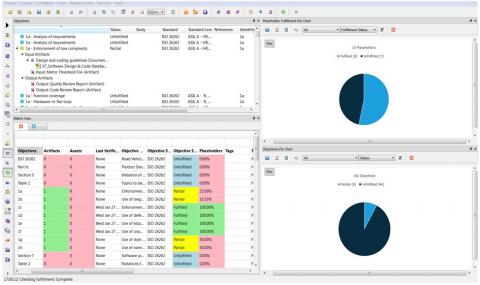
Modern software tools, specifically designed for this purpose, and that have proven themselves in the avionics arena, can capture requirements, add placeholders for the various artefacts that need to be produced, and automatically update the overall process status as code, tests and so on are completed. For compliance, this process also automatically documents design changes and updates throughout the software development lifecycle, removing a significantly time-consuming step in the certification process.
Do what you say
Once the processes have been outlined in the SPP, they need to be followed. Both the SPP and OPP are approved by the relevant regulatory oversight body. It is important to collect and collate evidence that the documented processes were followed. Software tools that provide process compliant templates for the documents identified in the SPP help streamline this process, especially when it comes to handling design changes and/or updates. In addition, the rapid feedback that these tools offer helps to reduce the introduction and propagation of errors.
Another area where software tools offer significant productivity benefits is in the process of ensuring compliance with the design and coding guidelines selected for the project. The SPP must specify a design and coding guidelines document that will be used to help build safety into the software. A good example of this is the Misra C: 2012 software development guidelines for the C programming language. Developed by Misra, its aims are to facilitate code safety, portability and reliability.
As code is created, any detected violations of the guidelines need to be identified and corrected. Static software analysis tools can be used to assess very quickly the software under development, helping to identify areas of code that do not comply with the selected guidelines. There are often situations where the guidelines contain undecidable rules or specific software implementations require a deviation from a non-mandatory rule. In both of these circumstances, a justification needs to be documented.
As the plan is implemented, developers always need to track that they have adjusted their processes to the risk levels associated with that piece of software.
Show what you did
The third step is to document what has been done. In this step, developers must ensure they can show consistent and reviewed data, provide checklists for the required document content, and show impeccable record keeping for document reviews. Tools exist that can provide a compliance framework that captures all planning documents, assets and artefacts produced during the development and verification portions of the life cycle. Collating all the evidence required to show compliance and associating them with ISO 26262 part six sub-sections provides transparency and traceability and increases auditor confidence for both internal quality assurance personnel and external auditors. Additionally, gaps in compliance evidence can be identified early to reduce schedule and compliance risk.
Furthermore, a tool suite can integrate traceability and compliance with automated software analysis and testing technologies. This integration allows for automated capture and collation of artefacts with compliance objectives, in a distributed and collaborative framework. Individual team members are better guided through verification workflow, artefact generation is highly automated and credible, while compliance processes and methodologies are enforced.
Conclusion
With costs of software recalls in the billions of dollars, the onus is on the developers of automotive software to build safety and security into their systems. By drawing a comparison to the aerospace industry as an example of how the auto industry can work to enhance safety, the NHTSA is referencing decades of experience in the development of safety and security critical avionics.
This experience can be brought to bear to enhance the compliance of automotive software systems with ISO 26262 by taking advantage of the software analysis and test tools that have been used for decades to build safety and security into avionics systems. The productivity benefits that come from streamlining the verification process with these tools ensures software functional safety at dramatically reduced project costs.
Mark Richardson is a lead field application engineer for LDRA
