Infotainment: A matter of integrity
Bill Weir from Pericom explains how redrivers can help engineers designing infotainment systems maintain signal integrity and thus quality
Putting a high-quality infotainment system into a modern vehicle poses a number of challenges for traditional automotive electronics engineers, not least is the problem that the electronic devices controlling these systems work at low voltages, so low that moving the signals around the electrically noisy atmosphere of a car can prove difficult.
A typical car could have up to 100 electronic control units embedded into its systems. These include in its engine, transmission and active safety components as well as for in-car passenger comfort and infotainment.
At the heart of a modern infotainment system is a high-resolution, full-colour touch screen display that makes the media system more usable, informative and attractive. This unit combines entertainment, GPS navigation, multimedia and driver information functions in one. Car owners are also looking for features such as smartphone integration, rear-seat LCD screens and all-round cameras for safety and parking functions.
A typical infotainment system would use USB and HDMI cables that have become longer and thinner and are commodity items that can be bought over the counter. They are often not suited to being the backbone of an in-vehicle infotainment system.
Higher quality cables could be used but these are expensive and add weight to the vehicle, something the car makers are keen to avoid. Also, thinner cables are easier to route round the cramped space within a car whereas the higher quality alternatives take up too much room and can limit airflow, causing a danger of overheating.
The specifications for USB and HDMI cables also contain recommended maximum lengths beyond which, even in ideal circumstances let alone with the high electromagnetic interference found in a car, the signal will degrade.
The trick therefore is to turn such passive cables into active cables using a product known as a redriver. Having these at each end of a long signal trace or cable can return a signal to within acceptable margins and are thus becoming an essential part of a modern vehicle system.
Specifications
USB 2.0 specifications define the wire types and maximum cable length. USB 3.0 and 3.1 don’t specify cable lengths but say the cables must meet the electrical specifications. Practically, this means for USB 3.0 using a 26-gauge cable, the maximum length is around three metres. For USB 3.1 at 10Gbit/s, this length drops to only a metre. Beyond this length, the signal integrity degrades.
HDMI specifications also do not give a maximum cable length, but with, say, HDMI 1.4 using AWG 28 cable, to achieve the 3.4Gbit/s speed without degradation, the cable length must be kept to just five metres. HDMI cables consist of four shielded twisted pairs, plus additional wires for other functions such as Ethernet and the audio return channel.
For USB and HDMI, the specifications define analogue and digital parameters for the likes of attenuation, bit error rate, cross-talk, impedance, differential impedance, insertion, jitter and skew, factors that all influence the signal integrity of the received signal.
Redrivers
Redrivers, also known as repeater ICs, can solve such signal integrity problems. These can be added at both the receive and transmit ends of the cable to boost the signal back to an acceptable level. These analogue amplifiers condition high frequency and differential signals and some also apply line impedance matching, programmable gain and other analogue parameters to compensate for line losses, impedance mismatch and channel effects.
Using equalisation, pre-emphasis and other technologies, a single redriver can adjust and correct for known channel losses at the transmitter and restore signal integrity at the receiver. This results in an eye pattern at the receiver with the margins required to deliver reliable communications with low bit error rates. Redrivers provide better performance than protocol-based signal repeaters, which act as an endpoint that must terminate and then retransmit the signal, thus introducing delay and added system cost. In addition, redrivers reduce deterministic jitter by conditioning and passing signals through at the physical layer.
Integrated equalisation circuitry can provide flexibility with signal integrity of the signal before the redriver. A low-level input signal detection and output squelch function can be provided for each channel, which can operate fully independently.
Redrivers can be used at either the source or the receiving end of a USB 3.0 cable. They turn the passive cable into an active cable, effectively letting the cable be both longer and thinner while still retaining the signal integrity needed for an in-vehicle infotainment system.
Clocks
To drive high-speed signals in a vehicle using the likes of PCI Express, Gigabit Ethernet or USB 3.0, highly accurate clock sources are needed. To handle real-time graphics and video, infotainment systems have started using PCI Express for high-bandwidth IO connecting peripherals and on-board storage. In some cases, rear seat LCD subsystems may connect via PCI Express due to its high data rate. In other cases, it may represent the only fast channel available.
All PCI Express devices need an accurate 100MHz clock generator to create 2.5 to 5.0GHz data rates.
Such a clock generator in a vehicle should provide several 100MHz outputs to drive multiple devices, partly to save board space compared with having one clock generator per device. Having multiple outputs also eliminates the need for clock buffers and their inherent timing latency. They also need to be automotive grade and qualified to AEC Q100.
Multiple outputs mean they can drive the processor and other PCI Express devices since most processors do not provide PCI clocks.
In vehicles, the real-time clock in the infotainment system is visible to the driver displaying the time of day. It also wakes up systems such as the instrument cluster, outside temperature display or back-up camera.
It can be tempting to use low cost tuning fork-based crystal oscillators, but these suffer from temperature drift and a long start-up time. In contrast, an AT cut crystal can give a fivefold improvement in temperature precision. Tuning fork oscillators can take as much as 1000ms to start up. Compare this some devices that can start up in as little as 2ms with a typical time of 10ms. This makes a big difference in what the driver experiences when a sequence of systems all have to boot up.
Packet Switches
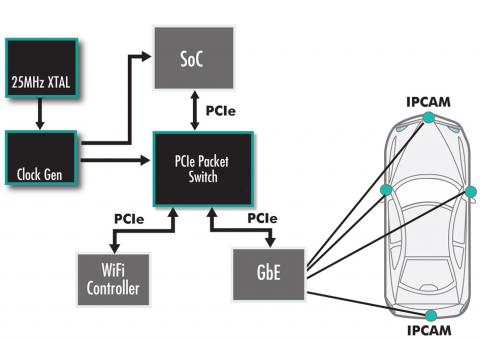
Many automotive processors do not provide enough PCI Express ports to handle all the infotainment and telematics module functions. A good example of how to expand PCI Express ports is by using a PCIe packet switch.
A packet switch can provides one x1 or x2 upstream PCIe lanes – at PCIe Gen 2 speeds, this is a 10Gbit/s link – and two x1 lane downstream ports. This gives the flexibility to expand or fan-out from a wide range of IO bridges such as PCH, ICH, IOH, embedded MCU, FPGA and other application specific ICs, and provide the needed number of ports to handle end points such as wifi, LTE, Ethernet and other functions.
A PCI Express packet switch can bridge one PCI Express port consisting of lanes to multiple ports. Based on the PCI Sig specification, the packet switch can have the intelligence to read each packet header address and pass it to the proper downstream port. This kind of intelligent switching offloads the host CPU or SoC by allowing routing decisions without processor intervention.
Conclusion
Automotive infotainment systems have numerous requirements to meet the expectations of an increasing discerning public. But to achieve the quality that users have come to expect in the harsh environment of a typical automobile, engineers face numerous challenges. However, products are available such as redrivers, PCI Express clock generators and packet switches that can help engineers solve these problems.
Bill Weir is senior director of marketing and business development for Pericom
