Power Technologies: Emergency power
Tony Armstrong from Analog Devices looks at how to maintain power to emergency applications such as ecall
Electronic systems must remain operational, regardless of external operating conditions. Said another way, any glitch in the power supply, whether momentary or seconds or even minutes, must be taken into account during the design process.
In automotive electronics there are many applications that require continuous power even when the car is parked, such as remote keyless entry, security and even personal infotainment systems, which usually incorporate navigation, GPS location and ecall functionality.
Maybe it is hard to understand why these systems have to remain on even when the car is not moving, but the GPS aspect of this has to be always on for emergency and security purposes. This is a necessary requirement so that rudimentary control can be employed by an external operator when needed.
By way of explanation, an ecall system is a safety feature that is becoming more pervasive in newer automobiles, with many manufacturers already rolling it out across their ranges. It’s a pretty simple bit of technology: in the event of a collision in which a car’s airbags are deployed, ecall automatically contacts the emergency services. It uses GPS to relay the time, location, type of car and what fuel it uses to the authorities, while a microphone in the car allows the driver or passengers to speak directly to call handlers when the system is activated.
The ecall system also shares what direction the car was travelling in when the incident occurred, allowing authorities to know which side of the freeway they need to head to in the event of a collision.
All this allows ambulance, police and fire crews to reach the car as quickly as they can following an accident, armed with as much information as possible.
An individual can also activate ecall by pressing a button, so if someone becomes ill or has been injured in a collision in which the airbags haven’t deployed, help can still be easily summoned.
Storage mediums
Having acknowledged the need for backup power for any given system, the question then arises: what can be used as a storage medium for this power? Traditionally, the choices have been capacitors and batteries.
It is fair to say that capacitor technology has played a major role in power transmission and delivery applications for multiple decades. For example, traditional thin film and oil-based capacitor designs performed a variety of functions, such as power factor correction and voltage balancing.
However, in the past decade there has been research and development that has led to significant advances in capacitor design and capabilities. These have been called supercapacitors – also known as ultracapacitors – and they are ideal for use in battery energy storage and backup power systems. Supercapacitors maybe limited in terms of their total energy storage; nevertheless, they are energy dense. Furthermore, they possess the ability to discharge high levels of energy quickly and recharge rapidly.
Supercapacitors are also compact, robust and reliable and can support the requirements of a backup system for short-term power-loss events. They can easily be paralleled, or stacked in series or even a combination of both to deliver the necessary voltage and current demand by the end application.
Nevertheless, a supercapacitor is more than just a capacitor with a very high level of capacitance. Compared with standard ceramic, tantalum or electrolytic capacitors, supercapacitors offer higher energy density and higher capacitance in a similar form factor and weight. And, although supercapacitors require some care and feeding, they are augmenting or even replacing batteries in data storage applications requiring high current and short duration backup power.
Furthermore, they are also finding use in high peak power and portable applications in need of high current bursts or momentary battery backup, such as UPS systems. Compared with batteries, supercapacitors provide higher peak power bursts in smaller form factors and feature longer charge cycle life over a wider operating temperature range. Supercapacitor lifetime can be increased by reducing the capacitor’s top-off voltage and avoiding temperatures above +50˚C.
Batteries, on the other hand, can store a lot of energy, but are limited in terms of power density and delivery. Due to the chemical reactions that occur within a battery, they have limited life with regard to cycling. As a result, they are most effective when delivering modest amounts of power over a long period of time, since pulling many amps out of them very quickly severely limits their useful operating life.
Backup power
As either supercapacitors, batteries or a combination of both are candidates for use as a backup power supply in almost any electronic system, what are the ICs available? Thankfully, there are products designed to address this application.
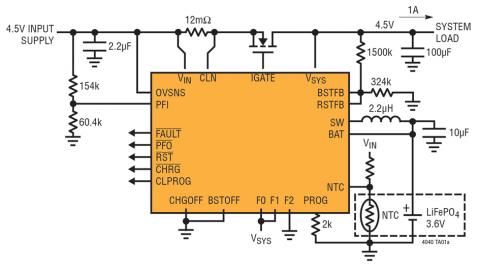
For example, take the complete lithium battery backup power management system in the diagram for 3.5 to 5V supply rails that must be kept active during a main power failure.
Batteries provide considerably more energy than supercapacitors, making them better for applications that require backup for extended periods. Such a device can use an on-chip bidirectional synchronous converter to provide high efficiency battery charging as well as high current, high efficiency backup power. When external power is available, the device operates as a step-down battery charger for single-cell Li-ion or LiFePO4 batteries while giving preference to the system load.
Typical applications include fleet and asset tracking, automotive GPS data loggers, automotive telematics systems, toll collection systems, security systems, communications systems, industrial backup and USB-powered devices. The diagram show a typical application schematic.
Conclusion
Whenever a design requires a system to be always available even if the primary power source should fail, it is always a good idea to have a backup power source. Fortunately, there are many IC option that can allow an easy backup power supply, whether that storage medium is a supercapacitor, an electrolytic capacitor or even a battery.
Clearly, in the case of an ecall system in an automotive environment, having it functional if an accident occurs where the main battery is disconnected can be a life saver.
Tony Armstrong is director of product marketing for Power by Linear products at Analog Devices
