Power Technologies: Keeping infotainment in check
Steve Knoth from Analog Devices explains how automotive infotainment designs can be made easier with multi-output power management ICs
As product form factors are decreasing, demand for their functionality and features continue to increase. Furthermore, the industry trend for sophisticated digital ICs such as microprocessors, microcontrollers or FPGAs that power these products continues to lower their operating voltage while simultaneously increasing their amperage.
Microprocessors are among the most popular of these to design in, and there is a growing list of power efficient types. They provide low power consumption and high performance processing for a range of wireless, embedded and networking applications.
The original intent of these processors was to let OEMs develop smaller and more cost-effective portable handheld devices with long battery life, while simultaneously offering enhanced computing performance to run feature-rich multimedia applications. Nevertheless, demand for this same combination of high power efficiency and processing performance has spread to non-portable applications.
Examples include automotive infotainment systems and other embedded applications, which demand similar levels of power efficiency and processing horsepower.
In all cases, a highly specialised, high performance power management IC (PMIC) is necessary to control and monitor the microprocessor’s power properly so all the performance benefits of these processors can be attained.
Further, as the electronic content of automobiles continues to increase dramatically, so too has the use of microprocessors as the workhorse of various control systems within the vehicle.
Infotainment systems have captured a wide array of functions to enhance the driving experience. Touch screens, Bluetooth communications, digital and high-definition television (HDTV), satellite radio, CD, DVD and MP3 players, GPS navigation, and video game systems have created a full-fledged entertainment centre inside the car.
PMIC
Electronic systems designed for automotive applications are challenging for many reasons, including the wide operating temperature range, strict EMC and transient requirements, as well as the high quality levels demanded by automotive OEMs.
Starting with the wide operating temperature range, PMICs have problems on two fronts. First, power conversion. Even when highly efficient, they must dissipate some level of power as heat. When several DC-DCs and LDO regulators are packed into a single device, the combined power dissipation can be significant, easily approaching two watts or more.
Typical PMIC packages such as the 6 by 6mm, 40-pin, exposed pad QFN have a thermal resistance of 33˚C/W resulting in a junction temperature rise in excess of 60˚C. When this is combined with a wide ambient operating temperature range, the maximum junction temperature of the PMIC can often exceed +125˚C. Even in body electronics, not under the bonnet, the ambient temperature inside a sealed plastic electronic control module can reach +95˚C. Due to these temperature difficulties, many PMICs rated for +85˚C, or even +125˚C, are not sufficient for sustained high temperature operation.
Another key to operating an integrated power management device in a high ambient temperature environment is for the device to self-monitor its die temperature and report when its junction temperature is getting too high, so the system controller can make an intelligent decision on whether to reduce power to the load(s). Operating system software can do this by turning off less critical functions or by turning down the performance in processors and other high power functions such as displays and network communications.
The environment within a vehicle’s dashboard is crowded with electronics. Adding to this crowding are radios from Bluetooth to mobile phone based network connectivity. Therefore, it is imperative that any additional entries to this thermally constrained environment do not contribute excessive heat or EMI.
There are strict EMC requirements that cover radiated and conducted emissions, radiated and conducted immunity or susceptibility, and ESD. Being able to conform to these requirements affects the performance aspects of a PMIC design.
Some are straightforward, such as the DC-DC switching regulators must operate at a fixed frequency well outside of the AM radio band. However, another common radiated emission source found in DC-DC converters comes from the switching edge rates of its internal power mosfets. These edge rates should be controlled to reduce radiated emissions.
Many of today’s embedded systems and advanced processors require controlled and choreographed sequencing as power supplies are powered up and applied to various circuits. Allowing for system flexibility and a simple approach to sequencing not only makes the system design easier, but it also enhances system reliability and allows for a single PMIC to handle a broader range of the system than just a specific processor’s requirements.
In summary, the main challenges facing the automotive infotainment system designer include:
- • Balancing power dissipation with the high level of integration of multiple switching regulators and linear regulators;
- • Accurate output voltage regulation and load step response required by advanced nanometre technology processors and FPGAs;
- • Monitoring junction temperatures;
- • Immunity to radiated and conducted noise, with low emissions contributions;
- • Large voltage transients and temperature extremes;
- • Managing power sequencing during start-up and shutdown; and
- • Reducing size and footprint.
Historically, many PMICs have not possessed the necessary power to handle these modern systems and microprocessors. Any way to satisfy the automotive power management IC design constraints, as already outlined, must combine a high level of integration, including high-current switching regulators and LDOs, wide temperature range of operation, power sequencing and dynamic I2C control of key parameters with hard-to-do functional blocks.
Furthermore, a device with high switching frequency reduces the size of external components and ceramic capacitors reduce output ripple. This low ripple combines with accurate, fast response regulators to satisfy demanding voltage tolerances of 45nm type processors.
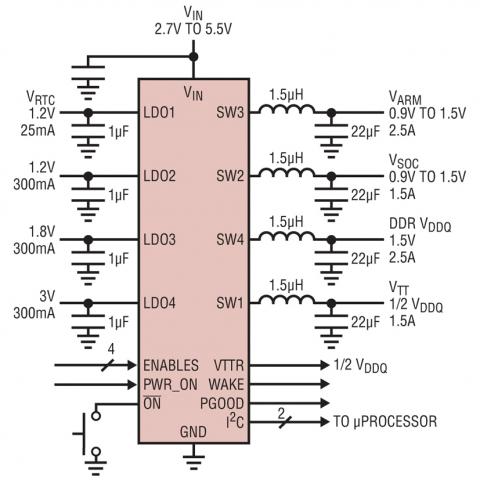
Such power ICs must also be capable of meeting the rigorous automotive environment including radiated emission suppression, although the input voltage is typically a pre-regulated 5 or 3.3V rail off the system or battery voltage. The diagram shows such a multi-output device.
This PMIC can solve the automotive infotainment system design problems mentioned and can satisfy the high-temperature automotive operating requirements. The IC includes a thermal warning flag and interrupt specifically for junction temperature monitoring and also includes a hard thermal shutdown for reliable protection of the hardware, should power dissipation be mismanaged, or in the event of a severe fault condition.
Suppressing emissions
Since there are four switching regulators on board, each has an associated reactive device (inductor) to be concerned about. One possible method is to shield the area to prevent EMI from being emitted. Besides being expensive and heavy, this does not solve the problem of contamination by any wires that might be connected to the power supply area. It is better to use source suppression and antenna elimination.
Source suppression necessitates good layout and component selection, and internal IC design, to prevent the generation of radio frequency energy. It is often necessary to use shielded inductors and to place those inductors further away from the device than the output capacitors.
This is because the AC currents circulate from the device through the inductor, through the output capacitor, to ground and back to the device. It is clear that wide traces, preferably area fill, should be used to connect the ground of the output capacitors to the ground of the device and to the ground of the PVin input decoupling capacitors.
There are some tools for source suppression. Its DC-DC converters include a dv/dt control feature that slows down the switching edge rates to reduce radiated emissions. Since the buck regulators are synchronous, both the rise and the fall time are controlled. A slow edge rate of about 3ns rise-fall was selected to pass emission requirements and still limit switching losses, which helps to optimise power converter efficiency.
To reduce the input ripple, which can end up radiating through the power input wiring, the buck regulators can be staggered between two different clock phases.
The device can provide considerable power, in excess of 10W. This can result in large circulating currents and so it is imperative to provide an uninterrupted path for this current to circulate. In particular, slots in the ground plane, which force the large circulating currents to flow around them, create slot antennas. But other obstacles, such as changing layers, contribute some energy in the EMI signature and should be reduced.
Ideally the top and bottom layers should be all, or mostly, ground plane, with the signal layers flowing internally. Since this is usually not practical, some thought needs to go into how the ground plane will be connected prior to commencing layout. For example, it is not a good idea to put the device into a corner or tab on the PCB. This will make it very difficult to route the ground plane properly. However, it is a good idea to route the high circulating current areas first to ensure the most optimum layout possible.
If EMI control is planned and executed with the concepts of source suppression and antenna elimination in mind, it is possible to create a full power system that is a good EMI neighbour without increasing product cost or weight.
Simple and effective power sequencing can be handled through serial communications or via pin strapping where power supply output voltages are tied to enable pins in the desired turn-on sequence. Internally each enable is delayed by microseconds to time stagger the start-up sequence.
This is supported with precision low voltage enable thresholds so the sequencing is possible even with output voltages as low as 0.43V. Each supply voltage output is also soft-started to limit inrush current and produce clean voltage transitions.
The IC includes two registers for initialising a power down sequence configuration that will be followed at the next turn-off event or overpower fault condition. Each regulator (DC-DC and LDO) can be pre-set to any one of four time slots for shutdown. Each regulator output includes an internal pull-down resistor that is engaged when disabled to guarantee the controlled discharges and a low starting point for the next turn-on sequence.
Conclusion
Modern automobiles have advanced significantly from those of yesteryear. Simple AM-FM radios have given way to modern technological advancements such as satellite radio, touch screens, navigation systems, Bluetooth, HDTV, integrated mobile phones, media players and video games. Further, by replacing discrete power IC components or traditional large overly integrated PMICs – for example with audio, codecs and so on – a system designer can use a new generation of compact power management ICs that integrate key functions for a higher level of performance with smaller and simpler designs.
High performance processors typically have a unique set of power supply requirements, including multiple high current and low noise rails, programmable sequencing and dynamic I2C adjustment. Therefore it is important to select the right PMIC to control and power them.
The latest let designers exploit the full power savings and performance benefits of these processors across an ever-growing range of applications. The latest devices solve many of the traditional problems associated with automotive infotainment system design, thus enhancing the modern automotive experience.
Steve Knoth is senior product marketing engineer in Analog Devices’ power products group
