Red Bull technical chief praises Siemens PLM software
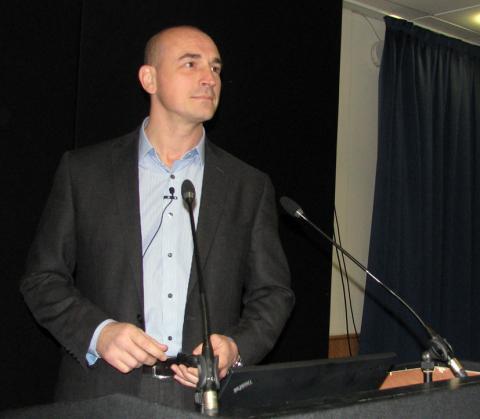
In a speech at this week’s Engineering Design Show, Al Peasland, head of technical partnerships at Red Bull Racing, explained how PLM software helped with the logistics of running a Formula One team
Red Bull Racing’s head of technical partnerships Al Peasland is full of praise for the product lifecycle management (PLM) software from Siemens that helps the company manage the logistics of running a Formula One team. Speaking at this week’s Engineering Design Show in Coventry, UK, he said: “We have a big partnership with Siemens. Their PLM products connect everything together and we couldn’t do it without them.”
But though Siemens is a German firm, he knows the team’s main competitor this year is from the same country – Mercedes, which has now won the constructors championship after it being in Red Bull’s hands for four years.
“We hope to get the constructors championship trophy back next year,” he said. “Even though the Mercedes works team is faster than us this year, we are quicker than all the Mercedes customer teams.”
He said that the team’s two main drivers were performance and reliability.
“We can have the fastest car but we won’t win if it keeps breaking down,” he said. “But we design it for speed first and then we make it reliable. We are an engineering led business.”
He said the logistics of a racing season was like moving a small factory around the world with 60 people working at the tracks and a lot more behind the scenes. This involves booking flights for 60 to 80 people, accommodation, making sure they are all clothed, fed and watered.
On top of all this is coordination, there is also the task of making the car, and this is where the Siemens PLM software comes into its own.
“The car goes from a piece of paper to being competitive on track in five months,” he said. “And it also helps when faults are discovered during the season that have to be rectified for the next race. We have to decide by Monday or Tuesday after the race what new parts we need, get them made and then shipped to the next race.”
Design changes
There are also constant design improvements going on during the season. For example, he said that last year the wheelnuts were redesigned ten times during the season to improve the pitstops. And it worked – the team broke the world record for the fastest pitstop, changing all four wheels in 1.923 seconds at the American Grand Prix in Texas.
“We design and develop the entire car in 3D software right down to every pin on every connector on every wiring loom,” he said. “The PLM system provides the digital backbone for this. This also eliminates having to do physical mock-ups for areas such as the wiring harnesses. The car has 7500 unique parts and around 100,000 parts in total.”
Before committing to manufacture, the engineers evaluate the aerodynamic design in a wind tunnel in Bedford, nearly 50km from the factory. Before that, a lot of CFD (computational fluid dynamics) simulation is carried out, generating up to 500Mbit of data every second.
“We also do a lot of finite element analysis, structural analysis and fatigue analysis before we go to manufacture,” he said. “But there still has to be some physical testing. We do a lot of crash tests, which are insisted on by the FIA. The aim is just to sneak through every test. If we pass the nose crash test too easily, for example, it probably means we have made the nose too heavy.”
There are 20 CNC machines making parts for the cars and a million jobs each year have to be tracked. Five full chassis are built each season. Every single component that goes on the car is inspected.
“We can’t afford a £1.50 widget to fail and lose us an entire race,” he said. “The big challenge is in-season development. The car we race in the first grand prix is grossly different to the one we finish with. Three years ago we did 22,000 design changes during the season, and that gained us 0.1 seconds per lap by the end of the season. Two years ago there were 26,000 design changes and last year we did 32,000 design changes. And we have pushed more through so far this year that we ever have before.”
The operations room in Milton Keynes runs in real time during the race, which effectively increases the number of engineers working beyond the 60 limit.
“They are in front of the data as if they were at the race track,” he said. “Every race day is a test for us. We get telemetry that we use for upcoming races. This is more important with the restrictions on in-season testing.”
One technique they use for testing during a race is special paint on the car that shows the airflow.
Owning ideas
“Our job is to be creative within the regulations,” he said. “If we invent something and we think it could be developed commercially, we could take it to market, but we patent very little. To us, the market is the race. But we have partnerships and if one of them helped develop something, they could take it to market on our behalf.”
Two years ago, the company launched an apprenticeship programme. Apprentices come in at the age of 16. The company also employs undergraduates during their gap years and there is a graduate recruitment scheme.
“We work closely with a lot of universities,” he said. “We have a steady stream of talent coming through.”
He reminded the audience though that the whole purpose of the Milton Keynes-based team was to promote the Red Bull brand of drinks. And he said it worked in that nearly 20% of all TV coverage of Formula One during 2013 had a Red Bull car in it. And 2.1bn people watch the sport throughout the season.
