Robots on wheels
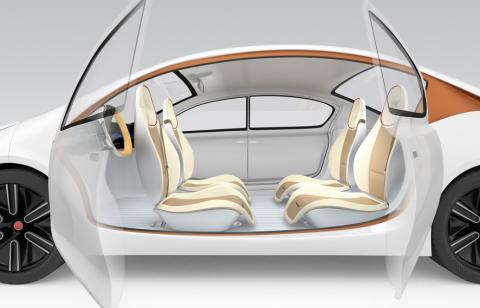
Stan Schneider from Real-Time Innovations looks for the secret behind autonomous cars
Intelligent vehicles are complex distributed systems. An autonomous car combines vision, radar, lidar, proximity sensors, GPS, mapping, navigation, planning and control. These components must combine into a reliable, safe, secure system that can analyse complex environments in real time and react to chaotic environments.
Autonomy is a supreme technical challenge. An autonomous car is more a robot on wheels than it is a car.
Data-centric connectivity was originally developed for autonomous systems. Unlike messaging technologies, it directly controls data interactions. It removes all the complexity of managing data communications from components.
In 2004, the technology was codified in a standard called the Data Distribution Service (DDS). DDS is a key component in the exciting emergence of autonomous cars and lorries. In contrast to traditional messaging technologies, it focuses on real-time performance, high reliability, system integration, precise dataflow control, and complex software decoupling. It greatly accelerates and simplifies distributed system development. It is the only technology that can deliver microsecond latency, IEC 26262 safety certification, top security, and proven operation in billion-dollar product lines.
Autonomous cars will operate in very chaotic urban environments or very structured freeways. Structured environments make sensing and situational analysis much easier. Much of the complexity is independent of speed. Car parks, for instance, are rife with unexpected obstacles, pedestrians and sensing challenges. Autonomy will likely be practical in structured freeways, even at high speed, before it will work reliably in general driving.
Real-time distributed systems need data-centric communications. However, an analogy with the database, a data-centric storage technology, is instructive.
Middleware
Because it is data centric, DDS is not like other middleware. With knowledge of the structure and demands on data, the infrastructure can do things such as filter information, selecting when or even if to do updates. It directly addresses real-time systems. At its core, it implements a connectionless data model with the ability to communicate data with the desired quality of service (QoS). A DDS-based system has no hard-coded interactions between applications.
The databus automatically discovers and connects publishing and subscribing applications. No configuration changes are required to add a new application to the network. The databus matches and enforces QoS. It overcomes problems associated with point-to-point system integration, such as lack of scalability, interoperability and the ability to evolve the architecture. It enables plug-and-play simplicity, scalability and high performance.
Functioning
Distributed systems must share information. Most middleware works by simply sending that information to others as messages. DDS sends information too, of course. However, it conceptually has a local store of data, which looks to the application such as a simple database table. The local stores together give the applications the illusion of a global data store. Importantly, there is no global place where all the data live; that would be a database. In a databus, each application stores locally only what it needs and only for as long as it needs. Thus, it deals with data in motion; the global data store is a virtual concept that in reality is only a collection of transient local stores.
The databus ties all the components together with strictly-controlled data sharing. The infrastructure implements full QoS control over reliability, multicast, security and timing. It supports fully redundant sources, sinks, networks and services to ensure highly reliable operation. It needs no communications servers for discovery or configuration; instead, it connects data sources and sinks through a background meta traffic system that supports massive scale with no servers.
The databus technology scales across millions of data paths, ensures ultra-reliable operation and simplifies application code. It does not require servers, greatly easing configuration and operations while eliminating failure and choke points. It is by far the most proven technology for reliable, high-performance, large-scale industrial IoT systems. There are at least 13 implementations.
Autonomy development
This middleware was developed for autonomy. It has very unique properties that map well to autonomy.
Autonomous systems cannot stop, even for a few microseconds. DDS provides this availability by making it easy to implement a fully redundant architecture, including computing, sensors, networking, storage and software. Since it communicates state instead of sending messages, the systems naturally support multiple producers and consumers of every dataflow. Also redundant network transports are allowed by being intelligent about delivering data only once upon receipt. Thus, adding redundancy is simple.
Response
There are many of ways to characterise real time. All systems should be fast. To be useful, it is important to understand specifically which timing requirements drive success. Real time is much more about guaranteed response than it is about fast. Many systems require low average latency, or delivery delay. However, true real-time systems succeed only if they always respond on time. This is the maximum latency, often expressed as the average delay plus the variation or jitter.
Even a fast server with low average latency can experience large jitter under load. DDS can achieve real-time performance by sending information directly between peers with no servers or brokers, by using multicast when possible, and by optimising both send and receive code paths.
Integration
Intelligent systems manage many variables and very complex-state relationships. DDS excels at decoupling the complexity. Large systems contain many modules, each typically an independently-developed application built by an independent team of developers. Module scale quickly becomes a key architectural driver. The reason: system integration is inherently an n-squared problem. Each new team presents another interface into the system.
Smaller projects built by a cohesive team can easily share interface specifications without formality. Larger projects built by many independent groups of developers face a daunting challenge. System integration can occupy half of the delivery schedule and most of its risk.
Data-centric middleware is a relatively new concept for distributed systems. Similar to a database data table, data-centric middleware allows applications to interact through explicit data models. Advanced technologies can even detect and manage differences in interfaces between modules, then adapt to deliver to each endpoint in the schema what the endpoint expects. These systems thus decouple application interface dependencies, allowing large projects to evolve interfaces and make parallel progress on multiple fronts.
Security
Security is critical. To make security work correctly, it must be intimately married to the architecture. For instance, the core standard may support various patterns and delivery capabilities. The security design must match those exactly.
For example, if the connectivity supports publish-subscribe, so must security. If the core supports multicast, so must security. If the core supports dynamic plug-and-play discovery, so must security. Security that is this intimately married to the architecture can be imposed at any time without changing the code. Security becomes just another controlled quality of service, albeit more complexly configured. This is a very powerful concept.
Deployment
Data centric design implies that only data interactions matter. Thus, modules may run anywhere in the system. There can even be redundant copies of modules running for reliability. Location, chip architecture, language and operating system differences are completely transparent.
Certification
DDS is already running many safety-critical systems. DO178C-Level A is more demanding than the most important standard affecting autonomous cars, the ISO 26262 functional safety specification. Thus, it is important for direct support for vehicles that require safety certification.
Summary
An autonomous vehicle is a robot on wheels. Connectivity is key to success for complex robotic systems. The DDS standard delivers reliable, flexible, real-time, secure connectivity proven in operational autonomous applications and hundreds of product lines.
With extensive QoS filtering and delivery control, it implements an extremely optimised system. It adapts to all the varying components, including perception, mapping and navigation, connection of vehicle, decision and planning, display and visualisation, and vehicle control. It can handle high-volume video and sensors as easily as low-latency feedback. It manages redundancy naturally; developers can implement double or triple redundancy with no extra work. It adds security control to all data flows and provably separates modules, making certification easier and much less expensive.
Thus, DDS delivers microsecond latency, easy scalability, ISO 26262 safety certification and top security. Because it separates and controls module interfaces directly, it eases development, integration, debugging and deployment. The right middleware – industry-proven, data-centric middleware – is the secret sauce that makes autonomous cars effective, safe and practical.
Stan Schneider is CEO at Real-Time Innovations
