Simulation & Modelling: Two wheels harder
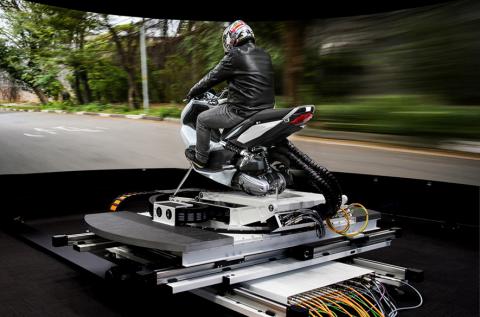
Difficulties is providing driver-in-the-loop simulation for motorcycles
When it comes to simulation and modelling, major differences arise between motorcycle applications and other vehicles because of the completely different steering dynamics and the freedom of the rider to move around on the machine.
In a car, the steering angle is an input from the driver and the steer torque is fed back to the driver as a system output. On a motorcycle the opposite happens; the rider applies a steering torque to the handlebars and the vehicle model calculates the appropriate steering angle for the front wheel.
Specialist software company RFPro is supplying simulator software to power the world’s first vehicle dynamics grade driver-in-the-loop (DIL) simulator for a motorcycle application. The technology allows manufacturers to evaluate alternative chassis configurations using riders with different styles and ability levels in a controlled, safe environment, with repeatability.
The company’s simulator software has previously been used on everything from Formula One cars to commercial vehicles but the motorcycle application raised new challenges, according to the company’s technical director, Chris Hoyle.
“Simulating the dynamics of a motorcycle accurately is incredibly challenging due to the mobility of the rider and the unique steering characteristics of the vehicle,” he said. “By working alongside a motorcycle manufacturer to create our technology we have been able to develop and validate solutions to these hurdles and so enable DIL simulation to significantly reduce development time and cost.”
Hoyle also explained how the greater field of vision available to a motorcyclist influences the performance required from the graphics system.
“A car driver is restricted by the windows, bonnet and roofline; he can look around freely, but only upwards and downwards through a range of 20 to 30 degrees,” he said. “The motorcycle rider can look anywhere, even down at the road surface and, once banked into a turn, because the rider is still upright on the motion platform, the horizon must be banked over to provide the correct visual cues.”
Despite the differences in the behaviour of a motorcycle to a car or lorry, the benefits of DIL simulation are just the same; confirming the vehicle’s behaviour in a virtual environment. This can include: the safe and repeatable exploration of limit handling; the controlled evaluation of alternative chassis configurations using riders with different styles and ability levels; and the facility to compare the machine’s behaviour around existing test tracks and circuits without shipping physical prototypes and personnel to various locations. Testing can also proceed all year round without interruption from variable weather conditions.
The application is being developed for a confidential customer by system integrator Ansible Motion and, in addition to the simulator software, RFPro is supplying a number of digital test track models to enable direct comparison with existing physical data.
RFPro has developed DIL simulators for various vehicle dynamics applications, offering the video and audio pipelines, an architecture for soft-real-time model execution and an optically correct off-platform vision system optimised for motion profiles suited to ride and handling development. This specialised area of DIL simulation is all about closing the loop through the driver and the vehicle model as quickly as possible while delivering a high quality and immersive environment.
