Snowtonomy
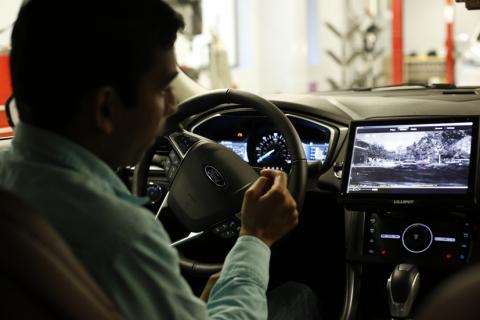
Ford has demonstrated how an autonomous research vehicle can navigate in winter conditions
Driving in snow can be a slippery challenge, with the potential for one blizzardy gust to white-out the field of view – a situation faced by many drivers. So if self-driving cars are to become a reality – and they almost certainly will – they must be able to navigate snow-covered roads.
In its quest to bring self-driving vehicles to millions of people around the world, Ford has revealed some facts about how its technology allows for a car to drive itself in snow.
To operate in snow, Ford Fusion Hybrid autonomous vehicles first need to scan the environment to create high-resolution 3D digital maps. By driving the test route in ideal weather, the autonomous vehicle creates highly accurate digital models of the road and surrounding infrastructure using four lidar scanners that generate 2.8 million laser points a second. The resulting map then serves as a baseline that’s used to identify the car’s position when driving in autonomous mode.
Using the lidar sensors to scan the environment in real time, the car can locate itself within the mapped area later, when the road is covered in snow.
The autonomous vehicles can collect and process more mapping data in an hour than the average person uses in mobile-phone data in ten years.
While mapping their environment, the vehicles collect and process a diverse set of data about the road and surrounding landmarks – signs, buildings, trees and other features. All told, the car collects up to 600Gbyte per hour, which it uses to create a high-resolution 3D map of the landscape. In the USA, the average subscriber of a cellular data plan uses about 21.6Gbyte per year, for a ten-year total of 216Gbyte.
The vehicles generate so many laser points from the lidar sensors that some can even bounce off falling snowflakes or raindrops, returning the false impression that there’s an object in the way. Of course, there’s no need to steer around precipitation, so Ford – working with University of Michigan researchers – created an algorithm that recognises snow and rain, filtering them out of the car’s vision so it can continue along its path.
The way Ford’s autonomous vehicles identify their location is more accurate than GPS. Where current GPS is accurate to about ten metres, autonomous operation requires precise vehicle location. By scanning their environment for landmarks, then comparing that information to the 3D digital maps stored in their databanks, Ford’s autonomous vehicles can precisely locate themselves to within a centimetre.
Sensor fusion – the combination of data from multiple sensors – and smart monitoring of sensor health help keep the autonomous vehicles out of the blind.
In addition to lidar sensors, Ford uses cameras and radar to monitor the environment around the vehicle, with the data generated from all of those sensors fused together in a process known as sensor fusion. This process results in robust 360˚ situational awareness.
Sensor fusion means that one inactive sensor – perhaps caused by ice, snow, grime or debris build-up on a sensor lens – does not necessarily hinder autonomous driving. Still, these autonomous vehicles monitor all lidar, camera and radar systems to identify the deterioration of sensor performance, which helps keep sensors in working order. Eventually, the cars might be able to handle ice and grime build-up themselves through self-cleaning or defogging measures.
The first person behind the wheel of a demonstrated autonomy test in snow was an astrophysics major who never dreamed he’d be in a self-driving car.
Before Wayne Williams joined Ford’s autonomy team, he worked on remote sensing technology on behalf of the federal government. A self-described geek, Williams was intrigued by autonomous vehicles, but he never envisioned one day being part of a team working to bring them to reality – let alone being behind the wheel of the auto industry’s first publicly demonstrated autonomous snow test.
The mood in the car that day was all business, he recalls, with a co-worker monitoring the computing system from the back seat.
“Because of the extensive development work, we were confident the car would do exactly what we asked of it,” said Williams. “But it wasn’t until after the test that the achievement began to sink in.”
Ford claims to be the first car maker to demonstrate autonomous vehicle operation in the snow publicly. The company's winter weather road testing takes place in Michigan, including at MCity – a 32-acre, real-world driving environment at the University of Michigan. Ford’s testing on this full-scale simulated urban campus is aimed at supporting the company’s mission to learn about and advance the emerging field of autonomous driving.
